Tencent brings Motus to Gamescom: one model family for rigging, skinning, and motion
Tencent Games made its first appearance as a technology vendor at Gamescom this year, and the piece of the booth that mattered to us was Motus. On August 24 at gamescom dev, technical lead Zijiao Zeng gave a talk called "Breathing Life into Geometry 2.0: Advancing the Unified AI Pipeline for 3D Character Animation," and on August 27 Tencent put out the release describing what Motus is.
The short version: it's a family of generative animation foundation models wired into one pipeline that starts with a static mesh and ends with a character moving in a game. Rigging, skinning, motion generation from text, video, or keyframes, motion cleanup, and real-time interaction all sit in the same system. The pitch is that "time saved through AI can be lost through tool switching and manual cleanup," so the way to actually save time is to stop switching tools.
What each stage claims
The rigging stage reads a character's topology and, per Tencent, produces a production-ready skeleton "within seconds," then computes skin weights so muscles, clothing, and attached parts deform naturally. Motion generation accepts a text prompt, a reference video, or a handful of keyframes and produces the clip, including multi-character work for combat, cooperative, and social scenarios where two or more rigs have to react to each other.
The stage I'd underline is refinement. Tencent says Motus automatically detects and corrects jitter, mesh penetration, abnormal joints, and foot sliding. Anyone who has generated motion from a model knows these four are where the time goes. The clip looks fine in a viewer and then the heel drifts two centimeters during a plant, or a hand passes through a thigh on a turn, and someone spends an afternoon in curves fixing it. A generator that refuses to hand you the clip until those checks pass is a different product from a generator that produces pretty turntables.
The last stage turns audio or text into facial expression, body movement, and responses in real time, aimed at NPCs, digital humans, and virtual presenters. That's the piece that connects Motus to Tencent's other announcement at the show, GIGA, a set of general game agents trained to play alongside humans.
Where it already runs, and who can use it
The release itself only says Motus "has been applied across multiple titles." Coverage from PC Guide and Digital Citizen filled in the list: Game for Peace, PUBG Mobile, Delta Force, Honor of Kings, Roco Kingdom, League of Legends, and Teamfight Tactics. Those are some of the most-played games on earth, so this isn't a research demo looking for a first customer.
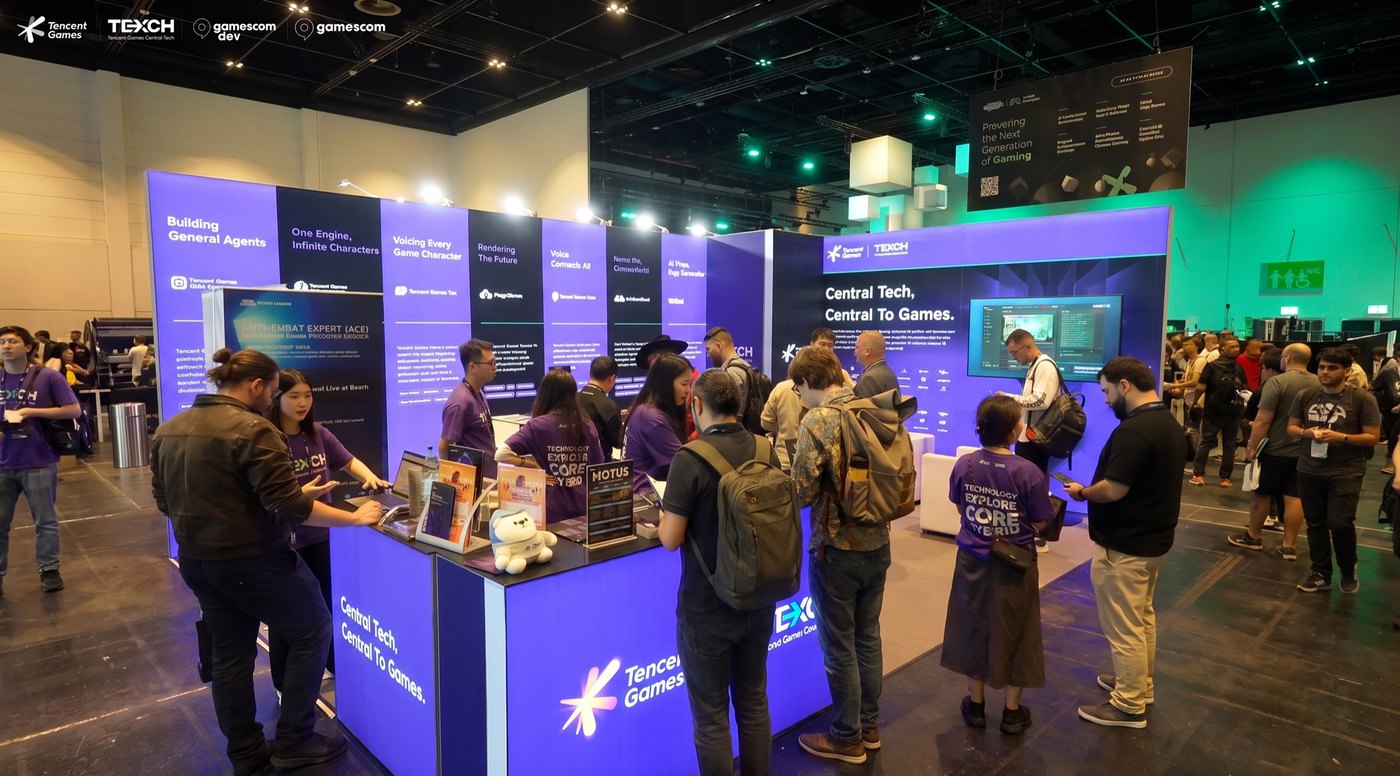
The Tencent Games Central Tech booth at gamescom dev. Motus shared the wall with GIGA, MagicDawn, and WeTest. Photo: Tencent Games.
Motus was one panel on a wider wall. Tencent used the show to introduce Central Tech as a brand for its internal tooling: GIGA for game agents, MagicDawn, which the company says turned Roco Kingdom into a 64 square kilometer cross-platform open world, WeTest's Acorn AI Studio for agents that playtest like humans, plus GVoice and the Anti-Cheat Expert system. None of it came with a sign-up page. Nothing in either release says Motus will be offered to studios outside Tencent, and nothing says it won't.
That matters because Tencent has open-sourced heavily elsewhere. The Hunyuan HY3 language model and the Hunyuan3D generation line both shipped with weights. Motus is a different division with a different history, and the games it powers are Tencent's own competitive advantage, so I wouldn't assume the same path.
Why we're reading the fine print
We run the same pipeline in a browser tab. Our auto rigger fits a skeleton and skin weights to an uploaded mesh, the animation library retargets 260 public-domain clips onto that skeleton, and the text-to-motion tool generates a clip from a sentence. We've spent most of this summer on exactly the problems Tencent lists under refinement, from grounding feet that drift to keeping a character's hands from shredding through its own body on a fast turn.
So the honest reaction is two things at once. Tencent's description of what the hard part is matches our experience precisely, which is reassuring. And a company with those games and that data has a training set for motion that nobody outside a handful of publishers can match, which is a reminder that the open, public-domain route we took is the route that's actually available to everyone else. If Motus ever shows up as a product, we'll test it the day it does. Until then, the useful lesson from Gamescom is that the pipeline shape is converging: rig, skin, generate, then spend your real effort on cleanup.
References
- PR Newswire: Tencent Games Motus makes Gamescom debut with end-to-end AI animation pipeline
- PR Newswire: Tencent Games Central Tech makes its gamescom debut
- PC Guide: Tencent Games Central Tech introduces new AI tools at Gamescom 2026
- PocketGamer.biz: Tencent Games showcases AI tools for game development at gamescom
- Wccftech: Tencent Games Central Tech debuts at Gamescom 2026