Blog
Subscribe via RSS
Where the holes in generated meshes come from A generated bird had slits under its wings. We blamed the rigger, then the remesher, tried nine fixes that didn't work, then read the extraction code and found a representation limit. The whole investigation, dead ends included, and the local fix now in production. Read more →

Giving a generated character hair that can move Try 46 reusable hairstyles on our frog, inspect candidate strand guides, and explore the measured scalp attachments—and the gaps that remain before natural hair physics. Read more →
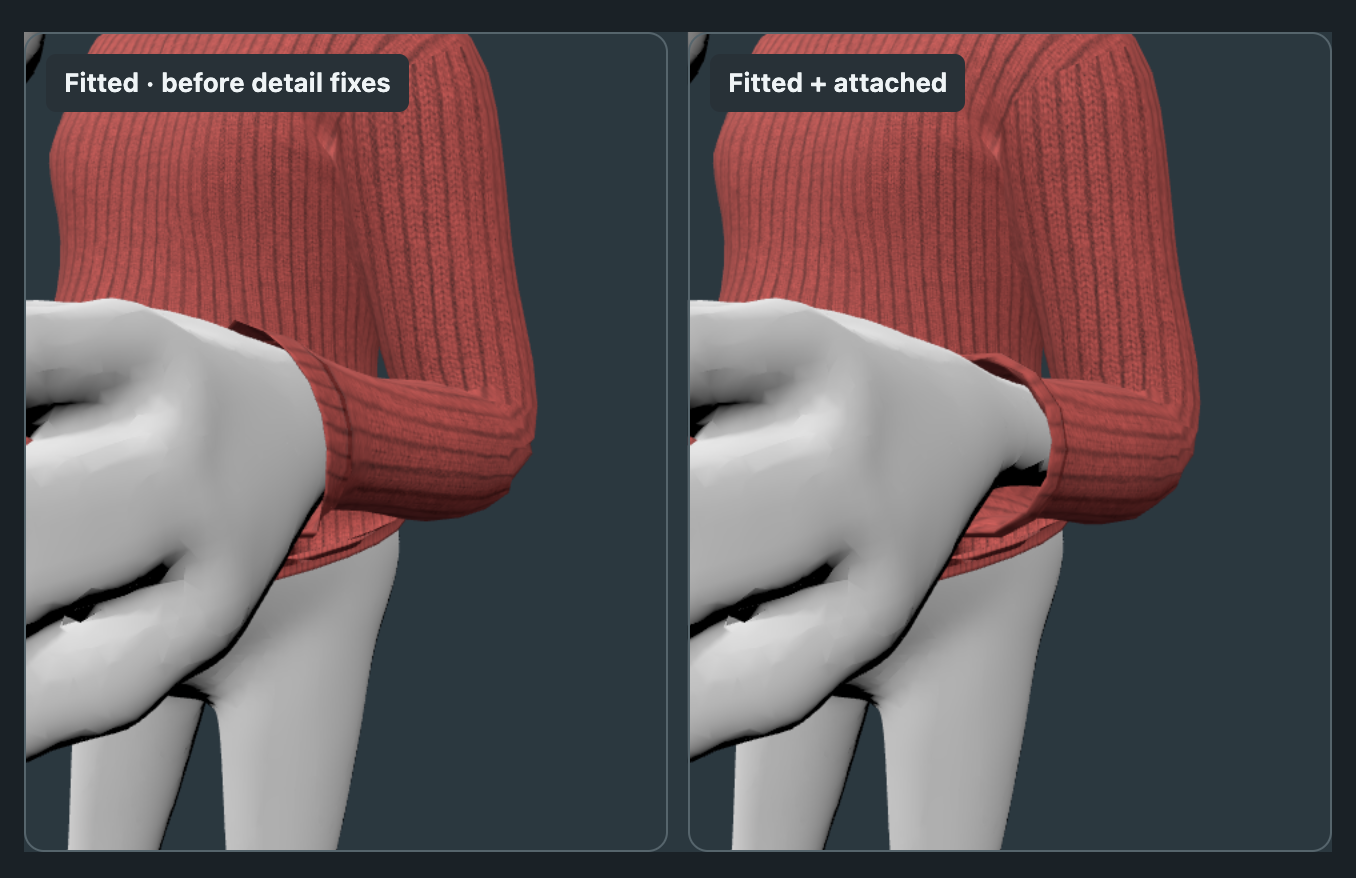
How to put clothes on a 3D model Explore the workflow from reusable clothing assets to fitted, rigged, and animated garments. Step through placement, alignment, attachment, and quality checks in interactive 3D demos. Read more →
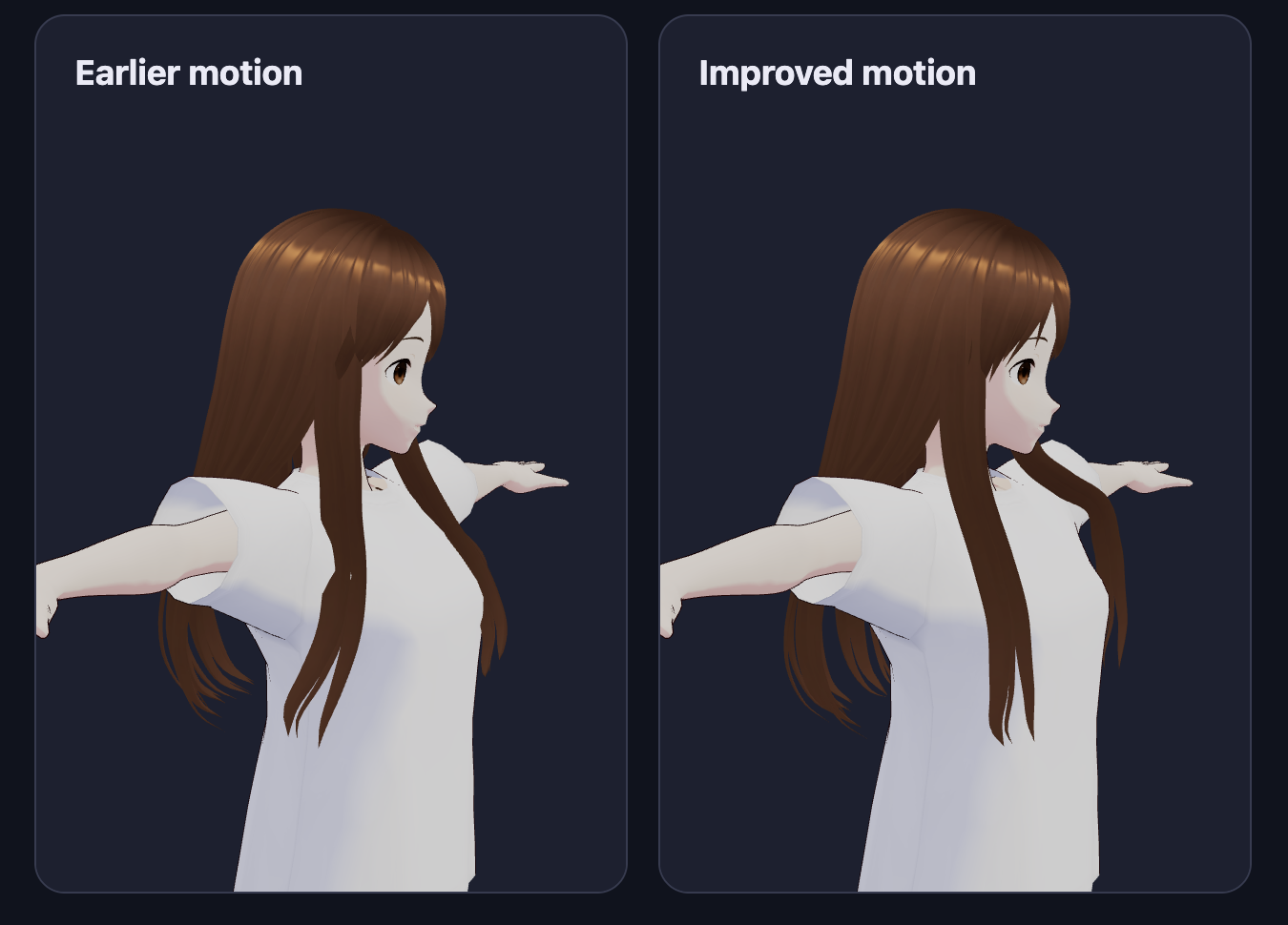
Hair should sway, not turn into a tentacle We rebuilt a real ponytail, fixed an over-curling hair solver, and measured the mesh. Try both real avatars in live before-and-after demos. Read more →
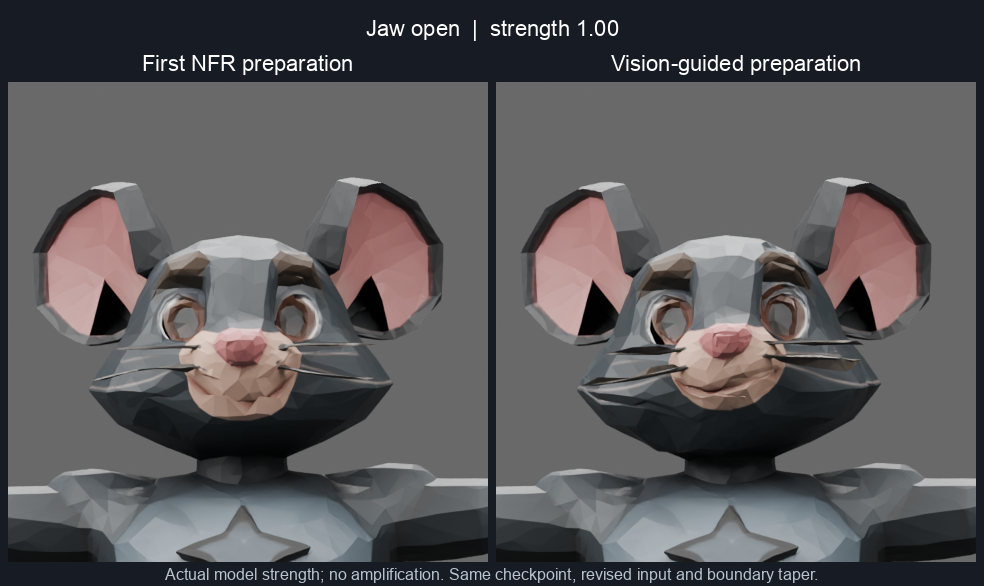
The mouse still won’t blink We’ve been building tools to rig and animate your models. Next come facial expressions. Our first experiments with NFR on a mouse character, including the bad crop, the revised one, and both results in motion. Read more →
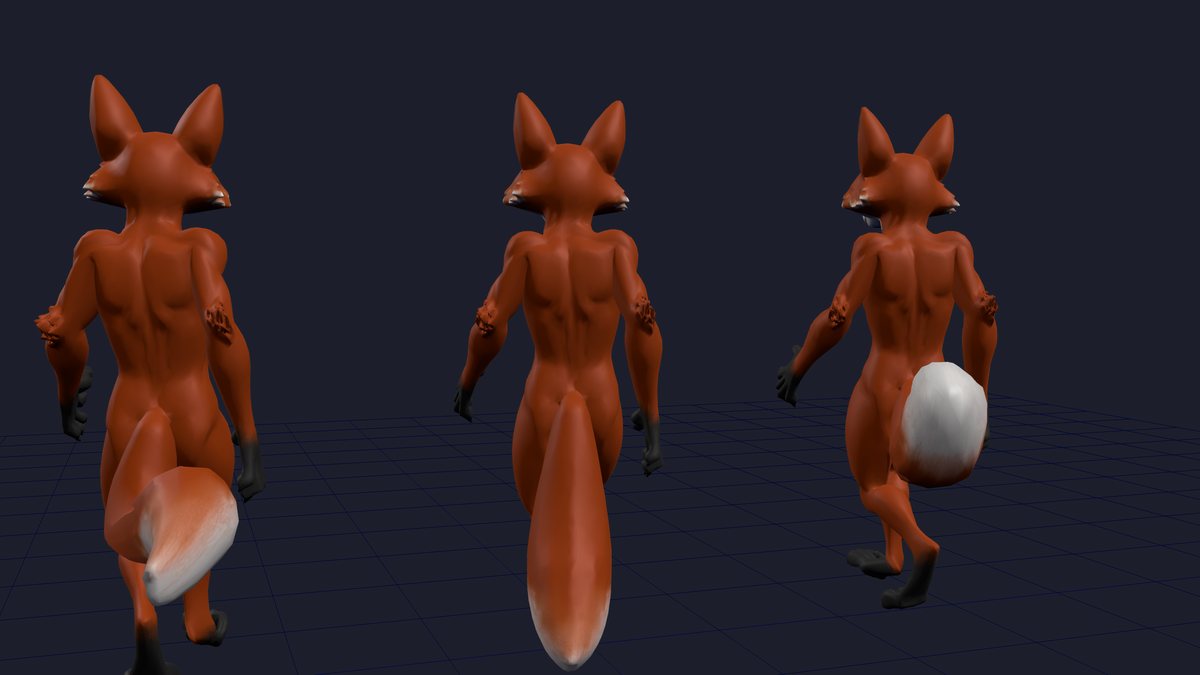
Animating tails the rigger never gave a bone A humanoid auto-rigger skinned a fox's tail to its left shin and Walk tore it apart. How we find the tail in the mesh, grow a bone chain along it, swing it on a spring at runtime, and measure the tearing to zero. With live characters you can orbit. Read more →

Solve the surface, not the skeleton Part 2 of our auto-rigging benchmark: instead of retargeting animation between skeletons, we solve it into each rig's own space from the deformed mesh. One control run, a transfer-quality score for every rigger, and live side-by-side proof. Read more →

Four auto-riggers, twelve animals, one shared flaw: straight legs We measured Tripo, Anything World, RigNet and SkinTokens against artist rigs on twelve CC0 animals. Every one of them, including the rigger we ship, puts a quadruped's leg joints almost in a straight line. Here is the number that shows it and the test that catches it. Read more →

Simulating a runtime that says no: how we sandbox the browser to act like WeChat A prompt rule is a suggestion, so we built enforcement: a strict-mode sandbox injected into our game preview that throws where WeChat's runtime would, flags what breaks after export, and feeds every violation into the AI's own debugging loop. The design, the poison list, and the four exceptions that taught us the most. Read more →

WeChat mini games: the biggest instant-game market you can't just deploy to 500 million monthly players, a $5.6 billion market that doubled in a year, and a platform your web game can't reach with a URL. What WeChat mini games actually are, the regulations you'll face as a developer outside China, the one monetization path that doesn't need a license, and how Cinevva's new mini game mode fits in. Read more →

Record profits, record layoffs: how game devs are actually getting rehired in 2026 The games industry made $195.6B last year and still cut roughly one in three developers. Here's the honest data on the layoff wave, why the job market got this brutal with ~288,000 people chasing the same openings, and the one thing that's actually pulling people back in: proof a recruiter can play, and decisions you can defend. Read more →

Best free browser games to play now (no download) A hand-picked list of the best games you can play instantly in your browser — no downloads, no installers. Top-rated indie picks across puzzle, roguelike, story, and rhythm. Read more →

Web game engines in 2026: PlayCanvas vs Three.js vs Babylon.js vs Unity WebGL A current, honest comparison of the main ways to build a 3D game in the browser. What each engine actually is, who it's for, WebGL2 vs WebGPU support, licensing, and a decision guide for choosing in 2026. Read more →
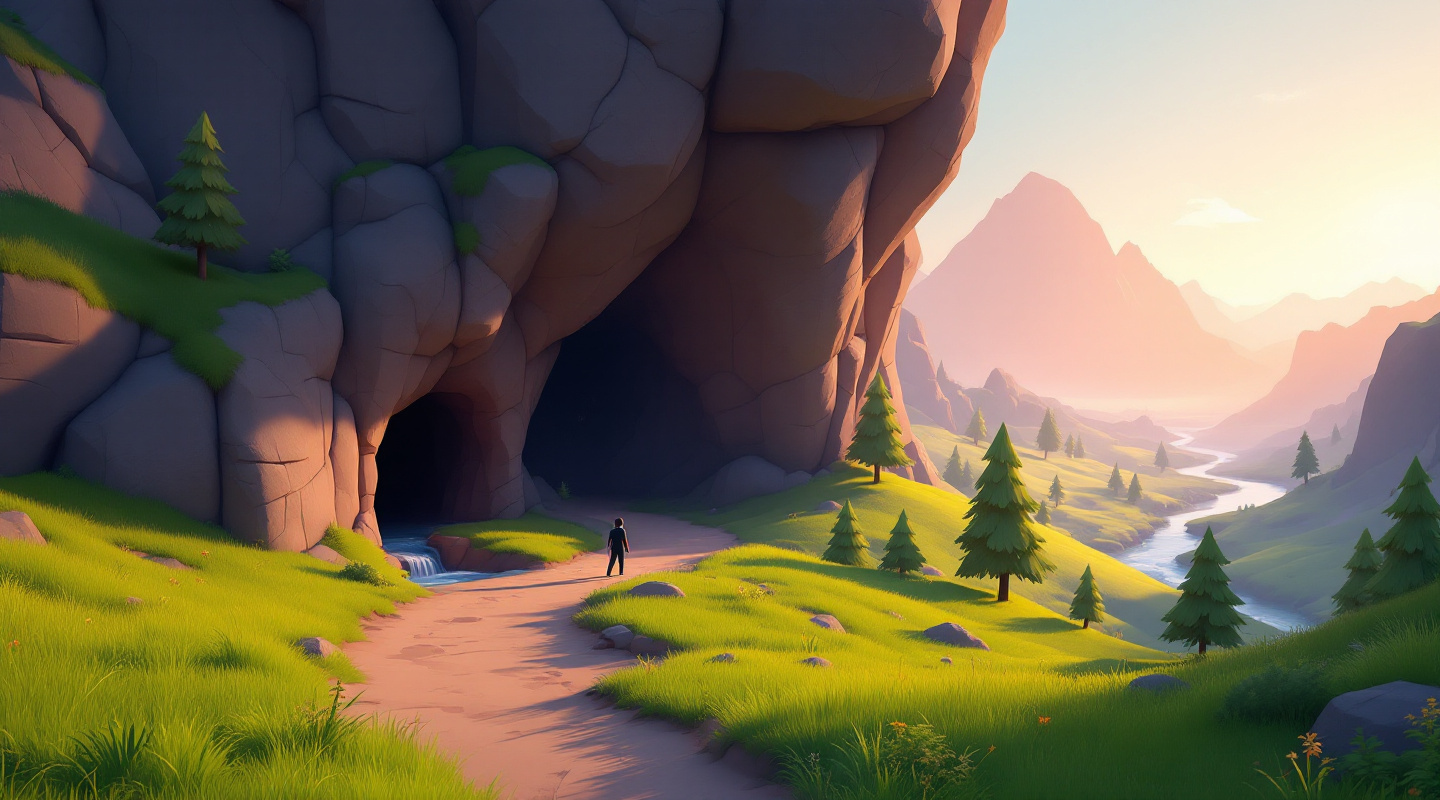
Why we built our own WebGPU engine instead of forking PlayCanvas We evaluated Three.js, Babylon.js, PlayCanvas, and Unity WebGL before writing our own renderer. Here's what each is good at, the four decisions that pushed us off the shelf (WebGPU-only, a custom character solver instead of Rapier, animation retargeting, in-world creation), and the cases where you should not do what we did. Read more →
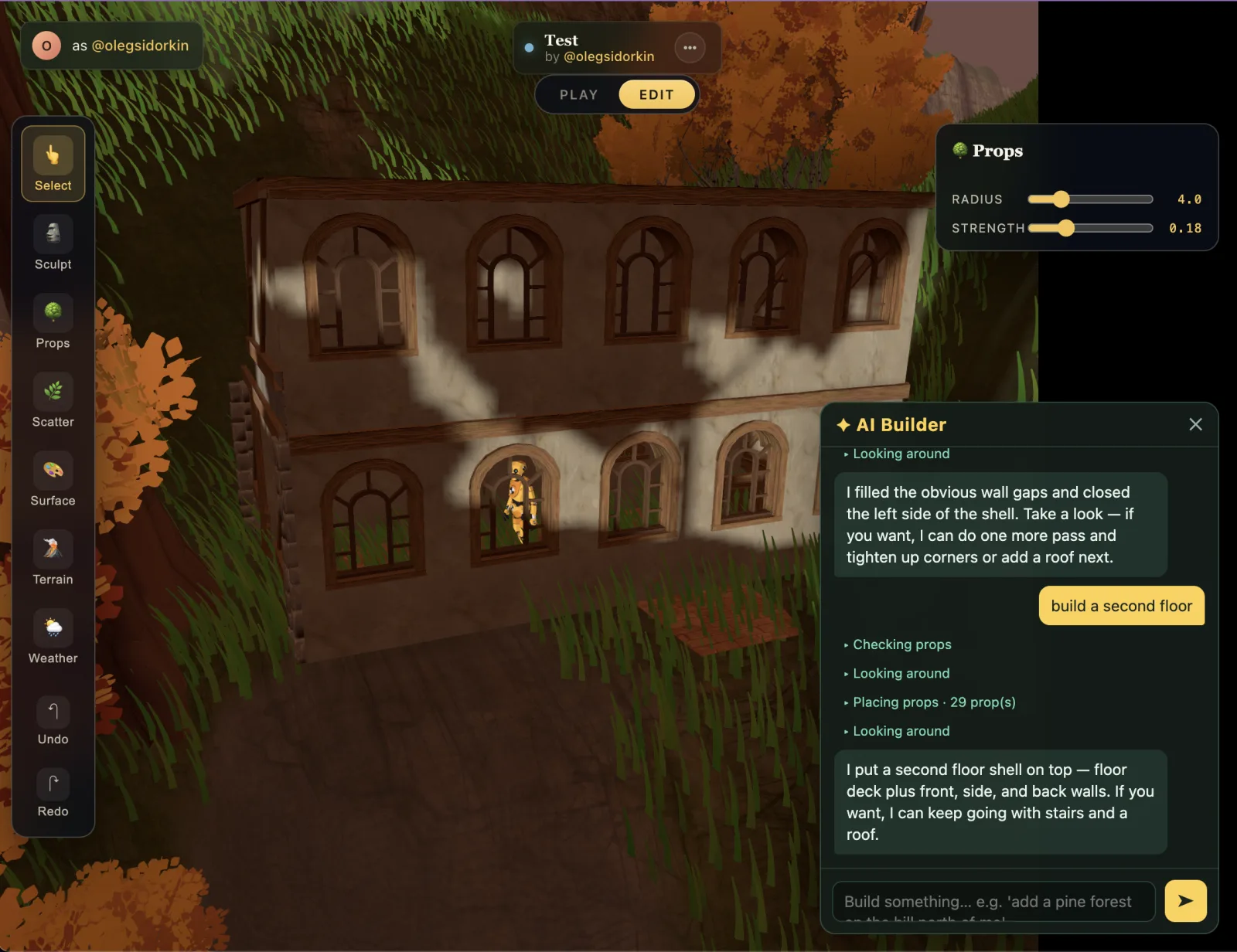
An empty world is a sad world: what every creator platform that lived or died can teach us We built an AI that constructs whole buildings in a shared 3D world from a sentence. Before opening it to everyone, we read the obituaries: Horizon Worlds, Decentraland, Dreams, Crayta, and the handful that lived (Roblox, Minecraft, the .io games, Figma). The line between them is sharper than the hype admits. The stories, the leaked numbers, the paradox at the center, and what we're doing differently. Read more →
Don't render grass behind the hill: terrain-aware occlusion culling Eight occlusion-culling techniques rated for a browser open world, why the heightmap horizon raycast beats a Hi-Z buffer when your terrain is a height function, and an interactive spike that lets you A/B the four cull paths in your own scene. Read more →

How modern engines beat foliage overdraw Z-prepasses, octahedral imposters, GPU-driven cluster culling, hashed alpha, visibility buffers, and distance-field shadows. The full stack of techniques that turns 8-15x foliage overdraw into 1-2x in dense forest scenes, with the canonical papers and engine talks behind each piece. Read more →

Volumetric clouds and weather effects in modern games How modern games render volumetric clouds, atmospheric scattering, fog, rain, snow, and dynamic weather. From Nubis voxel cloudscapes to froxel-grid fog, wet PBR, and snow deformation, with the foundational papers and engine talks behind each technique. Read more →

A short list of rendering techniques used in modern AAA games The core rendering techniques behind today's AAA visuals: PBR, Nanite-style virtualized geometry, Lumen-style global illumination, ReSTIR ray tracing, and ML-based upscaling like DLSS and FSR. Read more →
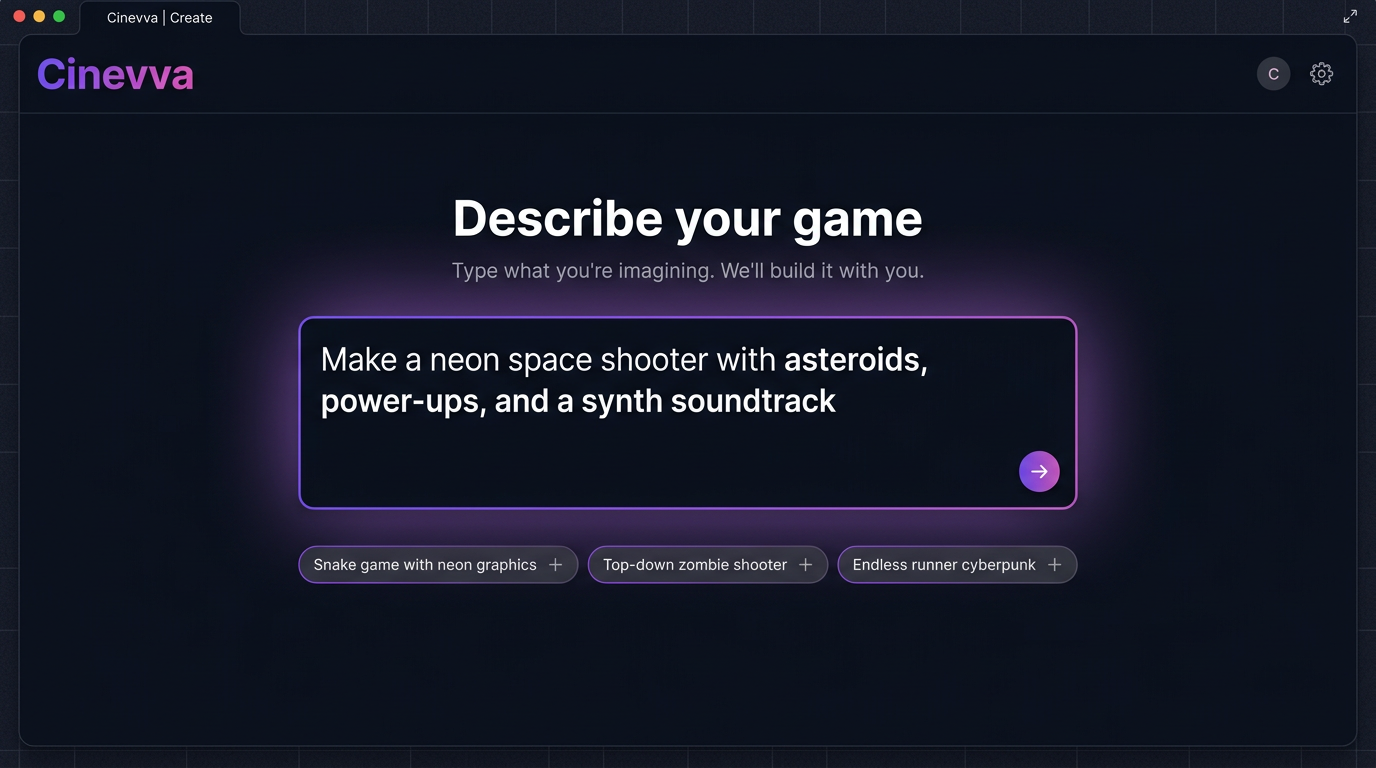
Anatomy of an AI game engine: what's actually inside the prompt Cinevva looks like a single text box. Behind it sits an orchestrator, 26 typed tools, eleven asset providers, a live game iframe the agent can play, and a storefront wired to gameplay reels. Here's the whole machine, piece by piece. Read more →

Four bets I made about gaming in 2022. How they're aging. In a 2022 interview I called WebGL game engines, GPT-3 for dialogue, real-time creative collab, and the indie takeover. Four years later, here's where each one landed. Read more →
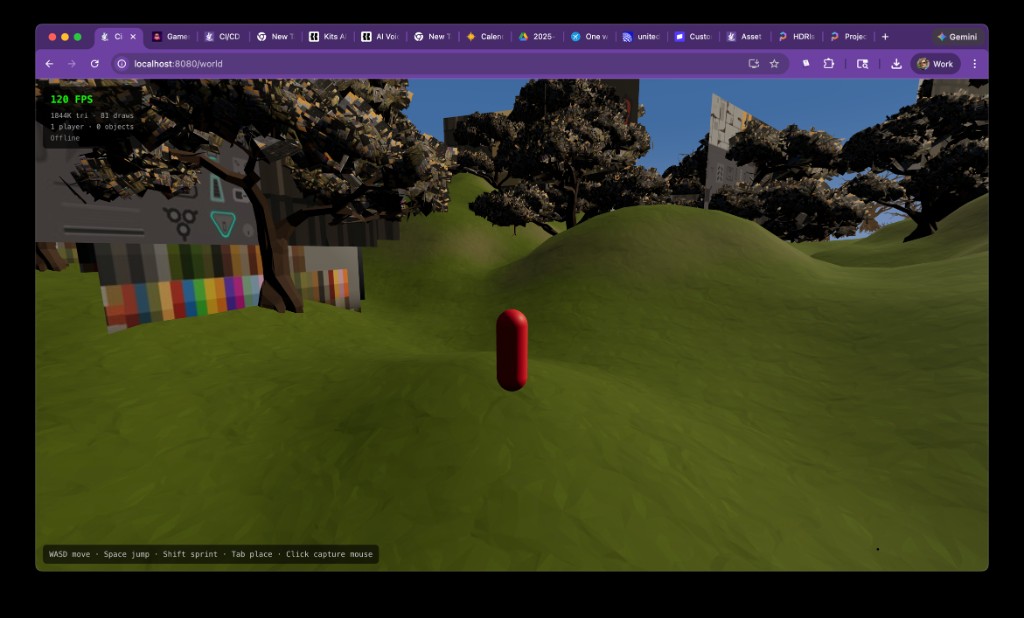
What it actually takes to build an open world in a browser A journalistic walkthrough of our 12-part engineering series: 24 spike experiments, from ugly terrain baselines to GPU marching cubes, streaming LOD, and the Transvoxel seam nightmare. The methodology matters as much as the tech. Read more →
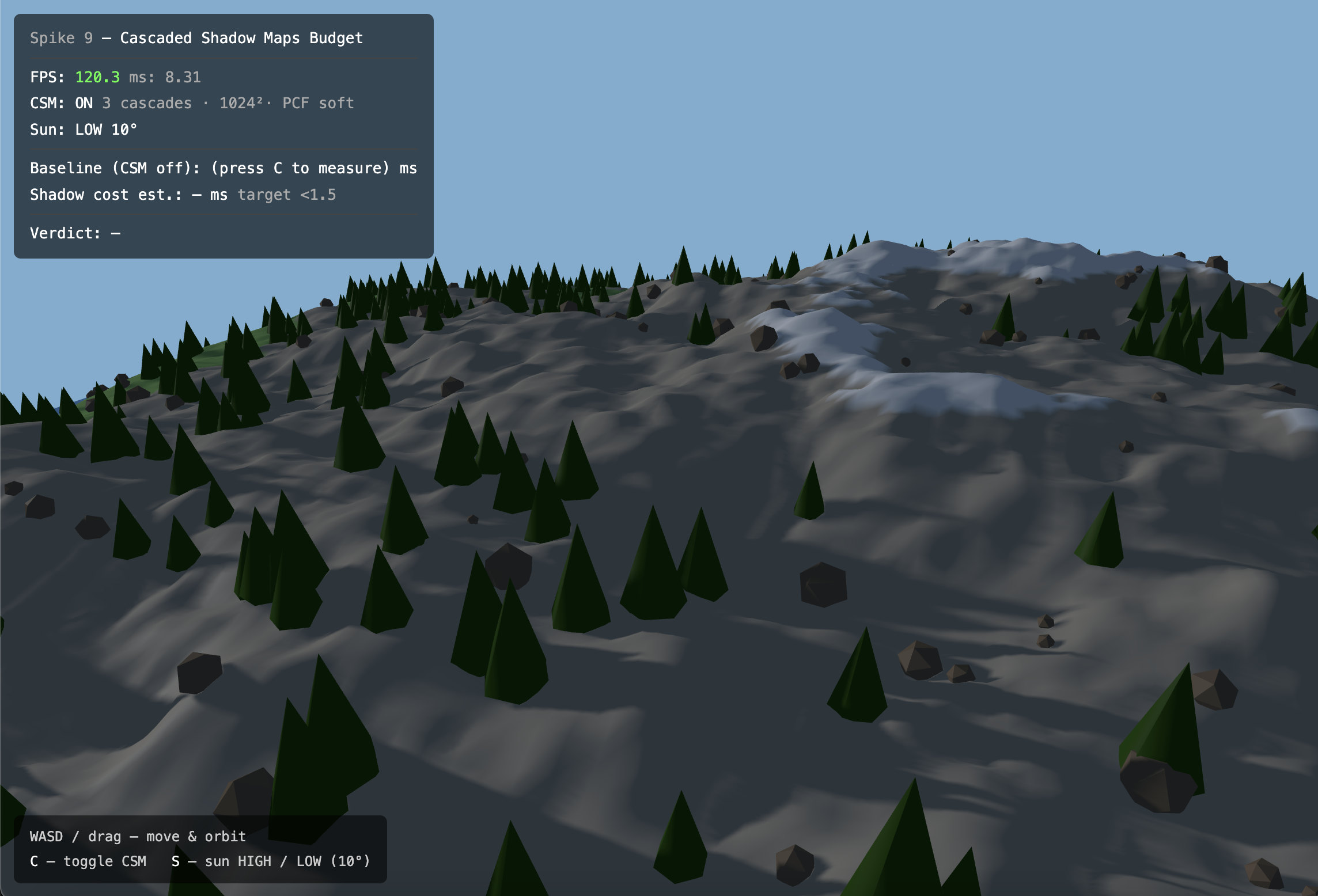
Building an open world in the browser, from Spike 1 to Spike 24 We documented the full engineering journey as a 12-part series. It includes wins, dead ends, seam nightmares, recovery patterns, and live runnable spikes embedded in each chapter. If you are building browser 3D terrain, this is the complete trail we wish we had when we started. Open the series guide →

A Breaker Belt: vibe coding a cross-genre game in 3 days Snake meets Arkanoid. Custom art, music, SFX, mechanics, levels, and story. Built by one to two people in about three days of vibe coding on Cinevva. Published on web, mobile, and PC. The kind of game a seven-person team would spend months on. Read more →

We didn't expect to build a radio station We have a music generator so game creators can make soundtracks. Then people started making music just because they could. One creator, Bella Bay, made over 100 tracks in two weeks. 362 tracks across 8 stations later, Cinevva Radio is live. Read more →

The intuitive mind in an age of AI Jensen Huang said AI has commoditized raw logic and computation. So what's left for humans? Intuition. The ability to sense what's missing and see around corners before the data appears. Here's why that resonates with someone who failed the SAT, ignored the rules, and built something people actually wanted. Read more →
The job market is transforming — from credentials to skills My cousin graduated with honors in CS. Spent fourteen months job hunting. Meanwhile, a dropout friend with five shipped indie games had three offers in a month. That's not an anomaly anymore. 90% of HR leaders now hire outside traditional degrees, and 94% say skills-based hires outperform credential-based ones. Here's what that means if you're starting out. Read more →

AI controversy, trust, and the post‑AI economy for games AI in games turned into a minefield around mid-2024. Voice actors cloned without consent. "AI slop" becoming shorthand for hollow work. Award nominations pulled over development placeholders. We run a platform, and you learn one thing fast: nobody likes feeling tricked. The debate won't settle anytime soon, but filters and honest labeling might actually work. Read more →
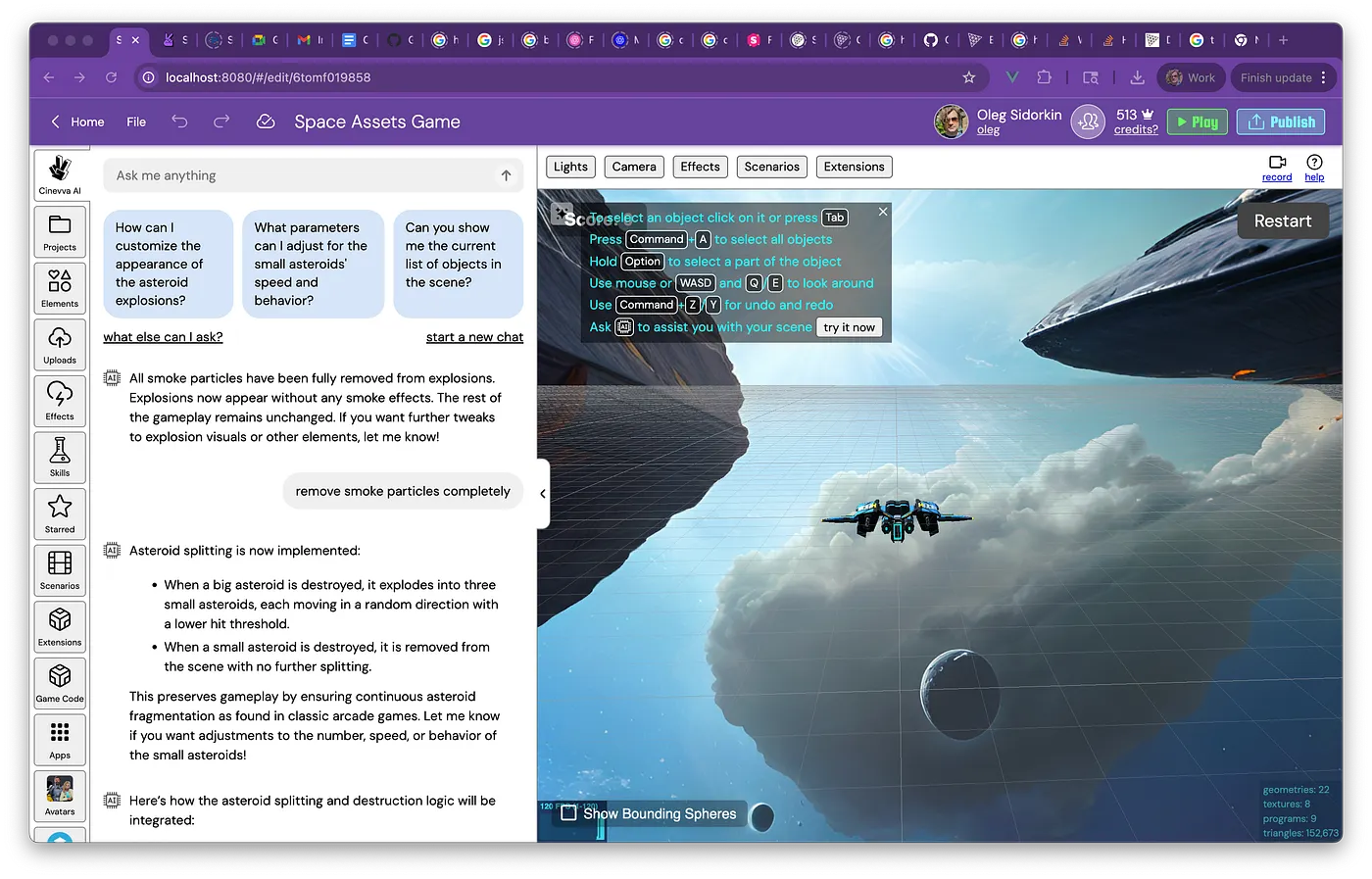
Prompting My Way Into Making 3D Games — And It Changes Everything For decades, building a 3D game meant learning to code, mastering complex engines, setting up scenes by hand. I built a playable asteroid shooter and flight sim in three evenings just by prompting. That's not a demo. That's a different world. Read on Medium ↗
Interview with "Tech Done Different" Ted Harrington asked the hard questions about Cinevva, the gaming industry, and what it's like being a creative in a world of engineers. We talked about bridging the gap between artists and developers, our biggest failures, and where gaming is actually headed. Read on Medium ↗

What will the value of an NFT be in 5 years from now? With all the noise around NFT trading, it's easy to get lost in the hype. Can you trust the uniqueness of artwork minted on today's blockchain? We dug into the stats and asked whether NFTs are here to last. Read on Medium ↗

"The future belongs to us: a world that we control, not a world that controls us." Oleg Sidorkin joined Cinevva as CTO & Co-Founder. This piece covers his vision for decentralized gaming, why he left a comfortable path, and what we're building together. Read on Medium ↗

Decentralised Platforms and the Future of Game Creators The current model for game distribution is broken for creators. Platforms take too much, discovery is a lottery, and ownership is murky. Here's how decentralization changes the equation. Read on Medium ↗

Cinevva on Bloomberg and Amazon Prime I pitched live on the #2MinuteDrill Show Season 2, broadcasted on Bloomberg TV. Two minutes to explain what we're building and why it matters. Read on Medium ↗
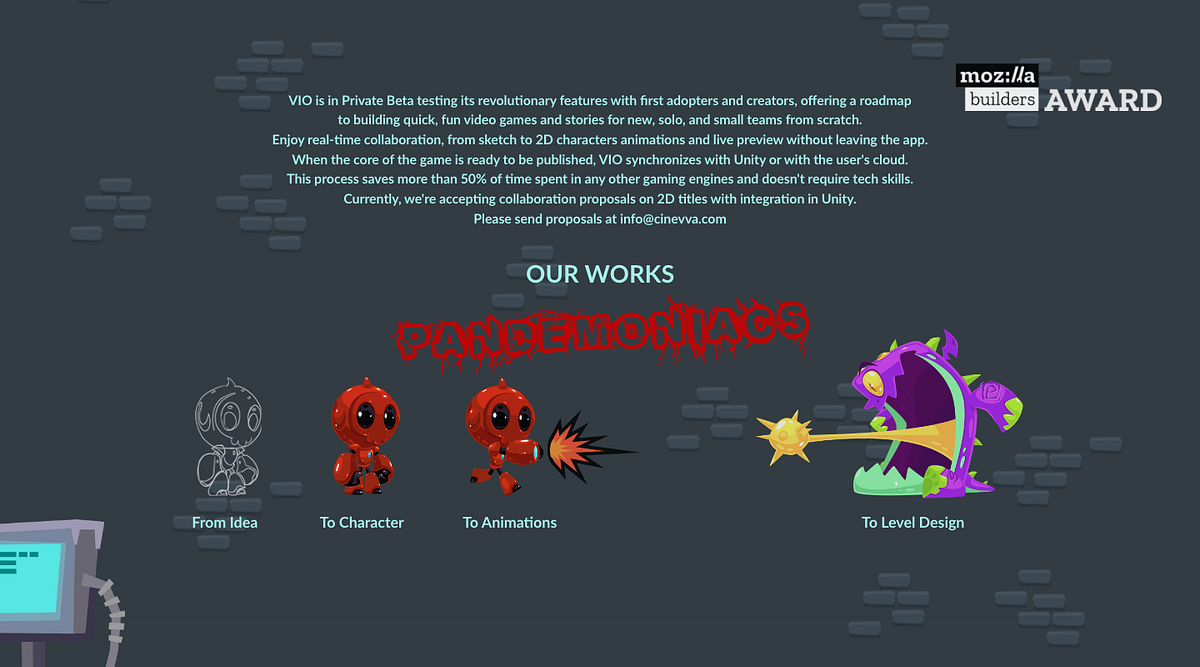
How VIO Makes It Easy for Anyone to Build Games AI and machine learning aren't just buzzwords here. They're the reason someone with zero coding experience can build a playable game. This is how the tech actually works under the hood. Read on Medium ↗

Goodbye, 2020! Hello, 2021! Looking back at a wild year. Mozilla Builders, first users, pivots that worked and ones that didn't. The defining moments that shaped what Cinevva became. Read on Medium ↗
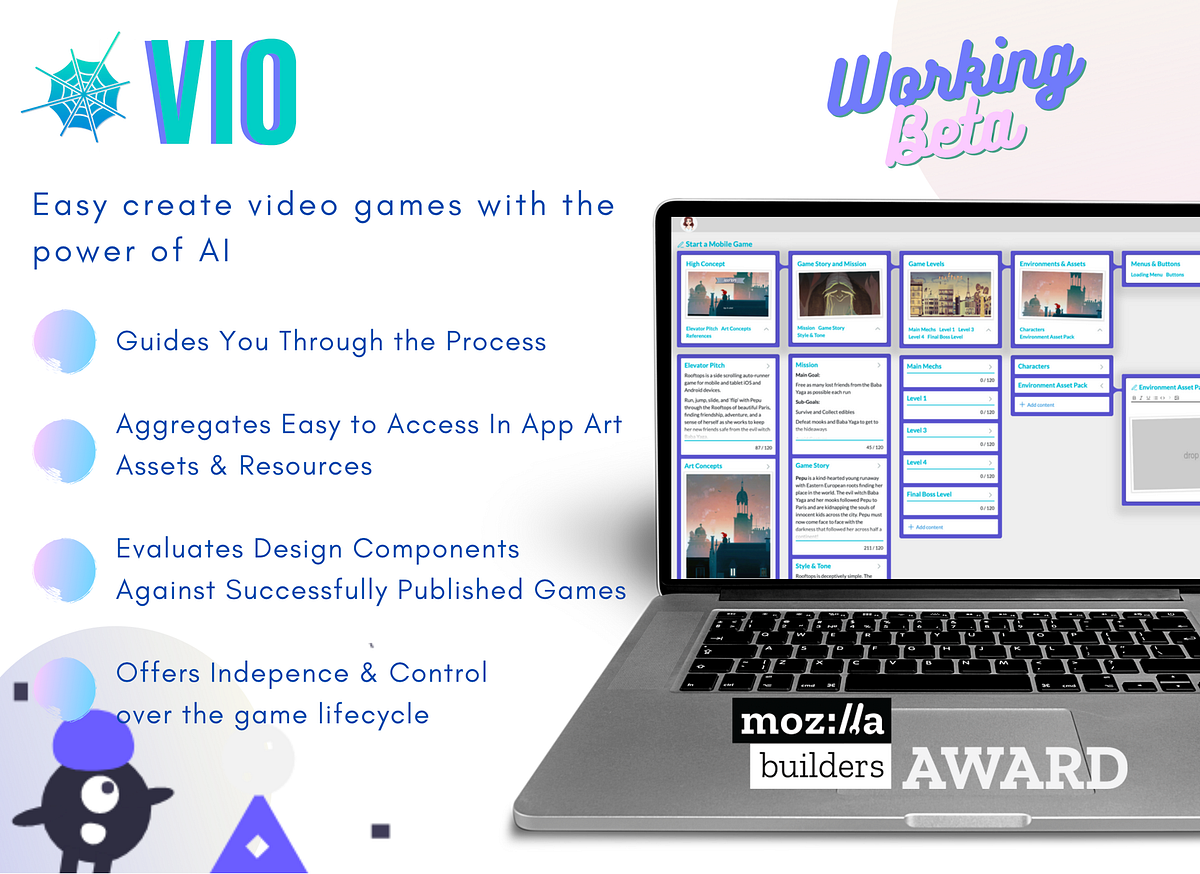
VIO Wins the Mozilla Builder Award at The Fix The Net Showcase We won. Out of hundreds of projects in the Mozilla Builders program, VIO took home the Builder Award. This is what that moment meant to us. Read on Medium ↗
See also: Press coverage →