Best Free 2D Sprites, Pixel Art and Tilesets for Games (2026)
Last reviewed: November 8, 2026.
For a first 2D game, choose a small, coherent pack before browsing individual sprites. Kenney's Tiny packs work well for compact tile-based worlds; Pixel Frog's Pixel Adventure and Ansimuz's SunnyLand supply a platformer cast and environment; 0x72's DungeonTileset II is a useful dungeon starting point. Those specific packs identify CC0 licensing. Other packs by the same artists can have different terms.
This guide compares usable starting points, explains what to check in a download, and walks through getting a sprite sheet into a game. Browse our platformer sprites, tilesets, UI sprites, and game icons when you already know the category you need.
Quick picks
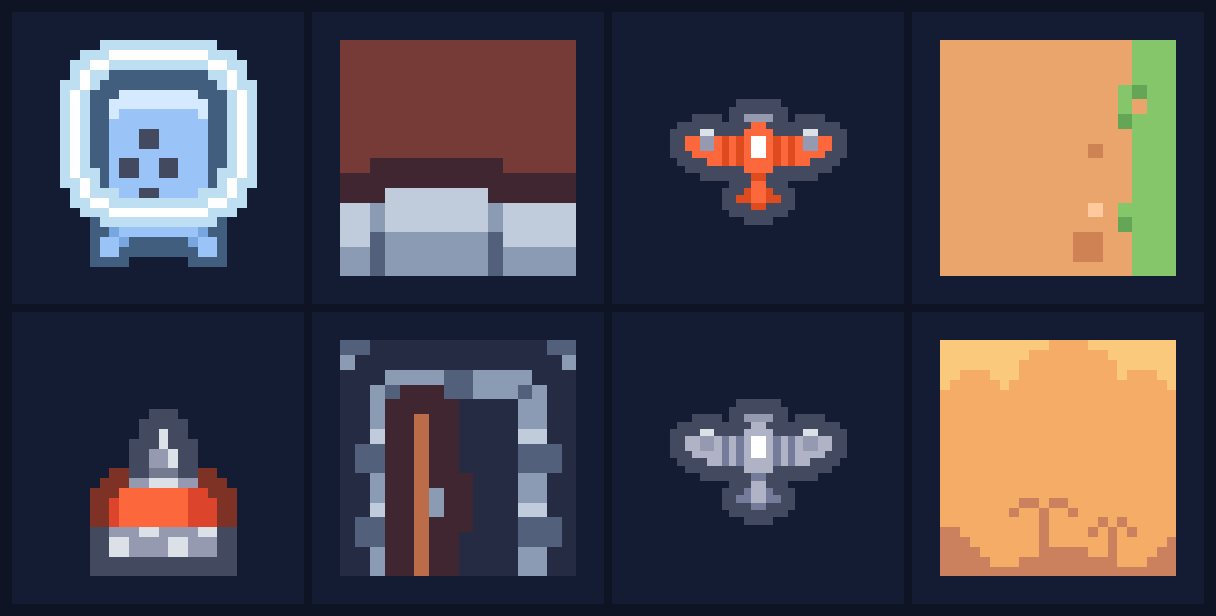
- A compact top-down world: Kenney Tiny Town or Tiny Dungeon, with a documented 16 × 16 tile grid.
- A platformer with animated characters: Pixel Adventure; inspect the supplied animation timing before importing.
- A platformer with example projects: SunnyLand; check which free files and paid extras you are downloading.
- A dungeon with small characters and props: 0x72 DungeonTileset II; verify frame dimensions rather than assuming every sprite occupies one tile.
- A more detailed top-down environment: Cainos Pixel Art Top Down - Basic, under a custom commercial-use license.
- Equipment and ability symbols: Game-icons.net, with creator attribution under CC BY 3.0.
These are editorial starting points, not benchmark winners. The most useful pack is the one that supplies the actions and terrain transitions your game actually needs.
Quick Reference
| Source or named pack | Useful for | License to record | Main check |
|---|---|---|---|
| Kenney asset packs | Tiles, UI, input prompts, sprites | CC0 | Pick a matching style and tile scale |
| Pixel Adventure | Side-scrolling characters, traps, items | CC0 | PNG artwork, not a finished game |
| SunnyLand | Platformer art and example projects | CC0 asset listing | Free download versus paid Plus extras; included notices |
| DungeonTileset II | 16 × 16 dungeon environments | CC0 artwork; MIT code field | Sprite bounds and animation frames |
| Cainos Top Down - Basic | 32 × 32 environment art | Creator's terms | No raw-asset redistribution or resale |
| OpenGameArt / LPC | Community art and modular characters | Per file or contribution | Credits and license choices for selected parts |
| Penusbmic Free Skeleton Warrior | Animated enemy | Creator's terms | Commercial use permitted; no individual asset resale |
| CraftPix freebies | Characters, UI, backgrounds | CraftPix Freebie terms | Finished-game use versus exportable art/templates |
| Game-icons.net | Inventory and skill icons | CC BY 3.0 | Credit actual icon authors and license |
Official pack and license links appear in the sections below. A site's “free” category does not replace the pack's permission statement.
The CC0 anchor: Kenney
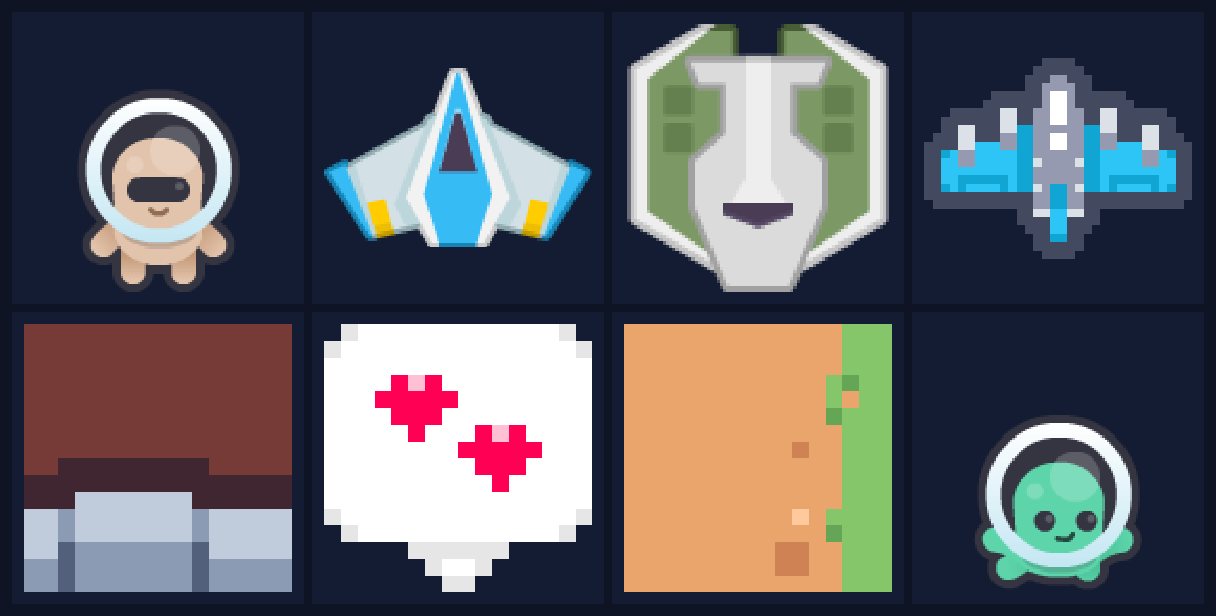
Kenney is a practical first stop because its support page explicitly identifies game assets on the asset pages as CC0, with no required attribution. Save the included license anyway, so the source remains clear when files move between projects.
Start with a specific family. Tiny Dungeon and Tiny Town both specify 16 × 16 tiles and CC0. A UI pack can supply buttons and input prompts, but compare outline weight, palette, and scale before mixing it with your world art. “Same creator” does not mean every pack has the same visual style.
Download the original ZIP, inspect whether it contains individual PNGs, a sheet, or both, and preserve its layout metadata. Use individual files for a quick prototype; use an atlas when your engine and loading strategy benefit from it. Kenney content is also available through Cinevva's asset search.
OpenGameArt
OpenGameArt is useful when you need a missing animation, a particular terrain type, or a community-maintained art family. Use its advanced search to narrow license options, then open the submission and read its attribution instructions and source list. Different submissions can use CC0, CC BY, CC BY-SA, OGA-BY, or GPL terms; they are not interchangeable.
The Liberated Pixel Cup ecosystem is especially useful for modular RPG characters. Avoid the old shortcut that “all LPC art is dual-licensed CC BY-SA 3.0/GPL.” The current Universal LPC generator describes several supported licenses, with authors, licenses, and original URLs tracked per image. It can export credits for the selected parts. Save that export with the generated sheet, and review the obligations of the actual layers you used.
Before choosing LPC, make one complete character with every action you need. Clothing, weapons, and hairstyles may not all support the same animation set. This small trial reveals missing combinations before you plan a large cast.
itch.io free asset packs
Search itch.io by perspective, genre, and resolution as well as price. “Top-down,” “16x16,” “platformer,” and “animated” are useful discovery tags; none is a license. Open the creator's pack page and save its terms, version, and download filename. A free sample may include fewer actions or environments than the paid preview suggests.
Pixel Frog
Pixel Adventure provides PNG graphics with an explicit CC0 statement. Its page specifies animation timing of 20 FPS, or 50 milliseconds per frame. Use that as the initial playback timing, then test transitions between idle, movement, jumps, and hits in your own controller.
Be precise about other packs. Tiny Swords has a free pack and a paid enemy pack. Its current page permits personal/commercial projects and modification, but prohibits redistribution, resale, and repackaging of the assets, including modified files. It separately lists an older CC0 download. Record which file you acquired; do not assign the old file's license to the current pack.
Ansimuz
SunnyLand lists CC0 in its asset-license field and includes animated characters, enemies, props, and effects. The downloads include art and example-project files, with paid Plus content listed separately.
It is a useful way to study a coherent platformer scene before replacing the example mechanics. Inspect included code and music notices separately, especially if you copy a full example project. The asset listing is evidence for this pack, not a license for every free or paid collection in Ansimuz's store.
0x72
DungeonTileset II labels its artwork CC0 and its code field MIT. The page includes a documented download version and links to community extensions. Keep the original sheet and documentation; read each extension's own terms and credits.
A tile grid describes the world layout, not necessarily every character's visible bounding box. A tall sprite, sword swing, or torch flame can extend beyond one cell. Set its pivot and collision shape for the gameplay footprint, and allow the artwork to overhang without cutting off the animation.
Cainos
Pixel Art Top Down - Basic supplies 32 × 32 sprites and tiles, props, and separated shadows. It includes a Unity package and textures usable in other engines, while Unity-specific shaders and demo features do not transfer automatically.
The creator permits free and commercial projects and modification, with optional credit, but prohibits redistribution and resale. That is a custom license, not CC0. It can suit a finished game; assess a public source repository, editable template, or asset-export feature separately.
penusbmic
Free Skeleton Warrior includes idle, run, attack, and death animations plus Aseprite source files. Its page permits commercial projects and modification, asks that individual assets not be resold, and makes credit optional.
It is a focused enemy pack rather than a whole game's art kit. Check its scale and silhouette against your hero, and inspect attack anticipation and recovery frames before assigning hit timing. Other DARK or STRANDED packs have their own scope and download terms.
CraftPix freebies
CraftPix's Freebie Products terms allow personal and commercial projects, modification, and selling games using the art, without required attribution. They restrict redistribution of source art and products that let users export reusable artwork. Educational materials and templates have additional provisions; the current terms also restrict AI/ML uses.
Choose a free pack for a specific gap, such as a GUI set or background collection, then inspect its layers and dimensions. A polished preview does not show whether animation frames, editable sources, or every advertised character are included in that particular download.
Game-icons.net
Game-icons.net publishes game-oriented symbols under CC BY 3.0. The site offers editing and export tools, which are useful for bringing icons into a consistent color scheme.
Credit the author of each icon you use, not just the website. Retain the source and license link and indicate modifications when required by the applicable license. If several icons share an author, you can group the entry while keeping the individual works identifiable. A recolor does not remove the attribution requirement.
For pixel-art UI, preview the result at its final displayed size. A detailed vector icon that reads well at 128 pixels may become unclear in a 16-pixel inventory slot. Reduce detail deliberately instead of shrinking an entire icon set and hoping it remains readable.
Lospec
Lospec is a useful resource for palettes, tutorials, and finding pixel-art tools. It is not a blanket license to reuse the artwork shown in its community gallery.
Use a palette as a production constraint: pick colors for outlines, backgrounds, characters, and interactable objects, then check whether those groups remain distinguishable in a busy scene. Keep a small reference sheet beside your editor. Matching colors helps, but perspective, lighting direction, and pixel density matter just as much when combining packs.
Draw your own
Piskel offers a free browser editor for animated sprites. LibreSprite is another free editing option. Aseprite offers paid builds and tools for animation, layers, and frame tags. Check their current download and platform pages before choosing an installation.
Start by drawing one missing object or editing a permitted asset. Keep an editable source file, export a transparent PNG at native resolution, and test it beside the rest of the game. A single custom door, pickup, or portrait can make a shared pack feel specific to your setting without redrawing the whole world.
From download to playable scene
A useful asset test takes one room and one character through the complete import path.
- Choose the native grid. Record tile size, sheet spacing, margins, and any atlas metadata. Do not resize the original sheet before slicing it.
- Check completeness. Build a room with inner and outer corners, a doorway, a narrow passage, and terrain transitions. A pretty straight wall is not a complete tileset.
- Set texture sampling. For crisp pixel art, configure nearest-neighbor sampling where appropriate and avoid accidental smoothing. MDN's pixel-art rendering guide explains browser scaling and canvas behavior.
- Align pivots. Put a character's origin near its feet or another consistent reference point. Run through every frame to find visual jumping caused by changing crop bounds.
- Separate collision from appearance. Use deliberate collision shapes; a sword trail, hair, shadow, or transparent padding should not automatically become solid geometry.
- Configure animation timing. Use elapsed time and the intended frame durations. Check start, loop, interruption, and return-to-idle behavior.
- Test camera motion. Move at your real game speed and target scale. Look for texture bleeding, uneven pixel sizes, seams, and jitter, especially at fractional positions.
- Package the credits. Keep the license and provenance alongside the source art and verify required notices in the exported game.
For automated terrain placement, Tiled's terrain documentation distinguishes corner, edge, and mixed terrain sets. A sheet labeled “autotile” still needs a mapping that matches the editor or engine you use. Our pixel art rendering tutorial covers the browser side.
Generate sprites with AI
An image generator can help with concepts, portraits, backgrounds, and draft icons. An animation-ready sprite needs additional checks: consistent frame size, palette, limb proportions, pivot, transparency, and directions. A sheet-shaped image is not proof that its frames form a usable walk cycle.
For Cinevva's Image Generator, use the current tool page for access and credit details and read generation rights. Avoid assuming that every generated result is exclusive or automatically cleared for commercial use. Keep input references you have rights to use and review the output before building a character system around it.
Licenses in 30 seconds
- CC0: no copyright attribution requirement, with other-rights and provenance questions still relevant.
- CC BY: commercial use is possible with attribution and the other terms of the stated version.
- CC BY-SA: assess ShareAlike when sharing adaptations; do not reduce it to a simple credit rule.
- Custom terms: read redistribution, templates, team use, and other restrictions even if commercial games are allowed.
- Missing terms: a free download button is not enough to establish the permissions you need.
See the CC0 deed, CC BY deed, and our game asset licenses guide for the distinctions.
Common Questions
Where can I download free 2D sprites for games?
Start with the named Kenney and itch.io packs above, then use OpenGameArt for specific gaps. Download from the creator's original page and save the included terms.
Where can I find CC0 tilesets?
Kenney Tiny Town and Tiny Dungeon, Pixel Adventure, and DungeonTileset II have explicit CC0 listings. Read the exact pack and file version rather than assigning a creator-wide license.
Where can I get free pixel art assets and sprites?
Choose a pack with both the characters and terrain your game needs. A complete small pack often saves more work than a large folder of mismatched individual sprites.
What does "free to use" actually mean for sprites?
It depends on the permission statement. Look for commercial-use, modification, attribution, and redistribution terms. Those answer different questions from the download price.
Are free sprites safe to use in a commercial game?
Many are licensed for that use, but check the file's creator, terms, and depicted content. The fact that a site accepts uploads does not guarantee every uploader owns all relevant rights.
What is the best free pixel art tileset for a dungeon crawler?
Try DungeonTileset II for characters and props or Kenney Tiny Dungeon for a compact environment. Build one representative room and test the combat animations before choosing.
Do I have to credit the artist when I use free sprites?
CC0 does not require credit; CC BY and CC BY-SA do. Custom licenses vary. Keep an internal record even when the player-facing credit is optional.
What license should I look for on itch.io asset packs?
Choose terms that cover your actual release. CC0 and CC BY are useful starting points; a custom commercial license can also work. Public source projects need particular attention to redistribution.
Can I use AI to generate sprites for a commercial game?
Check the tool's current output terms, input rights, and resulting content. Then test whether the sprites meet your game's technical requirements. Generation does not establish exclusivity or remove the need for cleanup.
What is the difference between a sprite, a sprite sheet and a tileset?
A sprite is a 2D image used as an object or animation frame. A sprite sheet packs multiple images into one texture. A tileset supplies repeatable terrain or building pieces that a tilemap arranges into a level; it may itself be stored in a sprite sheet.
Choose the look and core actions, then test the art in a playable scene.
Related
- Where to Find Free Game Assets - sources for every asset type
- Game Asset Licenses Explained - CC0, CC-BY, and the rest
- Best Free 3D Model Sites for Games - the 3D side
- Best 2D Game Engines in 2026 - what to build with
- Cinevva Asset Search - search Kenney and more from one box
- Cinevva Image Generator - concept art, backgrounds and icons; see current access terms
- Free tilesets, platformer sprites, UI sprites and game icons - browse the free library one category at a time