The intuitive mind in an age of AI
By Mariana Muntean, CEO of Cinevva
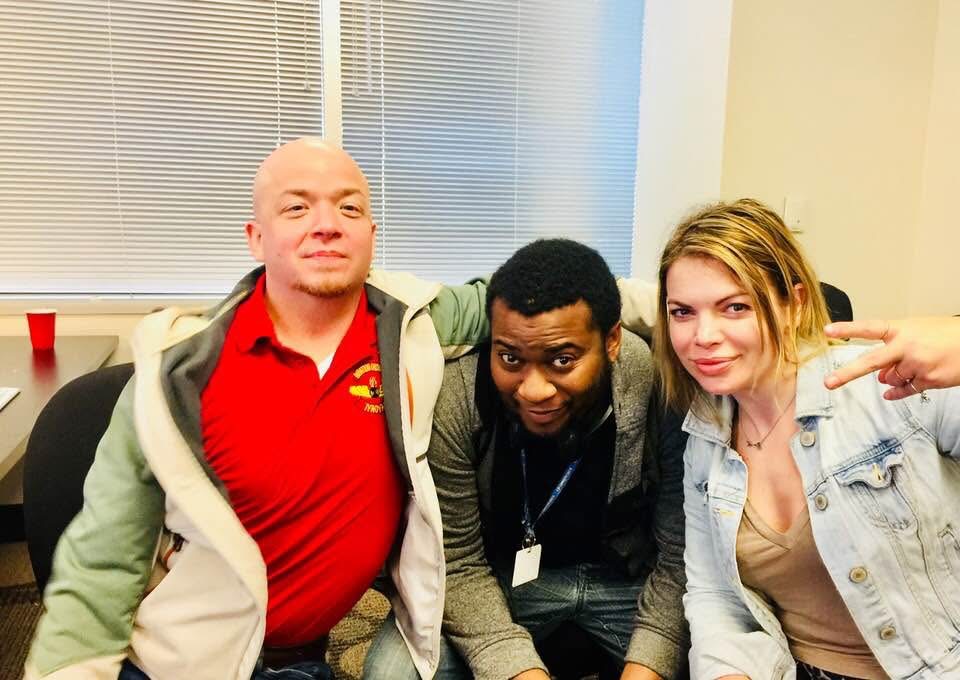 With classmates during a 48-hour game jam in Houston, 2018
AI has essentially commoditized raw logic and computational ability. The skills we used to worship, the mental math, the pattern recognition, the ability to grind through complex algorithms, AI does all of that now. Faster. Better. Without getting tired. Do we still need to know it? Absolutely, but perceptions change. Now everyone needs to adjust to the new era - an era of intuitive intreaction and outcomes.
According to Jensen Huang, NVIDIA's CEO, what matters now is the ability to sense a "vibe" and see around corners before the data appears. The intersection of technical literacy and deep empathy. The intuitive understanding that silicon can't touch.
I've never heard anyone with his credibility say something that validated my entire life trajectory quite so directly.
The SAT and the system that wasn't built for me
A few years back I took the SAT and failed. I'm not proud of it, but I also didn't try again. Something felt fundamentally wrong about the whole thing, and I couldn't shake that feeling no matter how much people told me to just study harder and take it again.
Looking back, I think I was right.
The SAT is designed for the American education system. That sounds obvious, but the implications run deep. American high schools teach to specific patterns, question types, and ways of framing problems. Students grow up marinating in that style of standardized testing from elementary school onward. By the time they hit the SAT, they've internalized the rhythm.
International students don't have that advantage. We come from systems with different educational philosophies. European schools often emphasize depth over breadth, essay-based examination over multiple choice, oral defense over bubble sheets. Asian systems have their own standardized tests, but they measure different things in different ways. South American, African, Middle Eastern educational traditions each carry their own logic.
When you drop an international student into the SAT, you're not just testing their knowledge. You're testing how quickly they can adapt to a foreign testing culture while simultaneously demonstrating mastery of content. You're testing cultural fluency as much as academic ability.
I was expected to prep for this over a summer and ace it. Learn an entire testing culture, unlearn my own educational instincts, and perform at a level that would impress American admissions officers. All in a few months.
I chose not to.
When you're young, you're smart in different ways. Intuitive ways. I was clearing a path for myself, even if I couldn't articulate exactly why at the time. Something in me knew this system wasn't mine.
Following the creative thread instead
I studied game development and design because I loved the idea of using creativity and visual effects to build virtual worlds people could play and interact with. I loved the intersection of art and technology, storytelling and interactivity.
What I found shocked me.
Games require serious technical depth. Physics simulations, collision detection, vector math, lighting calculations, optimization. I knew that going in. The math and engineering aren't obstacles to game development. They're part of what makes games work.
The problem was the gap between creative vision and implementation. The engines and tools dominating the industry were designed by engineers for engineers. Everything ran on "ifs" and "thens" and node-based blueprints. You wanted a vortex effect? Learn shader programming. Specific lighting mood? Dig into material graphs. Character movement that feels right? Debug character controller or physics parameters for hours.
If you're a visual person, if you think in vivid colors and moving images, if ideas come to you as fully formed scenes with sound and texture and emotional weight, you had to translate all of that into technical language before you could build any of it. You see a world in your mind, complete with lighting and atmosphere and the way characters move through space. Then you sit down at your computer and spend the next six hours debugging why your character falls through the floor.
The technical foundation matters. But the tools forced creators to live in implementation details instead of abstracting that complexity away. Game creation should feel like telling a story or directing a movie where people get to participate. That's the magic of the medium. Instead it felt like taking an engineering exam before you could even start.
Movie directors don't spend years learning physics engines before they can express their vision. They get a budget and a team that handles the technical execution. But in indie game development, you rarely have a budget. What you have is time and access to tools. And if you're a technical person, you can build a killer game. But only if.
This is how we got titles like Limbo, made by a small team with a singular artistic vision and the technical chops to execute it. Or Undertale, created largely by one person who happened to have the right combination of creative instinct and programming ability. Or Stardew Valley, where Eric Barone spent years teaching himself everything from pixel art to music composition to C# programming.
These games succeeded against enormous odds. But for every Limbo there are millions of creative visions that died because the tools demanded technical fluency their creators couldn't provide. Less than 3% of indie game developers ever achieve meaningful success. How many brilliant games never got made because their creators hit a wall of "ifs" and "thens" and gave up?
The barrier to entry wasn't creativity. It was technical gatekeeping built into the tools themselves.
Building what should have existed
So 5 years ago I started building something different.
The pitch was simple: game development should be accessible to anyone with a creative vision. You shouldn't need a computer science degree to express yourself through interactive media. The tools should adapt to how creative people actually think, not the other way around.
VCs from Sequoia, Pear, Draper, and dozens of other firms told me it wouldn't work. It's B2C. The market isn't there. Indies don't pay for anything. You can't simplify game development without sacrificing capability. Gamers want complex games, and complex games require complex tools. Millions of excuses dressed up as market analysis.
People told me I was crazy. Maybe I was. But I kept coming back to the same question: why should multimillion dollar budgets be a prerequisite for creative expression? Movie directors and celebrity game producers have teams and resources. Everyone else gets a code editor and a prayer. I wanted to build the thing that closes that gap. You describe what you want, and it happens in front of your eyes. Every part of me knew this was right. I could feel it in every cell of my body.
Today thousands of people use Cinevva daily for 3D game assets, games, music, levels and experiences. Millions of views on projects created so far. Growing every single day. A two-minute pitch to Sand Hill Road isn't exactly the format for "I failed the SAT but trust my intuition."
What intuition actually means
Huang wasn't just making a philosophical point. He was describing a real shift in what constitutes valuable intelligence.
For decades, we optimized for the wrong things. We built educational systems that rewarded memorization and calculation. We designed standardized tests that measured pattern-matching against previously seen problems. We hired people based on credentials that proved they could survive four years of academic gatekeeping. AI just made all of that less special.
What AI can't do, at least not yet, is sense what's missing. Feel when something is off. Intuit what people need before they can articulate it themselves. Read a room. Understand context that isn't captured in any dataset.
I poured my time, international life experience, money, and intuitive knowledge into building Cinevva. That's a mix hard to obtain in college. Hard to test for on the SAT. Hard to capture in any credential system designed before AI made raw cognitive horsepower abundant.
Sixteen or twenty years ago, computer scientists decided what tools should look like and how they should work. They built for themselves, for people who thought like them. The rest of us were expected to adapt. That era is ending. The people who will shape what comes next are the ones who understand what humans actually want. Who can feel when something is wrong and when something is right. Who build for people instead of for technical elegance.
I trusted something in myself that the system told me was worthless. And I was right.
Related:
- The job market is transforming — from credentials to skills
- Online Game Development Courses — skills-first paths that bypass traditional gatekeeping
- Everyone wants to be the AI game engine now — the industry shift toward tools that adapt to how people think