A Breaker Belt: Snake meets Arkanoid, vibe coded in three days
By Mariana Muntean, CEO of Cinevva
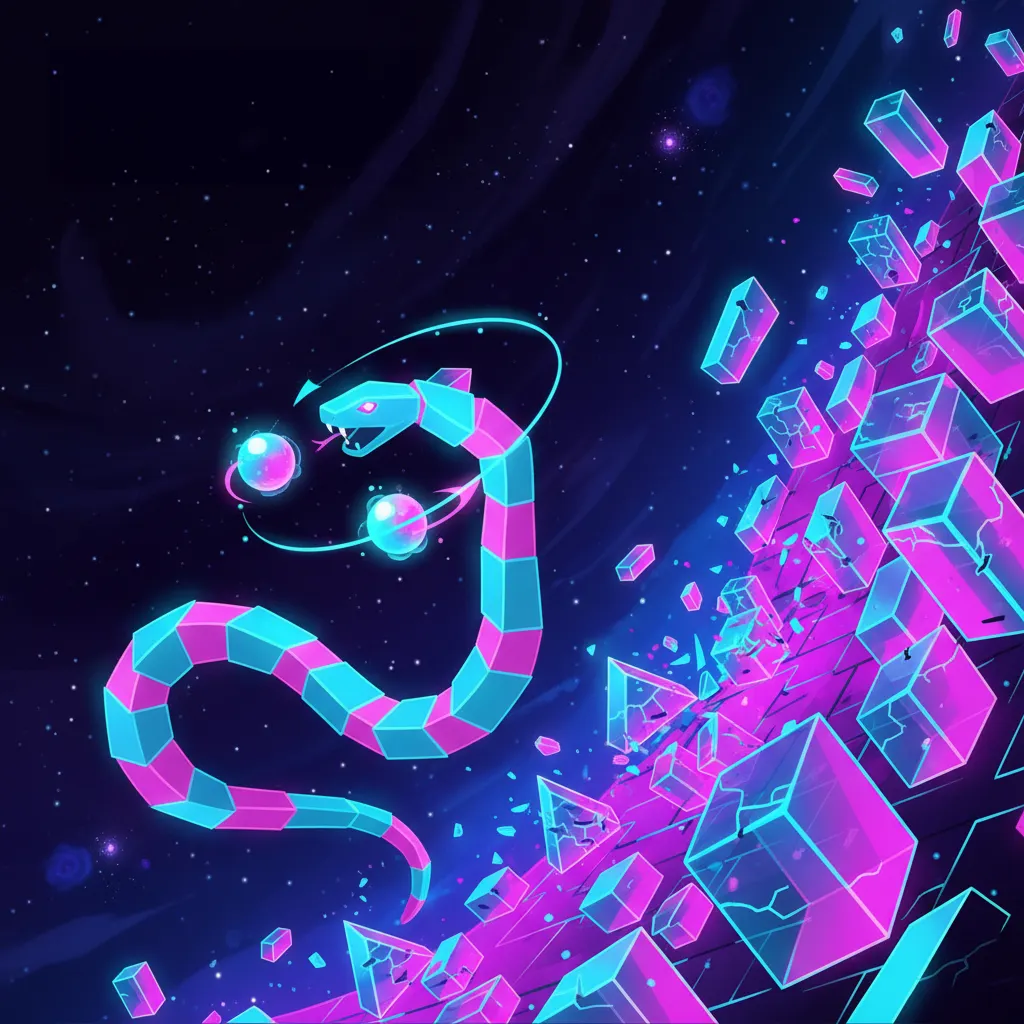
We made a game where your snake is the paddle and the bricks fight back. It shipped on web, mobile, and PC. It took two of us about three days. On and off, not crunching. And it's genuinely fun to play.
That last part is the thing worth paying attention to.
The mashup nobody asked for
Snake is about growth and spatial awareness. Arkanoid is about reflexes and angle prediction. They come from completely different design philosophies, and mashing them together sounds like the kind of pitch that gets politely declined.
But A Breaker Belt makes it work. You're a cosmic serpent, a living arc of neon current stitched from drift-metal vertebrae and comet silk, threading through an asteroid field of breakable blocks. Your head is the paddle. Your growing tail is both your greatest weapon and your most constant threat. The orbs ricochet off your body to shatter bricks, but one wrong turn into your own tail and you're done.
It's the kind of weird cross-genre experiment that usually dies before anyone gets to play it, because the development cost of finding out whether a weird idea works has traditionally been measured in months. Here it was measured in afternoons.
What actually shipped
The scope is what makes this interesting. This isn't a game jam prototype with placeholder rectangles and no sound.
The game runs 50 waves deep. That's not 50 variations of the same brick wall. The formations evolve from gentle onboarding arcs into fortress rings that demand angled shots through side gaps, then into layered diagonal mazes with one-tile-wide openings that require precision steering. Explosive bricks blow their neighbors apart. Phantom bricks flicker in and out of existence. Regenerating bricks heal back after you break them, forcing you to prioritize targets instead of sweeping left to right. Portal bricks teleport your orbs across the arena. Gravity wells bend your shots into slow, curving hymns. Laser emitters sketch red lines across the void. Mimic bricks look harmless until they decide they're not. By wave 15, you're navigating something that feels less like a puzzle and more like a living system that's learning your habits.
The music isn't a loop. It's a reactive soundtrack that builds with your gameplay. The underlying system runs a bass line, lead synth, pad, kick, snare, and hi-hat in E minor at 140 BPM, and as the action intensifies, additional percussion and synth layers fade in. When things calm down between waves, ambient pads take over. The music breathes with you. A dedicated composer would spend weeks tuning that kind of responsiveness. Here it was part of the creative flow.
The sound effects aren't samples pulled from a free pack. Every brick shatter, power-up pickup, orb bounce, and collision is synthesized in real time. Different pitch for head contacts versus tail contacts. Warm reverb for the spacey feel. Lowpass filtering to keep things satisfying without getting harsh. When you chain a combo, the audio tells you before the screen does.
And then there's the storytelling. Each wave opens with a narrative beat delivered by AI-generated voice. The writing has genuine personality. Wave one: "They call it the Breaker Belt: a ribbon of engineered debris that circles the old star like a warning." By wave 38: "The Belt stops feeling like a wall and starts feeling like a mind. It tests not your reflexes, but your habits. You break the habit. The Belt notices." It's 50 chapters of cosmic mythology that makes you care about why you're a snake breaking bricks in space.
The backgrounds evolve too. Early waves are calm indigo starfields with soft meteor rain. By mid-game, aurora bands and nebula clouds appear. Late game goes full Ion Storm with sharp cyan streaks against near-black space. Wave 15 and beyond, you're in Event Horizon territory: deep void punctuated by slow-moving nebula filaments and faint black hole lensing. The game communicates progression through atmosphere as much as difficulty.
All of this runs on keyboard, gamepad, or touchscreen. Published to web, mobile, and PC from one codebase. No separate builds. No porting.
The team that wasn't needed
Here's the part that should make any game developer pause.
A game with this depth of content would typically need a game designer, a couple of programmers, a 2D artist, a sound designer, a music composer, a level designer, a narrative writer, and QA. That's eight or nine people. At a modest indie pace, you're looking at three to six months of coordinated work. Standups, Jira tickets, asset pipelines, platform-specific debugging.
Two of us made this in a long weekend on the Cinevva Engine.
The talent required didn't change. The ratio between creative intent and implementation overhead did. The time was spent deciding what the game should feel like, not fighting tools to make it happen.
Why this matters if you make things
The interesting question isn't whether AI tools can help make games faster. That's been answered. The interesting question is what happens to ideas that used to be too risky to try.
"Snake but you're the paddle in an Arkanoid arena" is not something a producer greenlights. A few indie devs have tried variations of this mashup on itch.io (BreakSnake, SnakeOut, Snake Break), but they're all small game jam experiments. The genre fusion has never been given a real production pass with reactive music, AI narration, dozens of brick types, and 50 waves of escalating level design. In traditional development, that kind of polish on a risky concept gets killed in a meeting before anyone writes a line of code.
When trying something weird costs an afternoon instead of a quarter's budget, the strange ideas get built. Some of them turn out to be genuinely good. A Breaker Belt is one of those.
Play it. Or make your own.
A Breaker Belt is playable right now on web, mobile, and PC. If it makes you want to build something, the Cinevva Engine is free to use. Describe what you want, iterate on what comes back, ship when it's ready. The music, sound effects, art, and 3D models are all built in.
Your weird game idea might be three days away from existing.
Play A Breaker Belt | Build your own game | Browse community games
Related:
- Vibe coding is the new game jam — how AI tools collapse the gap between idea and prototype
- Game Jams & Hackathons — the jam format that makes weird mashups possible
- Web Game Engines Comparison — engines for shipping to web, mobile, and PC