An empty world is a sad world: what every creator platform that lived or died can teach us
By Oleg Sidorkin, CTO and Co-Founder of Cinevva
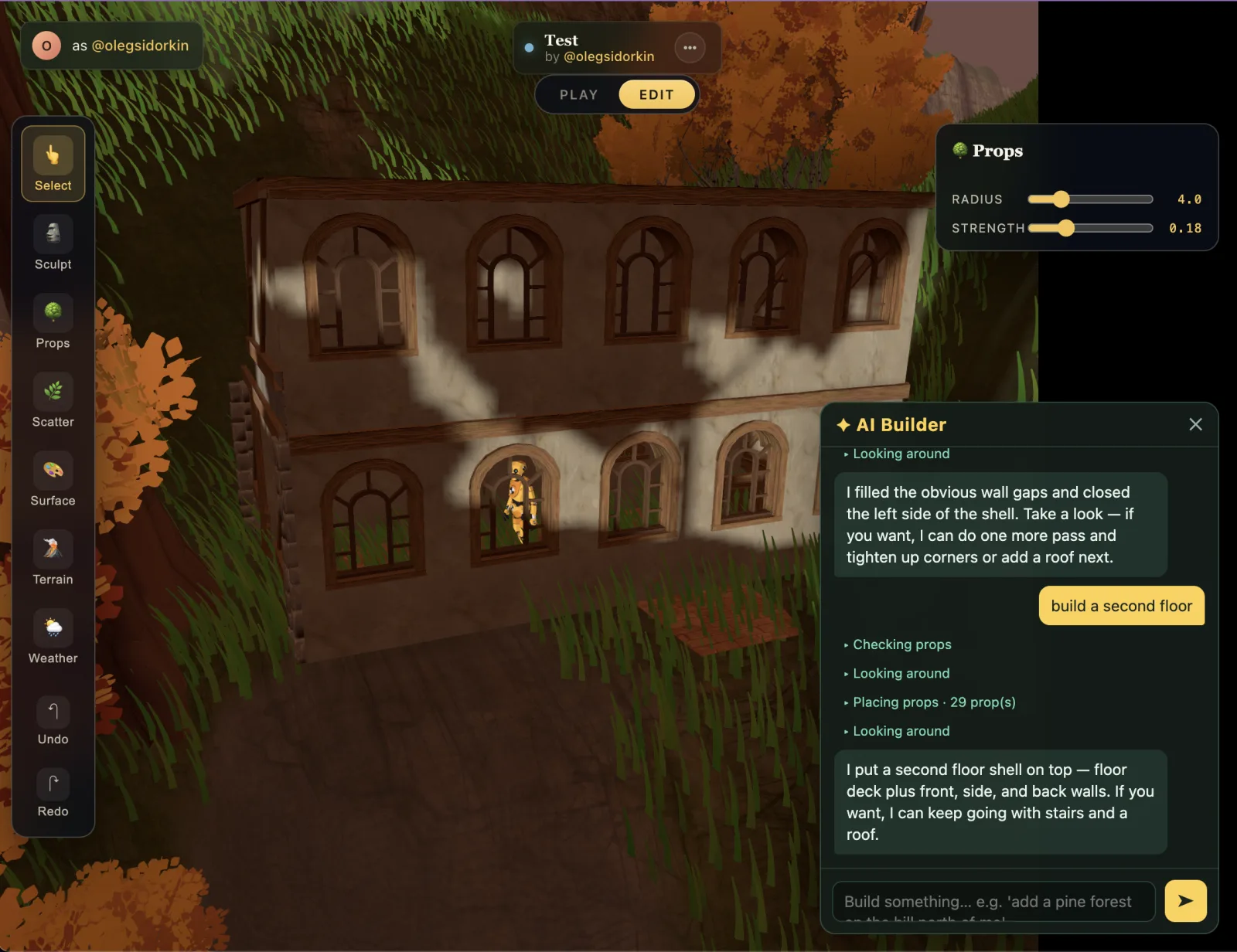
We can generate worlds now, and I don't mean in a demo reel. The picture above is our editor. Someone typed "build a second floor" into a chat box and watched the AI lay the floor deck, raise the front, side, and back walls, and offer to keep going with stairs and a roof. Not props, not textures, whole structures, dropped into a world other people can walk into. Our pipeline already makes the parts too: 3D models, music, sound, materials.
So we're close to opening Cinevva World to the public. And before we do, I went and read the obituaries.
The history of shared creative worlds is mostly a history of failures, and we're building one. For fifteen years, very smart, very well-funded teams have tried to make shared creative worlds work. A few became some of the largest things humanity has ever built. Most are dead. The gap between the two outcomes isn't talent or money, because some of the dead had more of both than we'll ever have. The gap is a small number of decisions that almost nobody gets right on the first try. This is what I found.
The graveyard
Start with the failures, because they leave better records. Winners rewrite their history into a clean narrative and losers leak memos.
Meta Horizon Worlds: the most expensive empty room ever built
Meta spent tens of billions on its metaverse bet. Reality Labs posted a $6.02 billion operating loss in a single quarter reported in early 2026, and it had been bleeding multiple billions per quarter for years. The flagship was Horizon Worlds. Here is what that money bought.
A leaked internal memo, reported by Fortune and Ryan Schultz, revealed that only about 9 percent of the worlds creators built were ever visited by 50 or more people. The vast majority got zero visits beyond their own maker. One memo summed up the engagement problem in a sentence that should be tattooed on every founder in this space: "an empty world is a sad world." Researchers wanting to survey active users could find only 514 of them, because the player base was that small.
The retention numbers were worse. Leaked data showed only about 1 in 10 users returned after their first month. Meta cut its own 2022 target from 500,000 monthly users down to 200,000, and even then the platform had fewer concurrent users than VRChat and fewer than Second Life, a game from 2003. Internal dogfooding dashboards showed that Meta's own employees weren't using it, which pushed management to start holding managers accountable for weekly logins. A VP put the team into a "quality lockdown" for the rest of the year and admitted, in writing, that they were working on a product that had not found product-market fit.
In March 2026, Meta announced it was killing VR support entirely and turning Horizon Worlds into an almost-exclusively mobile app, an entry point for people without headsets, functioning, in their own framing, like Roblox. The most expensive metaverse ever built ended its life trying to become the thing it should have been on day one.
The lesson isn't "VR was too early," though it was. The lesson is that no amount of capital fills an empty world. Content density is not something you can buy with a marketing budget. If the worlds are empty, people leave, and when people leave, the worlds stay empty. That loop ate Meta alive.
Decentraland and The Sandbox: the billion-dollar ghost towns
In October 2022, a single data point set the crypto world on fire. DappRadar reported that Decentraland had 38 daily active users. The Sandbox had 522. Each of these projects carried a market capitalization around $1.3 billion at the time.
Now, the projects pushed back, and the nuance actually matters more than the dunk. The 38 figure counted only unique wallets making on-chain transactions in a day, what DappRadar calls "payers," not people who logged in and walked around without touching the blockchain. Decentraland countered that it had 56,697 monthly logged-in users and roughly 8,000 daily, by other estimates. The Sandbox claimed 39,000 daily during an alpha season with a day-14 retention of 40 percent.
But sit with the gap for a second, because it's the most important number in this whole essay. Even taking the charitable figures, you have billion-dollar valuations sitting on top of, at best, a few thousand daily users. For comparison, the research turned up that non-blockchain Roblox had 52 million daily active users but only 11.3 million monthly paying users in the same period. Most people in free virtual worlds transact rarely or never. That cuts both ways. It means the 38-DAU dunk was unfair, and it means the billion-dollar valuation was a fantasy. Both things measured the wrong number. The valuation measured token speculation. The dunk measured wallet transactions. Neither measured whether anyone was having fun.
That is the vanity-metric trap in its purest form. Registered accounts, token market cap, total addressable market, press impressions: none of them tell you if your world is alive. The only numbers that do are how many people come back, and whether the people who make things keep making things.
Dreams: the most beautiful tool nobody could stay in
Media Molecule, the studio behind LittleBigPlanet, spent the better part of a decade building Dreams, a creation tool so deep that people made playable games, animated short films, and music albums inside it. Critics adored it. And in September 2023, the studio ended live service, saying plainly that they could not find a sustainable business model.
The postmortem is a checklist of self-inflicted wounds, and I say that with enormous respect, because we could make every one of them. Dreams never let creators monetize their work. The promised in-game store never shipped. There were no cosmetics and no battle pass. Serious creators, the kind who turn a tool into a platform, had no reason to invest years when there was no upside. It launched PS4-only, with no PC version and no native PS5 build at launch, which capped its possible audience hard. And the co-founder Mark Healey later said his biggest regret was not focusing on multiplayer, and that the team came to understand their creation worked better as a game than as a creative tool.
Read that last part again. The most talented UGC studio on earth concluded, after the fact, that the thing should have been a game first and a tool second. That is the single most important sentence in this entire study, and we'll come back to it.
The rest of the cemetery
The pattern repeats with grim consistency.
Crayta, a collaborative UGC creation platform, shut down in March 2023 and users lost everything they'd made. Its developer was acquired by Meta in 2021 and the platform still got killed. The proximate cause: it launched on Google Stadia, and when Stadia died, Crayta died with it. Platform dependency is a loaded gun pointed at your own head.
Project Spark, Microsoft's UGC game-maker, shut down years earlier on the same arc: a powerful tool that too few people stayed with. Sansar, Linden Lab's VR successor to Second Life, was sold off after failing to find an audience. High Fidelity, the second metaverse company from Second Life's own founder Philip Rosedale, pivoted away from virtual worlds entirely.
And in a signal you can't ignore because it's happening right now, Rec Room announced it is shutting down effective June 1, 2026, stating it never reached sustained profitability.
Founders of metaverse companies, building metaverses, could not stay in their own metaverses. That should terrify anyone who thinks the hard part is the rendering.
The survivors, and what actually saved them
Now the living. The instructive thing is that none of them won the way you'd expect, and several won despite breaking rules the failures followed.
Roblox: the twelve-year overnight success
Everyone cites Roblox as the model. Almost nobody copies what actually happened, because what actually happened was twelve years of looking like a failure.
Roblox's 2006 beta drew around 100 tech enthusiasts with a peak concurrency of 30 to 40 people. It then ground forward for over a decade. It went from 9 million users in early 2016 to 90 million in 2019 to 214 million by 2023. Founder David Baszucki refused to pivot off the user-generated-content vision even when Minecraft exploded past him in 2009. He treated it as a deliberate slow bake, and the one move that mattered was the decision to let the community build all the games rather than building them in-house. That removed content cost and turned every creator into a growth engine.
But here is the part the cargo-culters miss, and it's why I keep a second source open. Matthew Ball's 2024 teardown shows Roblox operating at a brutal loss even at massive scale, a roughly negative-38-percent operating margin, with only 6 percent of users buying its currency in a given month and revenue per user a fraction of console platforms. Roblox is the biggest game in the world and it still struggles to make money. The flywheel is real and the economics are hard. Anyone who tells you a creator platform is a license to print money is selling you something.
The deeper lesson, though, is hiding in plain sight in those user numbers. The overwhelming majority of Roblox's hundreds of millions of users never build anything. They show up to play a catalog of tens of millions of games other people made. That catalog took a decade and a developer-payout economy to grow. Roblox is a place to play that a small fraction of people happen to build, rather than a building tool that people happen to play. That ordering matters more than anything else in this post.
Minecraft: the world that could not be empty
Minecraft never had the empty-world problem, and understanding why explains most of what follows.
Minecraft shipped as a survival game with procedural generation. The world builds itself, infinitely, and on minute one you are not staring at a blank canvas wondering what to do. Night is falling and something is going to kill you, so you dig. The game is fun for one person with zero other users and zero user-generated content, forever, because the procedural generator is an inexhaustible content machine. The mods, the servers, the custom maps, the entire creative ecosystem, all of that grew on top of a game that already sold itself. Creative mode came after millions were already hooked on survival. Word of mouth and YouTube did the rest.
Minecraft solved cold-start by never having one. That is the cheat code, and we'll steal it.
Browser games: distribution as the entire moat
Then there's the genre that's closest to our actual delivery mechanism, the no-download browser game.
Agar.io reached roughly 5 million daily players within weeks of its 2015 launch. Slither.io racked up 68 million mobile downloads and 67 million browser plays. The research is blunt about why: "the competitive moat for the .io genre is distribution itself, not the game mechanic." You click a link and you're playing, with no install, no account and no app store. Agar.io's onboarding was one click: type a name, hit play, you're in. It spread through chat apps the way video spreads on TikTok.
The same property cuts the other way. No download means no commitment. The same frictionlessness that gets someone in gets them out, because closing a tab costs nothing. Browser virality is real, and it's also shallow by default. The .io games survived it by being instantly, obviously fun in the first ten seconds. The browser worlds that died were frictionless to enter and gave you no reason to stay once you arrived.
Among Us, Figma, Townscaper, VRChat: four more ways to win
Four quick ones, because each isolates a different lever.
Among Us launched in 2018 and was a commercial nothing for two years. The developers nearly abandoned it. Then in September 2020 a ladder of progressively bigger streamers discovered it, culminating in a multi-hour Sodapoppin stream, and it became a global phenomenon. The early oxygen came from an itch.io front-page feature and a Korean audience that became half its sales. The lesson is that the breakout can come years after launch, from a channel you didn't plan, if you survive long enough to be discovered.
Figma stayed in stealth for about three years, launched free, and waited two more years before charging. Its activation moment was multiplayer: the instant a designer felt someone else editing the same file. Figma's free tier originally limited you to 2 collaborators, which strangled the exact magic moment that sold the product, and they fixed it by making collaborators unlimited so people could feel it. They seeded the community by targeting design influencers on Twitter directly. The lesson is to find your aha moment, then remove every obstacle between a new user and it.
Townscaper was a tiny creative toy that became a hit on the strength of screenshots. Its developer watched his Twitter following jump from around 20,000 to 90,000 just by posting clips during development, and read that as the early signal it would do well. The lesson is that if people share your thing unprompted before you've even launched, that's the strongest validation you can get.
And VRChat, in the same months that Meta's billions and Rec Room both folded, hit a record of nearly 160,000 concurrent users. It is community-driven, creator-driven, and not remotely as well funded as the things that died around it. VRChat credits its survival to community loyalty and creativity over capital. Lesson, stated by the survivor itself: engaged creator passion outlasts money.
What actually separates the living from the dead
Lay the stories side by side and the pattern is not subtle.
| Platform | What it bet on | Where it ended up | The lesson |
|---|---|---|---|
| Minecraft | Procedural survival, fun for one player | Best-selling game ever, 350M+ copies | Never have an empty world |
| Roblox | Community-built games plus creator payouts | 80M+ daily users over twelve years | Be a place to play first, a tool second |
| .io games | One-click, no-download browser play | Millions of players in weeks | Distribution is the moat, commitment is shallow |
| Figma | Free tier, real-time multiplayer | A ~$20B acquisition offer | Clear every barrier to the aha moment |
| Among Us | A cheap social game, and patience | 3.8M concurrent, two years late | Survive long enough to be found |
| Townscaper | A beautiful toy worth screenshotting | ~380K sales, organic spread | Unprompted sharing is the realest signal |
| VRChat | Community and creator energy | ~160K concurrent in 2026 | Passion outlasts capital |
| Horizon Worlds | Billions in capital, VR-first | VR shut down 2026, ~1 in 10 returned | Money cannot fill an empty world |
| Decentraland / Sandbox | A token economy before a game | ~$1.3B valuations, hundreds of daily users | A valuation is not an audience |
| Dreams | A deep tool, no economy, no multiplayer | Live service ended 2023 | Pay creators, ship multiplayer, be a game |
| Crayta | A UGC platform living on Stadia | Shut down with Stadia, 2023 | Never build on a platform that can evict you |
| Project Spark / Sansar | Powerful tools, no reason to return | Shut down or pivoted away | A tool without a game has no daily habit |
The thing that kills creative worlds is the empty room. Horizon Worlds, Decentraland, Dreams, Crayta, Project Spark, Sansar, all died the same death: not enough people, not enough content, not enough reason to come back, in a loop that feeds on itself. The cold-start problem is the hardest part of the whole endeavour.
The thing that saves them is having a reason to exist before the crowd shows up. Minecraft had procedural survival. Roblox had a decade of patiently seeded games. The .io games had ten-second fun. Every survivor was worth your time with an empty catalog. Every casualty was a beautiful container waiting for other people to make it worth visiting. This is the Dreams confession made general: build a game first and a platform second. The platform is the second act. You earn it by first being something people use for its own sake.
The metrics that predict survival aren't the ones in the press release. The research is consistent here. The defining signal of product-market fit is that your retention curve flattens: some cohort of people keeps coming back forever. A curve that declines to zero means no fit, no matter how big the top of the funnel. Rough industry benchmarks are 40 percent day-1, 20 percent day-7, 10 percent day-30 retention, with day-30 being the one that predicts long-term health. And for anything with a creator side, the supply side is where you die: about 67 percent of failed marketplaces collapse on the supply side rather than demand. Creator retention is the vital sign, and registered accounts and valuations are vanity metrics.
A few more that fall out of the stories. Monetize your creators or lose them, because Dreams proved that talented people will not invest years for no upside. Multiplayer is usually the point, not a feature, per Media Molecule's own regret. Never build your house on a platform that can evict you, per Crayta. And no-download is a double-edged sword: it is the best acquisition channel in existence and the weakest commitment device, so the burden falls entirely on the first sixty seconds being good.
The trap underneath all of it
There's one more layer, and it's the one specific to our moment, because we have a tool the dead never had. We can generate worlds with AI. Which raises a paradox I've gone back and forth on for weeks.
If it's AI, every world could be unique, generated fresh for each person and tuned to them. But if each person's world is unique, nobody ever bumps into anyone else, since a shared moment requires a shared place. And if the world has to be shared anyway, the case for AI over handcrafting one beautiful place, the way a real studio would, gets weaker.
Each of those pulls, followed to its end, lands on something that doesn't work. A world generated just for you is a world with nobody in it. Google's Genie can spin up a playable environment from a sentence and it vanishes a minute later, single-player, with no memory and no neighbors. That's the lonely dead end. But handcrafting one fixed world is also a dead end: it's a hundred-person, multi-year job to fill two square kilometers by hand, and when you're done it's frozen, the same on your hundredth visit as your first, unable to grow as people arrive.
The way out is to stop treating "the world" as one thing. It's three layers, and uniqueness and sharedness can live in different ones without fighting. The ground everyone stands on is one shared world, curated to a high bar, the meeting place. What you bring to it, your AI-generated assets, the building you made, is wildly unique, and you deposit it into the shared world so your uniqueness becomes everyone else's discovery. And your path through it, the quests you get, what it points you toward, is personalized for free, because a path is not a place. The false choice was "a personalized world," which kills multiplayer, versus "a personalized path through a shared world," which deepens it. We want the second.
So AI's job was never to hand each person a private world. Its job is to make one shared world feel infinite, alive, and personal to move through. The uniqueness comes from everything that accretes in it over time, every creator's one-of-a-kind contribution. Every Minecraft server is unique. Everyone on a given server shares it. Those two facts aren't in tension, and the screenshot at the top of this post, the AI building a house that stays put in a world other people can walk into, shows what that looks like.
How we're launching Cinevva World
Here is what all of this turns into for us: five bets, each placed against one of the things that killed the platforms in the first half of this piece. I'll grade each one by how much the evidence backs it.
Bet one, the one I would stake the company on: we launch a game first and a platform second. It's the most consistent finding in the entire study. Minecraft, Roblox, and Fortnite all led with something fun to do and grew the creator layer on top of it. Media Molecule, the most gifted creation studio alive, concluded after the fact that Dreams should have been a game first. So the first thing a new person does in Cinevva World won't be staring at an empty plot. It'll be a loop with a goal, a reason to be there on a Tuesday when almost no one else is online. Most people who show up will play and never build, and that's the design. It's Roblox's actual shape: hundreds of millions who play, sitting on a thin layer who create. The flywheel is the second act, and we have to earn it. I'm sure of this one because the graveyard already ran the experiment.
Bet two, the one that's a real wager: AI lets us manufacture the supply everyone else died waiting for. I want to be precise about why this is a bet rather than a guarantee, because no platform in this study was ever bootstrapped with generative AI. I have a mechanism but no proof. The mechanism: roughly two thirds of two-sided platforms die on the supply side rather than the demand side. The classic fix is to fake supply until it's real, the way DoorDash drove the food itself, Reddit's team posted under fake handles, and Roblox's founders hand-built the early games for years. We can do that with generation, at a cost and speed none of them had. The Decentraland tombstone is the check on this bet: Decentraland was full of generated stuff and drew about thirty people a day, because pretty isn't the same as worth your time. So I'm not betting that AI makes the world fun. I'm betting that AI removes the asset bottleneck so that every hour of our scarce human effort goes into the one thing that actually retains people, the loop. AI builds the hill cheaply. We hand-build the reason to climb it. And we cap the synthetic seed at roughly 30 percent, converting it to real creator content inside about 60 days, because fake supply that never turns real breaks trust the instant anyone notices.
Bet three: we publish our own kill-criteria. This is the difference between a grounded plan and a hopeful one. The metric that predicted survival in every single case was whether the retention curve flattens, whether some cohort keeps coming back instead of decaying to zero. So that is the test we hold ourselves to, out loud. If alpha day-7 retention does not flatten, if the players who never build do not return, if the AI-seeded content gets walked past and ignored, the thesis is wrong, and we change it or we stop. We will track players and creators as two separate funnels with two separate aha moments, because the data is clear they are not the same person. And we will not pretend money does the early work. At fifty users, or even a thousand, tips and marketplace earnings round to zero, so they retain no one yet. Early retention comes from the loop or it does not come at all. Dreams is the receipt for getting that backwards.
Bet four: we start narrow. The research on networked products is unanimous. You don't launch to a market, you launch to an "atomic network," the smallest group dense enough to be alive on its own. Facebook started at one school. Ours already exists: the Cinevva creators who have generated 3D assets, music, and sound, and who already have inventory to place. Fifty of them in one world at the same hour, with a goal and a frontier, is a denser and more alive thing than fifty thousand scattered signups will ever be. The evidence backs this one hard.
Bet five, the softest, and I'll say so: we tell the truth about the emptiness instead of hiding it. A polished, quiet world reads as dead, and the failures all tried to cover that with ambient effects. We will try the opposite. This is the least proven move of the five, closer to a hunch than a finding. The first people in are not visiting an unfinished product. They are the founding citizens of a place that is empty because they're early, and what they build will still be standing when the next thousand arrive.
That's the plan, graded. Four bets the graveyard strongly supports, and one real wager on a tool none of the dead had, fenced in by the exact discipline they lacked. We can generate the hill. We can't generate the feeling of being first up it, or the stranger who waves from the top. The job is to make that wave possible, prove it on the retention curve, and stop when the curve says no.