Appearance
Skip to content
Arcade › Rocket Run
Rocket Run
How to play
Click the game above and it runs right here in your browser. No download, no installer, no account needed. Parth Jaiswal built it with Cinevva, so it works on a phone or a tablet too.
Discussion
Nobody has said anything about Rocket Run yet. Play it, then tell Parth Jaiswal what you would add next.
Make your own game
Rocket Run was built by Parth Jaiswal with the Cinevva game creator: describe the game you want in chat, watch it get built, and play it in your browser minutes later.
Remix Rocket Run opens the real game in the creator and forks its actual files, chat and design doc, so you start from the code rather than from a description.
Read the build brief for Rocket Run
Cinevva's analyzer read this game's design doc and its source, then wrote the brief below. "Make your own" hands it to the game creator as your opening message, so you start from a real spec rather than a one-line idea.
Create a fullscreen 2D vertical space shooter called “Rocket Run,” matching a dark neon arcade presentation. Use a responsive canvas filling the viewport over a deep navy-to-blue vertical gradient space background, with roughly 90 small white stars drifting downward at varied speeds and sizes, plus a subtle blue radial glow near the bottom center. Keep the camera fixed in a straight-on top-down/vertical arcade view: the player stays near the bottom while meteors descend from the top.

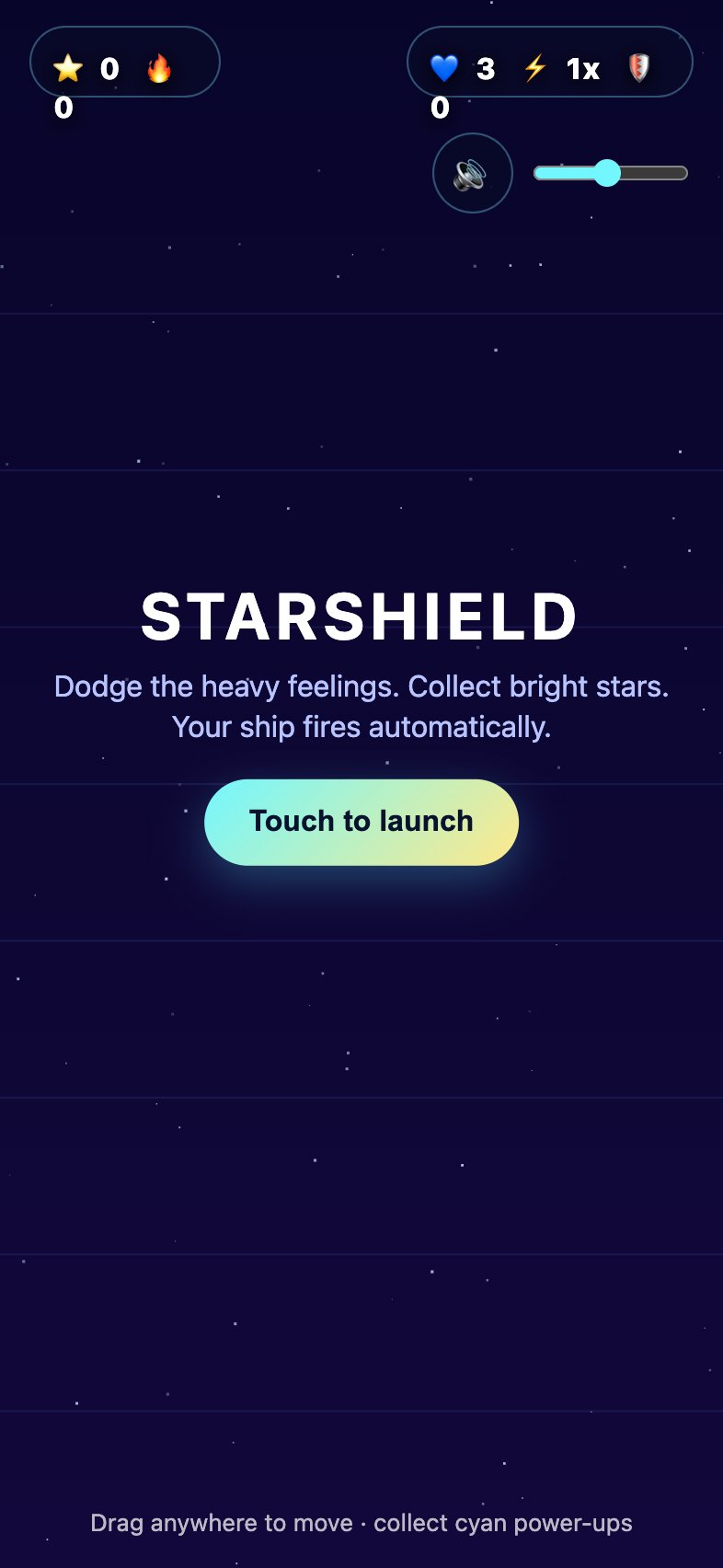
Before play, show a centered launch overlay covering the screen with a dark translucent radial backdrop. The panel is a rounded rectangle (about 430px maximum width, 88vw on small screens), dark navy with a thin blue-lavender border and soft shadow. Display the large, bold, widely letter-spaced white title “ROCKET RUN,” the subtitle “Pilot your rocket through the meteor belt. Blast asteroids, stay alive, and chase a high score.”, and a bright cyan-to-blue gradient rounded “LAUNCH” button. Clicking/tapping Launch starts or resets the run and hides the overlay.

The controllable avatar is a small blue spaceship/rocket at the lower portion of the screen, centered horizontally initially, rendered as a blue sci-fi player ship sprite (a triangular fallback silhouette is acceptable if the sprite is unavailable). Its gameplay size is approximately 70x48, though it can be drawn around 90x60. Move it only horizontally, clamped to the screen with left/right movement. Support keyboard A/D and Left/Right arrows; hold Space to fire. On touch devices, show two translucent rounded arrow buttons (left and right) at the lower left and a star/fire button at the lower right, and make them work as hold controls. Display the hint “Move with A/D or ←/→ · Fire with Space” along the bottom on non-touch devices.

Continuously spawn irregular gray-blue outlined asteroids at random horizontal positions just above the top edge. They descend toward the player with a base vertical speed of 90–175 pixels/second plus 8 pixels/second per level, and a small random horizontal drift that reverses when an asteroid reaches a side boundary. Asteroids are jagged nine-sided rocks with darker crater-like details, rotate while falling, and have random radii from 16 to 44 pixels. Large rocks (radius over 34) have 2 hit points; smaller rocks have 1. Spawn roughly every 0.72 seconds initially, becoming faster with level, but never more often than every 0.28 seconds.

When firing, emit a narrow bright green/cyan laser upward from the ship’s nose, around 8x26 gameplay size (or a matching laser sprite), at 720 pixels/second. The ship can fire repeatedly while Space or the touch fire control is held, with about 0.18 seconds between shots. A laser hit occurs when the projectile is close to an asteroid (simple axis-aligned distance checks are sufficient). Remove the shot and reduce the asteroid’s HP. On any hit, make a small yellow burst; when an asteroid is destroyed, add 100 points and create a larger orange explosion burst. Expired shots and asteroids that fall below the bottom should be removed.

If a falling asteroid overlaps the player’s rectangular ship area, count a collision unless the ship is temporarily invulnerable. Subtract one from the hull, play a light impact sound, and create a red burst around the ship. Give the player about 1.7 seconds of invulnerability after being hit, represented by blinking/flickering the ship. Start each run with HULL 3 and a 1.5-second initial invulnerability period. If hull reaches zero, follow the implemented arcade behavior of restoring HULL to 3 and subtracting 150 points (never below zero), accompanied by a larger cyan burst; continue the run rather than ending it.

Use a minimal HUD over the canvas: top-left bold white “SCORE 0” (updating with points) and top-right bold white “HULL 3” (updating with current hull), both with slight dark text shadow. Increase the internal level every 1200 points, which affects asteroid speed and spawn interval, but do not add a separate level indicator unless desired for internal logic. Draw particle bursts as short-lived colored circular particles with fading alpha and decelerating velocities. Include simple arcade sound effects: a quiet laser sound when firing, rate-limited so it cannot play more than about once per 90ms, and a moderate impact sound on collision; allow audio to initialize on the first launch or keyboard interaction.

The overall art direction should be clean, readable, and modern: deep space navy background, cool cyan/blue player and UI accents, pale outlined gray asteroids, vivid green laser, and orange/yellow/red particle effects. Keep the experience mouse/touch/keyboard friendly and responsive to resizing while preserving the fullscreen layout.