Arcade › StarChakra Cosmic Rally
StarChakra Cosmic Rally
How to play
Click the game above and it runs right here in your browser. No download, no installer, no account needed. Davonya built it with Cinevva, so it works on a phone or a tablet too.
Discussion
Nobody has said anything about StarChakra Cosmic Rally yet. Play it, then tell Davonya what you would add next.
Make your own game
StarChakra Cosmic Rally was built by Davonya with the Cinevva game creator: describe the game you want in chat, watch it get built, and play it in your browser minutes later.
Remix StarChakra Cosmic Rally opens the real game in the creator and forks its actual files, chat and design doc, so you start from the code rather than from a description.
Read the build brief for StarChakra Cosmic Rally
Cinevva's analyzer read this game's design doc and its source, then wrote the brief below. "Make your own" hands it to the game creator as your opening message, so you start from a real spec rather than a one-line idea.
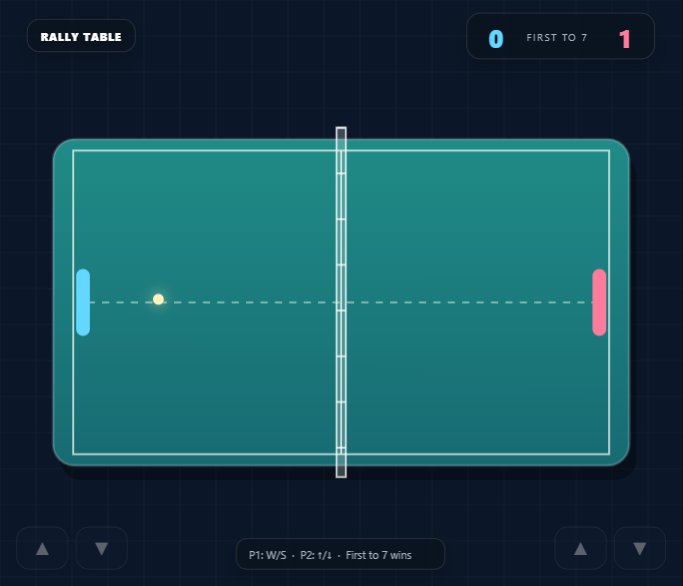
Create a responsive browser arcade game titled “Rally Table,” a neon minimalist two-dimensional table-tennis/pong game. Use a full-screen dark navy interface with a subtle 40px square grid, a soft blue radial glow near the top, and a canvas centered behind the UI. The playfield is a rounded-rectangle teal/cyan table with a vertical center line, a white inset perimeter, a faint dashed horizontal center marking, and a translucent narrow net extending slightly above and below the table at the exact center. Add a dark shadow offset down-right behind the table. The table should preserve roughly a 1.62:1 aspect ratio, be centered on screen, and size responsively up to about 900px wide and 64% of viewport height.

The game has two slim glowing paddles: Player 1 on the left in bright cyan, Player 2 on the right in bright pink. They move vertically only and are positioned near the side edges. Render a small glowing pale-gold ball with a soft halo. Start each rally with the ball in the center, moving randomly left or right with a small random vertical velocity. The ball bounces off the top and bottom boundaries. A paddle can return it when it reaches approximately 9% from the corresponding side and is vertically within about 0.105 normalized table height of the paddle center. On a hit, reverse horizontal direction, increase its horizontal speed by about 4.5%, and adjust vertical velocity according to the offset between ball and paddle, clamped to a playable range; increment a rally counter and play a short electronic hit tone. If the ball travels beyond either side, award the point to the opposite player. A point resets the ball and starts another countdown. First player to reach 7 points wins.

Provide a top HUD over the canvas: on the left, a rounded dark translucent badge reading “RALLY TABLE” in spaced uppercase lettering; in the center, a rounded dark score card showing the cyan Player 1 score, the label “FIRST TO 7,” and the pink Player 2 score; and on the right, a rounded “Pause” button. At the bottom, show the hint text “P1: W/S · P2: ↑/↓ · P: Pause · First to 7 wins.” Add touch controls near the bottom: two dark rounded buttons with cyan ▲ and ▼ on the lower left for Player 1, and matching pink ▲ and ▼ buttons on the lower right for Player 2. Hide the right-side touch controls in Human vs Computer mode.

On initial load show a centered dark translucent rounded menu modal titled “Rally Table” with the subtitle “Choose how you want to play,” a “COMPUTER DIFFICULTY” style label, a select dropdown defaulting to “Normal computer” with Easy, Normal, and Hard computer options, and two side-by-side buttons: cyan-accented “Human vs Human” and pink-accented “Human vs Computer.” On small screens stack the mode buttons vertically. Starting a match hides the menu, resets both scores and paddle positions, and shows a centered countdown card displaying 3, then 2, then 1, followed by “GO!” before play begins. Use short synthesized arcade tones for countdown, paddle hits, wall bounces, scoring, and victory when browser audio has been activated by interaction.

Controls: Player 1 uses W to move up and S to move down; in two-human mode Player 2 uses ArrowUp and ArrowDown. The on-screen touch buttons should behave as held controls while pressed. Press P or the Pause button to pause/unpause, with a centered “PAUSED” card and the text “Press P or Resume to continue,” plus a Resume button. When a player reaches 7, stop play and show a centered winner modal such as “PLAYER 1 WINS,” with “Play another match or change the mode,” and buttons “Rematch” and “Change mode.” Rematch restarts the same mode and difficulty; Change mode returns to the initial menu.

For computer mode, have the computer paddle track the ball only when it is on its half (ball x greater than roughly 0.52), moving toward the ball’s vertical position with a small sinusoidal error. Difficulty should affect computer movement speed and error: Easy speed about 0.38 with error 0.12, Normal speed about 0.62 with error 0.055, and Hard speed about 0.9 with error 0.018. Clamp both paddles between roughly 8% and 92% of table height. Keep the visual style polished and restrained: rounded translucent navy panels, thin low-opacity borders, cyan/pink player glows, gold status text, high-contrast white typography, soft shadows, and no extraneous gameplay objects.