Arcade › Neon Smash
Neon Smash
How to play
Click the game above and it runs right here in your browser. No download, no installer, no account needed. kellen.lenzt0 built it with Cinevva, so it works on a phone or a tablet too.
Discussion
Nobody has said anything about Neon Smash yet. Play it, then tell kellen.lenzt0 what you would add next.
Make your own game
Neon Smash was built by kellen.lenzt0 with the Cinevva game creator: describe the game you want in chat, watch it get built, and play it in your browser minutes later.
Remix Neon Smash opens the real game in the creator and forks its actual files, chat and design doc, so you start from the code rather than from a description.
Read the build brief for Neon Smash
Cinevva's analyzer read this game's design doc and its source, then wrote the brief below. "Make your own" hands it to the game creator as your opening message, so you start from a real spec rather than a one-line idea.
Recreate a browser-based 2D neon platform fighting game titled “Neon Smash.” Use a full-screen HTML canvas with a responsive dark sci-fi presentation and an HTML overlay UI. The game opens on a character/stage selection screen: large spaced uppercase “NEON SMASH” heading, subtitle “Pick a fighter, a stage, and whether P2 is a CPU. Launch rivals off the arena.”, dark translucent rounded panel, cyan/pink/gold neon accents, and compact illustrated fighter tiles. Let the user choose P1 or P2, enter nicknames up to 12 characters, toggle P2 as a CPU, select CPU level (Rookie, Rival, Elite), choose 1–10 stocks (default 3), randomize fighters and stage, swap fighters, and confirm characters before choosing a stage. Include keyboard character-grid navigation: WASD for P1 selection and arrow keys for P2 selection. Show two selected-fighter banners with fighter name, role, description, nickname, and human/CPU status. Stage selection includes Skyline, Quarry, Frostline, Sun Temple, Reactor, Gyro World, and Lava Cave, each with a colored thumbnail and hazard description. Provide a loading/matchup screen with large P1-vs-P2 portraits, fiery “Loading” presentation, then enter the match.

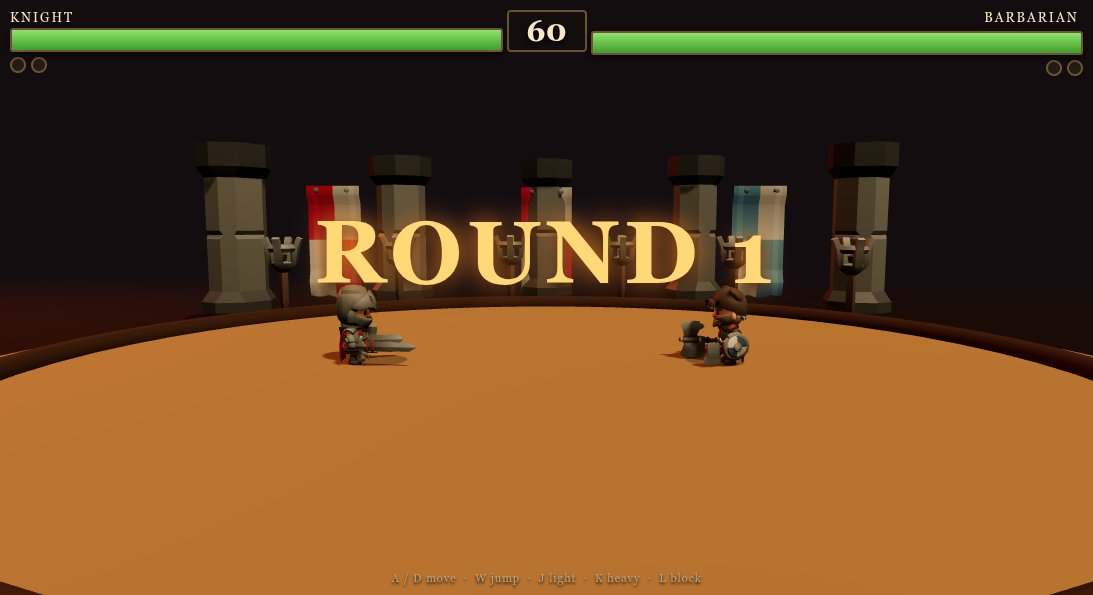
The core game is a two-dimensional local platform brawler viewed side-on with no camera scrolling: characters fight inside the full viewport arena and are knocked out by reaching 115% damage or falling beyond the arena. Each fighter has stocks, a damage/KO percentage, health-like shield, attacks, cooldowns, and a chargeable one-use super. Place several floating platforms plus a wide bottom platform. Platforms have dark navy bodies, bright stage-colored top edges, outlined panels, and some platforms bob or drift; Gyro World also slowly rotates its platform arrangement. Characters accelerate left/right, face the direction of travel, jump, fall with gravity, land on platforms, and use attacks to deal damage and knockback. Use bright particles, trails, hit flashes, screen shake, sound effects, and short slow-motion/zoom emphasis for supers. Falling or KO’d players spin and burst into particles, lose one stock, and respawn at their starting side with brief invulnerability; the match ends when one player has no stocks, then show a Victory result screen naming the winning fighter, stage, and KO threshold, with Rematch and Character/Stage Select buttons.

Controls during battle: P1 uses A/D to move, W to jump, S to hold shield, F light attack, G heavy attack, H special, T extra, and V to activate a ready super once. P2 uses Left/Right arrows to move, Up to jump, Down to shield, J light attack, K heavy attack, L special, U extra, and I super. R restarts the battle. Shield is a visible colored arc or, for Unicorn, a fluffy cloud-like bubble; it drains while held, absorbs damage, briefly parries attacks at shield startup and can reflect projectiles, breaks at zero and stuns the player, and slowly recharges after a delay when not used. Breaking destructible arena props restores some damage and recharges the shield. Display both HUD fighter panels at the top corners with nickname/name, damage percentage, stock icons, shield/super state, and the center cooldown indicators; show a bottom control hint.

Implement these fighters with distinct color palettes, silhouettes, attacks, and descriptions: Gunner (cyan, ranged control: blasters, mines, rail bursts; shoots blasters, heavy shots and a multi-shot/rail super beam); Brawler (coral, power bruiser: heavy punches and shockwaves; jumping punches and shockwave super); Fencer (lavender, precision duelist: lunges, ripostes, crescents; fast lunges, temporary powered slash super); Mage (purple, arcane caster: orbs, blink magic, starfall; magic projectiles, blink heavy, falling star/rain super); Spear (green, reach fighter: long pokes and spinning sweeps; long spear attacks and huge spear super); Astra/Lightning (yellow, lightning god: thunder dashes and sky bolts; lightning attacks and targeted thunder super); Slugger (orange, diamond bruiser: throws baseballs and swings a heavy bat; baseball projectiles, bat lunges, and powerful hit super); Strongman (brown, boulder titan: throws boulders and crushing punches; large bouncing boulders, heavy punches, massive-boulder super); Unicorn (pink/purple, rainbow mystic: rainbow beams and fluffy cloud shields; rainbow projectiles and cloud shield visual); Robot (light cyan/steel, lock-on machine: guided missiles and electrocute punches; homing missiles, invulnerable electric attacks and missile barrage super); Dragon Human (red/orange, skyfire brawler: infinite jumps, fire breath, dragon punches; can jump repeatedly/infinite-air-jump, uses fireballs and dragon punch, with air-time shield cost); 67 (gold/purple, number blaster: shaped like 6 and 7, firing number blasts; attacks launch “6” and “7” projectiles); Among Us (red imposter with blue visor, blaster shots, knife stabs, and a giant tongue super; use the recognizable rounded imposter silhouette).

Give each fighter a simple stylized canvas-rendered body: colored head and torso, dark outline/base, fighter-specific props such as guns, sword, spear, bat, robot antenna, dragon horns, imposter visor, or the visible “6 7” glyphs. Use fighter-specific neon colors and small iconography. Build destructible stage props such as antenna structures, crates, crystals, urns, reactor cells, or rings; props can be struck, knocked, rotated, and broken, and breaking one produces a white burst plus a shield reward.

Stages should share a dark gradient background and glowing geometric art but have distinct palettes and hazards: Skyline is blue/pink with moving skyline buildings and drifting drone mines; Quarry is brown/orange with angular rock silhouettes and falling rocks; Frostline is blue/cyan with icy particles and falling icicles; Sun Temple is purple/gold with shrine/temple shapes and solar bursts crossing the arena; Reactor is near-black/green with circular energy motifs and sweeping energy pulses; Gyro World is purple/cyan with concentric orbit rings, slowly rotating platforms, and an orbiting hazard; Lava Cave is dark red/orange with a glowing lava floor, three geyser positions and a timed lava wave that sweeps the left side, with geyser and wave timing visibly represented through the arena art. Use glowing outlines, particles, geometric silhouettes, and stage-color lighting rather than detailed painted backgrounds.

Add simple synthesized audio through the Web Audio API: looping low-fi electronic notes during play and distinct tones for selection, jumping, hits, specials, shield charge/break, zap, falling, and victory. Maintain polished responsive layout: on narrow screens reduce the selection grid to four columns and stack the player banners; use rounded translucent panels, uppercase labels, cyan focus/hover states, gold headings, and neon drop shadows. Do not add modes, characters, stages, weapons, or rules beyond this selection flow and stock-based two-player platform battle.