Appearance
Skip to content
Arcade › 2041 Command
2041 Command
How to play
Click the game above and it runs right here in your browser. No download, no installer, no account needed. Liam Schuldes built it with Cinevva, so it works on a phone or a tablet too.
Discussion
Nobody has said anything about 2041 Command yet. Play it, then tell Liam Schuldes what you would add next.
Make your own game
2041 Command was built by Liam Schuldes with the Cinevva game creator: describe the game you want in chat, watch it get built, and play it in your browser minutes later.
Remix 2041 Command opens the real game in the creator and forks its actual files, chat and design doc, so you start from the code rather than from a description.
Read the build brief for 2041 Command
Cinevva's analyzer read this game's design doc and its source, then wrote the brief below. "Make your own" hands it to the game creator as your opening message, so you start from a real spec rather than a one-line idea.
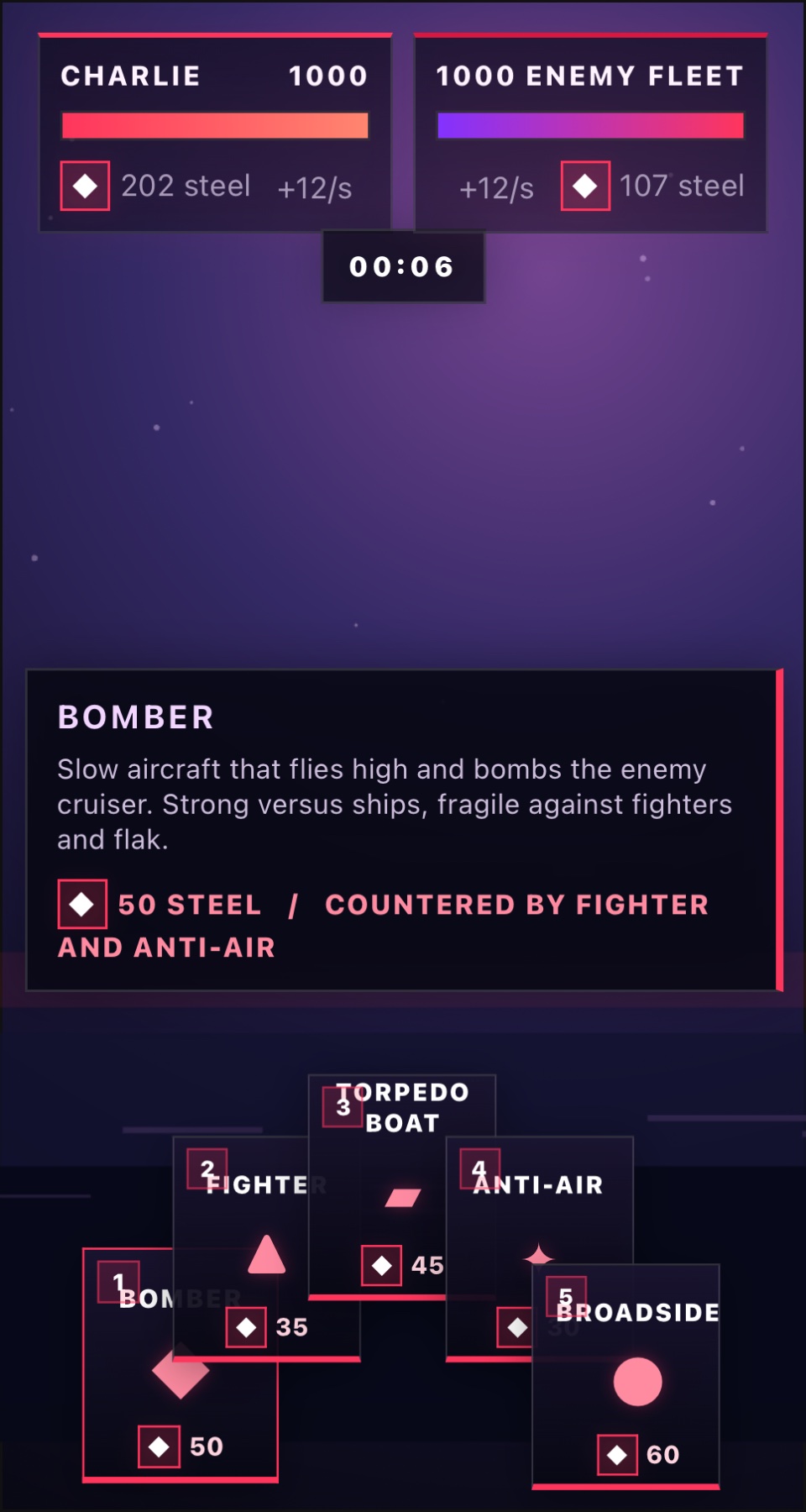
Recreate a mobile-friendly 2D real-time strategy game titled “2041 Command” using a full-screen HTML canvas with HTML HUD overlays. The game is viewed from a top-down/flat battlefield perspective: a dark futuristic gradient arena covered by a faint cyan (or map-colored) square grid, glowing horizontal lane strips, translucent rectangular obstacles, and scattered low-contrast debris. The visual style is neon sci-fi command interface: very dark navy backgrounds, cyan/teal highlights, magenta/purple or red accents, glowing outlines, compact bold HUD typography, and small illustrated SVG-like unit sprites. Use these available custom assets when possible: rifle.svg, hacker.svg, rover.svg, tank.svg, apc.svg, artillery.svg, support.svg, enemy_drone.svg, enemy_heavy.svg, base.svg, gate.svg, and node.svg; provide simple vector fallbacks if assets are unavailable.

Core gameplay: the player commands a squad in real time, builds units using energy, selects units, orders them to move or attack, captures energy nodes with Hacker Infantry, and survives progressively larger enemy waves while protecting the friendly base. Start each mission by placing its predefined starting units near the friendly base and spawning enemy wave 1 near the red breach gate. Energy increases continuously over time, captured nodes provide additional energy income, and destroyed enemies award energy. The player has a unit cap of 18. Enemies either attack nearby player units or advance toward the base and damage it when they reach it. Player units automatically acquire and fire at enemies within their weapon range, while selected units can be manually moved or given an attack target.

Player unit types and exact roles/feel: Rifle Infantry is inexpensive anti-drone infantry (cost 20, 55 HP, speed 72, range 92, damage 8, attack interval .62s); Hacker Infantry costs 25, has 45 HP and captures nodes by remaining within roughly 42 pixels of a neutral/non-player node for 2 seconds; Scout Rover costs 35, is a fast light vehicle (80 HP, speed 96, range 86, damage 10, .5s attack interval); Siege Tank costs 55, is slow and durable (150 HP, speed 46, range 128, damage 25, 1.25s interval); Hover APC costs 45 (115 HP, speed 62, range 105, damage 14, .9s interval); Field Artillery costs 70, is slow and long-range (95 HP, speed 34, range 188, damage 34), and must visibly fire two shells before reloading, with a short .34 second delay between the two shots and a 2.1 second reload; Support Drone costs 40, has 65 HP, moves at 86, does not attack, and repairs the most damaged nearby allied unit for 9 HP at .35 second intervals. Render health bars above every unit and a bright selection ring around selected units. Show attack lines, artillery shell/projectile arcs, impact rings, movement-order rings, and small destruction sparks.

Enemies enter from the right-side red glowing breach gate. Normal enemy drones are small, quick red/orange shapes with approximately 48 + 7 per wave HP, speed 52, range 68, and 7 damage; every fourth enemy on waves after wave 2 is a larger heavy enemy with roughly 105 + 10 per wave HP, speed 34, range 88, and 15 damage. Show enemy health bars and target them automatically when in range. The friendly base is a large cyan-glowing illustrated structure on the left side with 100 base HP; the enemy gate is a red-glowing illustrated breach structure on the right.

Implement four campaign maps, each with its own palette, base/gate placement, node positions, lanes, obstacles, starting units, starting energy, wave target, and objective:
1. Pacific Arcology: cyan/navy palette, start energy 95, starting Rifle Infantry + Hacker Infantry + Scout Rover, capture 2 nodes and hold through Wave 3.
2. Sahara Battery: warm dark brown/gold palette, start energy 110, starting two Rifle Infantry + Hacker Infantry + Hover APC, capture 1 node and survive Wave 4.
3. Orbital Port: dark indigo/purple palette, start energy 130, starting Rifle Infantry + Hacker Infantry + Scout Rover + Siege Tank + Support Drone, capture all 3 nodes and defeat Wave 5.
4. Hammerfall Countdown: dark red/crimson palette, start energy 150, starting two Rifle Infantry + Hacker Infantry + Hover APC + Siege Tank + Support Drone, hold off 5 waves; after the final enemies are destroyed, trigger an orbital bomb sequence instead of a normal victory. Show a red-tinted screen, an expanding warning circle centered in the arena, “BOMB INBOUND,” and a countdown of about 2.8 seconds, then destroy all units/enemies, neutralize nodes, create a large radial explosion of sparks, and complete the mission shortly afterward.

Use map layouts based on normalized positions: bases around x=.15-.18 on the left and gates around x=.82-.86 on the right. Place three possible energy nodes across the center/right of each map. The first map uses nodes around (.39,.29), (.55,.62), (.68,.34); the second around (.43,.43), (.58,.26), (.65,.69); the third around (.36,.27), (.52,.52), (.69,.32); and Hammerfall around (.36,.28), (.50,.64), (.68,.35). Nodes are glowing diamond-like structures, initially neutral, and become green-glowing/player-controlled after a Hacker has stayed nearby long enough. Include translucent glowing lanes and several rectangular obstacle/debris areas unique to each map.

Controls must work with mouse and touch/pointer input. Tapping a unit selects it; tapping an already selected unit deselects it. Dragging on the battlefield creates a translucent cyan selection rectangle and box-selects units inside. Tapping empty ground moves all selected units there in a loose grid formation while staying inside battlefield bounds; show a pulsing destination ring. Tapping an enemy while units are selected issues an attack order. Include a “Select All” button and a “Hold” button above the bottom dock; Hold stops selected units at their current positions and clears their targets.

HUD layout: add a fixed top bar with the title “2041 COMMAND,” a small futuristic subtitle, and compact statistic pills showing Energy, squad count/cap (such as 4/18), Wave, and Base HP. Add a selection information card near the upper left showing “No squad selected” and concise instructions when idle, or the selected unit/type summary and artillery loaded/reloading status when selected. Add a mission panel near the upper right showing current mission/map name, objective, captured-node progress where applicable, and Restart plus Next Map campaign buttons. Add a temporary centered toast for events such as energy shortages, deployments, node capture, attack orders, enemy wave detection, base loss, mission completion, and the orbital bomb.

Place a bottom command/build dock designed for phones. It must show all six buildable unit buttons without swiping in a 3-column by 2-row grid on narrow screens and one six-column row on wide screens. Each button includes its unit icon, name, and energy cost; disable buttons when energy is insufficient, the unit cap is reached, or the mission is over. Above the dock provide thumb-reachable floating command buttons for Select All, Hold, and Hide UI. Hide UI should remove the build dock and campaign command row while leaving a small Show UI button available to restore them. Respect safe-area insets and prevent accidental page scrolling/selection on touch devices.

Mission rules: wave 1 begins immediately; later waves begin when the previous enemies are mostly cleared and a timer expires, with wave counts increasing by mission. A normal mission is won once its required nodes are captured, its target wave has been reached, and all enemies are gone. Losing the base ends the mission and displays “BASE LOST” with a prompt to restart. Winning displays “MISSION COMPLETE” and enables/tells the player to use Next Map; after the final map say the campaign is complete but allow replay. Keep the simulation real-time with a capped frame delta, continuous movement, cooldown-based attacks, repair, energy generation, visual projectile/particle effects, and responsive resizing of the canvas/HUD. Do not add unrelated mechanics, inventories, terrain elevation, or multiplayer; preserve the focused four-map squad-command prototype feel.