Which games people ask an AI to clone
We counted requests for existing games in 8,801 first messages to our game creator, then looked at what a tool rule and a store review can each catch.
Digital Sun, the studio behind Moonlighter, was ten days from opening the first Steam playtest of its new game ReVamp to tens of thousands of players when it moved the test to Discord. Its October 19 announcement pointed to recent news of unreleased games being reverse-engineered and cloned, with the copy published first. The studio hopes to open a public playtest around January, and it asked platforms to do more to protect original work.
ReVamp's playtest trailer, starting at the in-game footage (0:38). Video by Digital Sun Games.
Three days earlier, Alliance Arts had canceled the public demo of Drunken Goddess Reflux in favor of closed sessions. One of its two reasons was that imitations could be produced quickly with AI or other tools and released before the game. Inven Global reported that the two-person Korean team YNOT pulled the demo of its cooking game Spookitchen after being told someone was cloning it with AI. Inven also reported developers receiving emails that demanded payment under the threat of an AI clone released first, though none of the reports we cite describes a clone that followed such a threat.
Official second trailer for Drunken Goddess Reflux. Video by Alliance Arts.
Official trailer 0.2 for Spookitchen. Video by YNOT.
Anthropic and Valve both responded in the last week of October. Anthropic added two sentences to Claude Code's instructions. An X user posted the wording and Game Developer relayed it. The sentences told Claude Code to keep building original games and genre games, and to refuse a recreation of a specific existing game "even if it is renamed or called original." Anthropic's Addy Osmani confirmed the change on October 30 and cited the company's policy against IP infringement. Valve's Tom Giardino took questions at a Steam Indie Connect event in South Korea, where he said Steam doesn't want to be a gatekeeper over the tools developers use. We have his answers from GamesRadar's account of Inven Global's translated report.
About one in eight first messages asks for an existing game
Our game creator is a chat box that builds a browser game. We took the first message of every chat transcript we store, from late January to November 26. After removing our own accounts, test runs, remixes and chats that don't open with a usable typed message, 8,801 messages were left. That is more than the 6,876 saved games in our November 25 post, because it also counts chats that never became a saved, titled game and games deleted since. The messages come from about 4,400 accounts, plus 1,656 chats with no account attached.
We matched each message against a list of 160 well-known games and franchises, and 1,260 matched, about one in seven. An AI assistant then labeled a random 100 of the matches in a single pass, with no second reader. Of the 100, 87 asked for the named game or for something modeled on it, 11 were false matches and 2 couldn't be judged. That puts real requests at about one in eight. The list misses smaller games and many non-English spellings, so the true share may be higher.
Three names account for 42% of the matches: Grand Theft Auto with 207, Roblox with 174 and Minecraft with 156. Five Nights at Freddy's, Pokémon, Mario, Call of Duty and Fortnite follow with between 42 and 48 each. Fourteen messages were the single word "minecraft" and fourteen were "gta". Of the 87 genuine requests in the sample, 36 asked for the game itself, some with the words clone, copy or exactly. The other 51 used the title to describe a kind of game.
Games and franchises matched most often in first messages
Messages matching each name, out of 8,801
None of the 8,801 messages asks for ReVamp, Drunken Goddess Reflux or Spookitchen. Our count comes from a chat box that builds small browser games, so it can't tell us what someone does with a coding agent and a downloaded build.
Our instructions, and how often the original's name survives
Since June, our instructions have told the model to answer these requests by building an original, playable slice of the fun part, such as the driving, the mining or the shooting, under a name of its own, and to say in one sentence that it can't deliver a one-to-one clone. That paragraph is mostly about what one chat turn can build. An instruction from May says the model can't ship a game's exact assets and may use a similar art style.
Across every game we checked only the title, so we can't say whether any of them copies a character or a level. Of 801 titled games built from these requests since June 18, 26 still carry the original's name, about 3%, and users can also set a title themselves. Before that date it was 5 of 152, which is too few to tell whether the instruction changed anything.
Anthropic loosened its rule after a week
On November 4, Osmani said the rule had also been triggering when people named a game only to describe the mechanics they wanted, as Tom's Hardware reported. Since the update, naming a game gets an original game in that genre and asking for a copy gets an offer to build something similar, which is close to what our instructions ask for.
We think the line is in the right place. The US Copyright Office's page on games says copyright doesn't protect the idea of a game or the method of playing it, while parts with enough expression, such as artwork and rules text, may be protected.
Osmani wrote that Anthropic wants the rule "to protect your work if someone else tries to copy it." We doubt it protects the studios that changed their plans. Tom's Hardware reported that Claude Code also began refusing reverse-engineering work at the end of October, and that one developer carried on by switching to an older model. Users, according to Game Developer, pointed out that open-weight models have no such rule.
What a store review could catch
We build with AI ourselves, and we agree with Valve that a store shouldn't decide which tools a developer may use.
Two of the cases Inven Global described are about listings. Needle In A Haystack Simulator saw at least eight titles with similar names and concepts appear before its release, and its developer responded by adding the word "ORIGINAL" to its own store images. A game called Family Time found a second Family Time listed ahead of its release with a similar description and page layout.
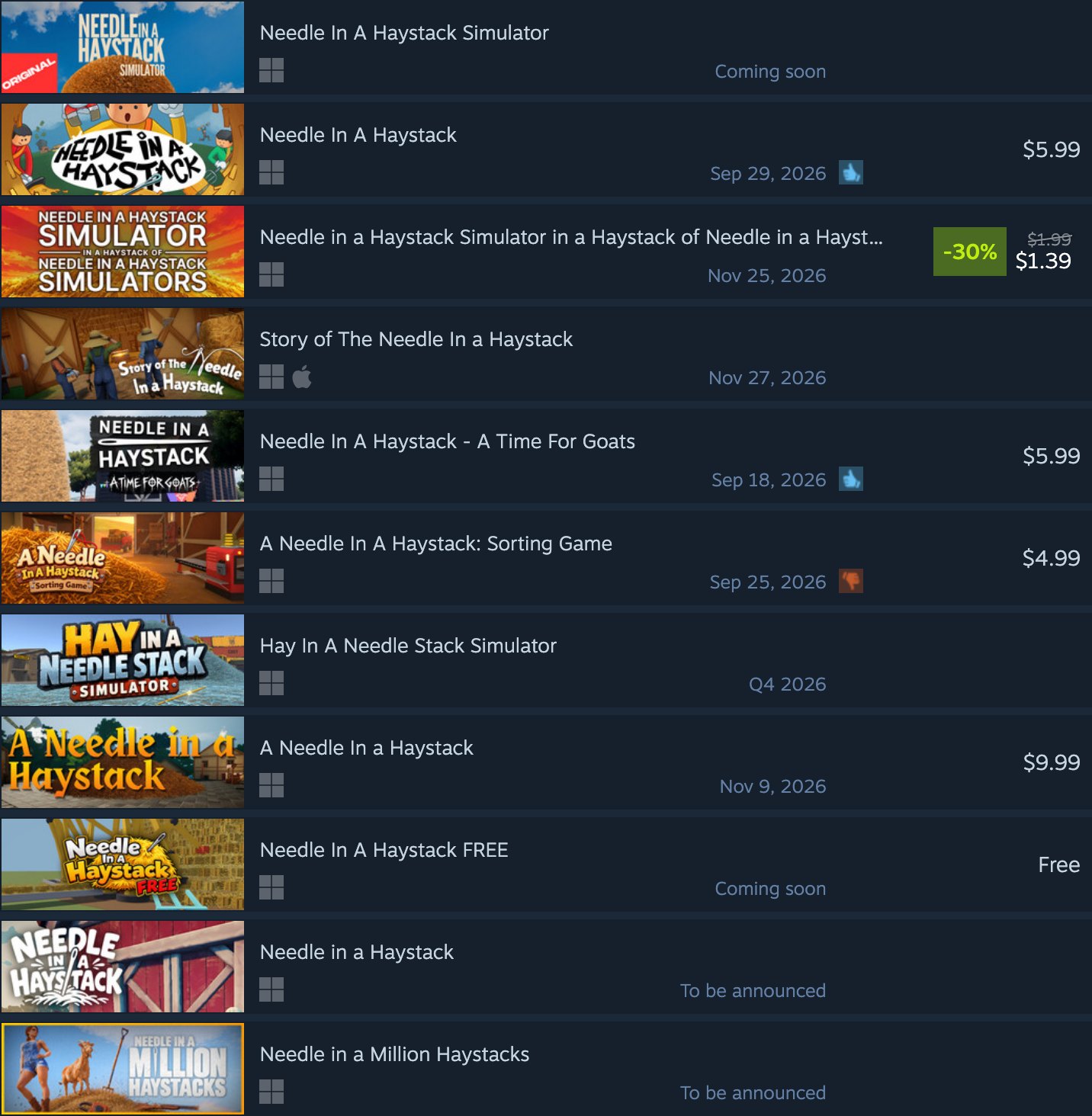
The Copyright Office page says copyright doesn't cover a game's name or title either. A lookalike name is about trademark and about confusing buyers, and the store shows them both pages. It knows which page went up first and reviews pages and builds before release, whereas a complaint can come only once a page is up.
Giardino asked developers to send clone threats to Valve and advised growing a game beyond any single mechanic that's easy to copy. Asked about AI copies surfacing during Next Fest, his colleague Marc Wilkinson said many people at Valve are thinking about how to solve it.
Copying a mechanic is legal, and it's how genres form, so our argument stops at the page. Valve's November 3 update to its pre-release review doesn't mention comparing a new page with earlier ones, and the listings Inven described got through. That comparison would catch a lookalike page but would miss a game rebuilt from a demo and released under a different name, and there a studio's defense is still keeping the build private. It would also add work to a review that the same update says is running up to 12 business days.
Our own Arcade makes no such comparison. It lists a published game unless a moderator or an automated screen for gibberish, placeholder titles and abusive content rejects it. This week we matched the Arcade's roughly 6,700 titles, and only the titles, against our list of 160, and 45 matched, a few of them loosely.
Related:
- The AI Scarlet Letter: our July case for games without a storefront gate, which we narrow here
- Unreal's upgrade path is an AI now: three different rules for AI-assisted code in one month
- One in three new Steam games now discloses AI: the census behind Steam's release growth
- What 2,200 games at Steam Next Fest tell you about discovery: what a public demo is worth to a small studio