Unreal Engine 6 drops Blueprints and makes AI the upgrade path
By Oleg Sidorkin, CTO of Cinevva
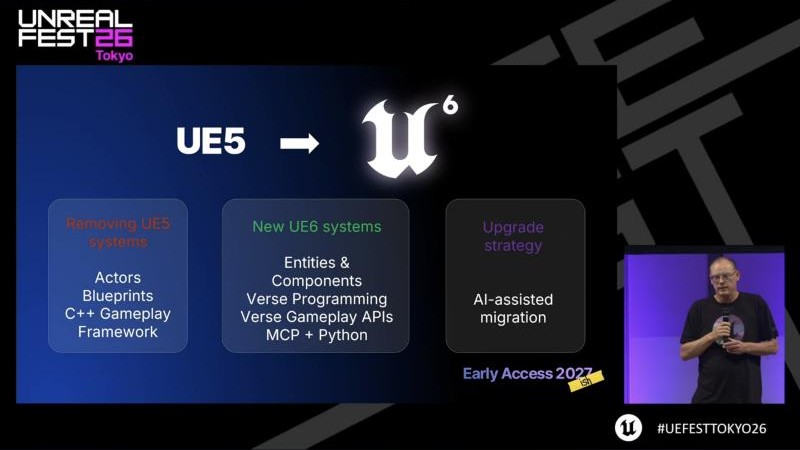
On November 20, Epic's Marcus Wassmer posted that "UE6, including UE6 Early Access, won't include Blueprints or the Actor Gameplay Framework." Gameplay will be written in Verse on a new Scene Graph framework. In June, Epic had said Blueprints would stay in UE6 alongside the new framework so projects could move over gradually. The reason given for the change is AI, which Epic now expects to do most or all of the conversion from UE5.
The evidence Epic offers is Fortnite. Two weeks before the post, the team tried converting every Battle Royale Blueprint with AI. A job Epic had expected to take years produced what it calls "a working prototype" of the game, about 3 million lines of Verse from more than 20,000 Blueprints.
The Unreal Fest Tokyo keynote, starting where Sweeney announces the change (19:19). Video by Unreal Engine JP.
Eight months from startup idea to Unreal's roadmap
In March we wrote about three small engines designed for AI agents, with text scene formats, MCP interfaces and no visual editor. We predicted those ideas would "get absorbed into mainstream engines within two years." It took eight months. Tim Sweeney gave the reason on stage in Tokyo on November 3. Epic had found AI far more productive with text-based code than with Blueprints, and he apologized to the developers who love them. His slide lists MCP and Python among the new UE6 systems and names AI-assisted migration as the upgrade strategy. Epic's post lists "AI operability" among UE6's four design goals. The 5.9 preview that shipped on November 9 adds wider Python access to the editor, MCP improvements and an experimental web target, and Epic says much of that release was built with AI agents.
We think the direction is right, and we build the same way. Our game creator is an agent working through typed tools, with a small state contract on every game so it can inspect and change a running build. The web target also matches what we argued in May. Unreal moved HTML5 export out of the engine in 4.24, and it has an official browser target again, on WebAssembly and WebGPU.
What the 13x figure covers
Epic's cost argument is that the price of any given AI task has been falling "13x year over year" while the complexity of converting a game stays about the same. The figure matches Epoch AI's September report, which found the cost of a given level of AI performance dropping about 47% per quarter since 2023. The same report found that the decline slows for any fixed level of capability, from 75x a year when that level first appears to 4.7x a year two years later. Epic expects the trend "to continue and to accelerate."
That curve prices the writing of Verse. Right after the Fortnite numbers, Epic says the team is still validating the result for performance, memory usage and architecture.
In our experience that remaining part is where the cost sits. People have started 6,876 games on Cinevva by typing into a chat box, and some of the worst failures were ones nobody could see in the code. One generated game ran at 316 milliseconds a frame. The model had put a point light inside a prop's constructor, the world reused that constructor, and the scene ended up with 102 lights. Keeping the 7 in range brought the frame to 6.7 milliseconds with no visible difference. The source read fine and the screenshots looked right. We found the cause by measuring the running game.
Inverted cameras and controls were the most common complaint in four consecutive reviews of our chat transcripts through July, at about a quarter of the problems we logged. In July we moved that code into a runtime library the model imports, so it no longer writes the sign conventions itself. We also probe each game's light count, draw calls and triangles when the model declares it ready, and we return the readings to the model. Our own loop still has the gap we're describing. The model that writes the code is also the one that reports it works.
Verse is also new to the models. Sweeney wrote on X that today's leading models saw little of it in training and that he expects this to change by January.
What Blueprints gave designers
Former Valve writer Chet Faliszek, whose team is staying on UE5, described the loss in a video. Blueprints, he said, created a middle level of skill between everyday users and expert engineers. They let designers and artists reach deep parts of the engine inside limits the engineers set. Without them, a designer either writes Verse or prompts for it, and in his words loses "that determinism from game design."
"Goodbye Blueprints, Hello Verse AI!" by Chet Faliszek, quoted via PC Gamer.
Sandfall has said Clair Obscur: Expedition 33 was "95 percent built" with Blueprints, according to Game Developer. Epic's post describes what replaces Blueprints for writing gameplay. It doesn't describe what a designer will read in their place.
We see this from the other end of the skill range. Many of the people building on Cinevva are students and first-time creators, and for them a chat box is an easier first step than a node graph. Chat on its own doesn't give them the determinism Faliszek describes. In our product we had to add it back as libraries the model must import and checks whose results it receives. UE6 will need its own version of that layer.
Three rules for AI-assisted code
Earlier this month, 19 jurors for the Independent Games Festival said they wouldn't vote for any game that uses generative AI, as Kotaku reported. House House then disclosed that LLMs had helped with bug fixing late in Big Walk's development, touching by its estimate well under 0.1% of the code. Its statement gives one example, a shadow-culling fix of about ten lines in Unity's render pipeline. The studio added that Steam doesn't ask about code or chatbot use, which has been Valve's rule since January.
Within one month, AI-assisted code of this kind fell under three different rules. Steam doesn't ask about it. A group of festival jurors won't vote for a game that contains it. Epic expects it to be how Unreal projects reach the next engine. In July we wrote that AI is welcome at the tooling layer because "nobody outside the studio ever sees it." That no longer holds.
PC Gamer reports that Freshly Baked Games, the studio behind Queen's Domain, plans to change engines for its next project because of Unreal's AI direction. It's the first case we've seen of a studio choosing an engine over AI policy.
What this means if you're building
Engine choice now carries a position on AI. A studio that wants to tell a jury or its players that no generative AI touched its game can stay on UE5, which Epic says it will keep developing, or move to an engine like Godot, whose project has required human-authored contributions since July. A studio that moves to UE6 should expect an AI-assisted port and budget for validation as the main cost.
Write the AI usage policy before someone asks for it. House House called the lack of one a failure, and its disclosure reached the public through a jury dispute.
If you already build with an agent, put instruments on the running game and give the agent the readings. Reading the generated code didn't reveal either of the problems above.
Related:
- AI-native engines are shipping: the March prediction this post checks
- The AI Scarlet Letter: the line between tooling and storefront that Big Walk moved
- The browser is a shipping target now: the case for a web target, six months before Unreal shipped one
- Anatomy of an AI game engine: the tools and state contract behind our agent
- Create a game: describe a game in chat and play it in the browser