Best Open-Source Generative AI Models for Games (2026)
Last updated: September 2026.
Here's the thing about generative AI. For years, the best models lived behind API keys and unpredictable pricing. You'd build your workflow around a tool, get comfortable, then wake up to an email saying the pricing changed. Or worse, the company pivoted entirely.
That changed in late 2024. Tencent, Alibaba, and DeepSeek started releasing models you can actually download. Models that rival the closed alternatives. And suddenly, creators have options that don't depend on someone else's business model.
What if you could generate video, 3D assets, music, and voices, all from models you control? That's where we are now. This guide walks through what's real, what works, and what you can start using today.
Video Generation
For years, video generation meant Runway or Pika: closed platforms, subscription fees, limits on what you could do with the output. Now? You can run comparable models on your own hardware.
HunyuanVideo text-to-video generation, 720p output from the leading open-source video model
| Model | Org | Params | Specs | Hardware | Cost |
|---|---|---|---|---|---|
| HunyuanVideo | Tencent | 13B | 720p, text+img | 80GB | ~$0.20 |
| HunyuanVideo-1.5 | Tencent | 8.3B | 480p-1080p, text+img | 14GB | ~$0.05 |
| Mochi 1 | Genmo | 10B | 480p@30fps | 12GB+ | ~$0.10 |
| LTX-Video | Lightricks | — | 768x512, real-time | 12GB | ~$0.02 |
| LTX-2 / LTX-2.5 | Lightricks | 19B (2) / 22B (2.5) | 4K, synced audio, multishot in 2.5 | High-end | ~$0.30 |
| Wan 2.1 | Alibaba | 1.3-14B | 480p-720p | 8GB+ | ~$0.03 |
| Wan 2.2 | Alibaba | 27B MoE (14B active) | 720p, MoE | 8GB+ | ~$0.03 |
| CogVideoX1.5-5B | Tsinghua | 5B | 1360x768@16fps, up to 10s | 12GB | ~$0.04 |
| SkyReels-V3 | Skywork | 14-19B | Audio-driven, ref-to-video, V2V | High-end | ~$0.10 |
| MiniMax H3 | MiniMax | 33B | 2K, 4-15s, stereo audio, up to 9 ref images | High-end | not benchmarked |
| Step-Video-T2V | StepFun | 30B | Largest open T2V, 204 frames | High-end | ~$0.15 |
| Open-Sora 2.0 | HPC-AI | 11B | Flux integration | High-end | ~$0.20 |
Weights: HunyuanVideo ↗ · Mochi 1 ↗ · Wan 2.1 ↗ · Open-Sora ↗
See samples: HunyuanVideo gallery ↗ · Mochi examples ↗ · CogVideoX samples ↗
What this means for creators
HunyuanVideo outperforms Runway Gen-3 in professional evaluations, and it's fully open. The catch? You need serious hardware. An A100 or H100 with 80GB VRAM. For most of us, that means renting cloud GPUs when you need them.
HunyuanVideo-1.5 changed the calculus on hardware. Tencent released it in November 2025 as an 8.3B-parameter open model that runs on a 14GB consumer GPU, with text-to-video and image-to-video at 480p/720p and optional 1080p upscaling. A new Selective and Sliding Tile Attention (SSTA) mechanism gives it roughly double the inference speed of the original HunyuanVideo. If you wanted HunyuanVideo quality but couldn't justify an 80GB card, this is the version you can actually run at home.
Mochi 1 is the one you can actually run. A 12GB GPU, that's RTX 3060 territory, handles it fine. The output is genuinely creative, with a distinct artistic quality. Not quite HunyuanVideo's fidelity, but you own the process.
LTX-2 is where things get interesting for games. It's the first open model that generates synchronized audio with video. Imagine cutscenes where the sound just... matches. No post-production sync. Lightricks open-sourced the full weights, inference, and training code in January 2026, with native 4K output at up to 50fps and synced audio up to 20 seconds. One license caveat: LTX-2's open weights are free for academic use and for commercial use only by companies under $10M in annual revenue, so check that threshold before you build a business on it. The current checkpoint as of September 2026 is LTX-2.5, a 22B model that adds native multishot generation (several connected shots with one character and look), a diffusion video decoder in place of plain VAE reconstruction, and a Gemma 4 12B text encoder for longer prompts, all still under the LTX-2.x Community License with the same $10M revenue line and a paid agreement above it.
SkyReels-V3 (Skywork, January 2026) is the notable newer open line. It's a unified multimodal model that does audio-driven video, reference-to-video, and video-to-video in 14B and 19B variants, so it's strong when you need a character or a reference image to drive the shot. Step-Video-T2V (StepFun) is the largest open text-to-video model at 30B and ships under a clean MIT license, worth knowing if permissive licensing matters more to you than fitting on a small GPU.
MiniMax H3 (Hailuo 3.0) is the newest open entry and the one to watch for reference-driven cutscenes. MiniMax launched it as an API on July 31, 2026 and put the 33B base weights on Hugging Face in August with two checkpoints: FL2VA for first-and-last-frame generation and Ref2VA, which takes up to 9 reference images, 3 reference video clips, and 3 audio clips (12 files total) and generates 4 to 15 seconds at up to 2K with native stereo audio. The licence is the MiniMax H3 Community License, and the model card asks users in the USA, EU, UK, and South Korea to file an application form first, so it's not a drop-in for every studio.
Wan 2.1 runs on a gaming laptop. An 8GB GPU works for the smaller variants. If you've ever wanted to prototype with video generation but couldn't justify the hardware, this is your path in.
Wan 2.2 (Alibaba, July 2025) is the first open-source video model built on a Mixture-of-Experts design: 27B total parameters with only 14B active per step. It ships as text-to-video (T2V-A14B), image-to-video (I2V-A14B), and a hybrid 5B variant that runs on consumer GPUs, all under Apache 2.0 for commercial use.
One caveat worth knowing: Wan 2.2 is still the last open Wan. The newer Wan 2.5 (September 2025), 2.6 (December 2025), 2.7 (April 2026), and now Wan 3.0 (August 2026, with 30-second single-take clips at up to 1080p and reference inputs, per Alibaba Cloud Model Studio) added synced audio, 1080p, and finer frame control but are API-only, with no public weights. The Wan-AI Hugging Face org still tops out at 2.2 as of September 2026, whatever the affiliate sites claim. If self-hosting matters to you, 2.2 is the ceiling. LTX-2.5 is the open model to reach for when you need 4K and synced audio.
The workflow that makes sense: Mochi 1 or Wan 2.1 for prototyping locally. HunyuanVideo-1.5 or LTX-2.5 on cloud GPUs when you need final quality.
Image Generation
This is where open-source already won. The models you can download today genuinely compete with Midjourney. Not "almost as good," actually competitive.
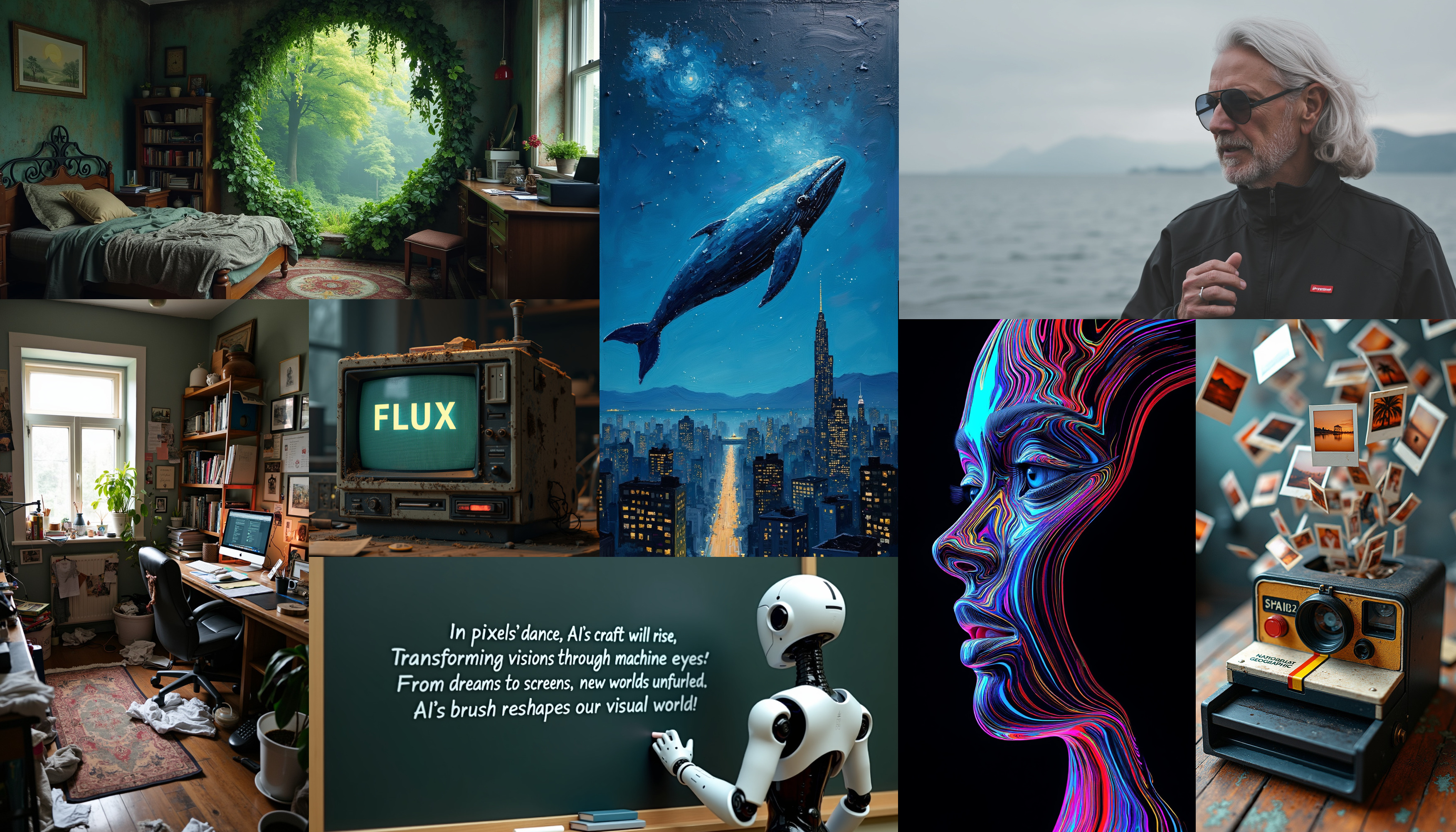 FLUX.1 samples, photorealistic quality from an Apache 2.0 licensed model
| Model | Org | Released | Params | Key Feature | License | Cost/image |
|---|---|---|---|---|---|---|
| FLUX.1 [schnell] | Black Forest Labs | Aug 2024 | 12B | 4-step generation, fast | Apache 2.0 | ~$0.001 |
| FLUX.1 [dev] | Black Forest Labs | Aug 2024 | 12B | Quality close to Pro | Non-commercial | ~$0.002 |
| SD 3.5 Large | Stability AI | Oct 2024 | 8B | Text rendering, diverse styles | Stability license | ~$0.002 |
| SD 3.5 Large Turbo | Stability AI | Oct 2024 | 8B | 4-step, fast | Stability license | ~$0.001 |
| HiDream-I1 | HiDream.ai | Apr 2025 | 17B | High quality, Full/Dev/Fast variants | MIT | ~$0.002 |
| CogView4 | Tsinghua / Zhipu | Mar 2025 | 6B | Native Chinese text, up to 2048px | Apache 2.0 | ~$0.002 |
| Qwen-Image | Alibaba | Aug 2025 | 20B | Best-in-class text rendering, editing | Apache 2.0 | ~$0.002 |
| FLUX.2 | Black Forest Labs | Nov 2025 | 32B | Text+edit, 4MP, multi-ref | dev: Non-commercial / klein 4B: Apache 2.0 | ~$0.003 |
| Ideogram 4.0 | Ideogram | Jun 2026 | 9.3B | Design work, text rendering, JSON layout control | Non-commercial | ~$0.002 |
Try them directly: FLUX.1 schnell demo ↗ · SD 3.5 Large demo ↗ · GitHub (FLUX) ↗
See samples: FLUX gallery ↗ · FLUX LoRA gallery ↗ · Replicate examples ↗
For building game assets
FLUX.1 [schnell] is the one to know. Apache 2.0 license, meaning you can ship commercial games without worrying about licensing drama. It generates in just 4 steps, so you can iterate fast. Describe what you want, see the result, adjust, repeat.
SD 3.5 Large finally handles text rendering properly. Previous versions mangled any text you tried to include. This matters for UI mockups, in-game signage, title screens, anywhere you need readable words in your images.
FLUX.2 (Black Forest Labs, November 2025) is the bigger successor: a 32B model that handles text-to-image and image editing in one checkpoint, with strong multi-reference character/style consistency and reliable text rendering at up to 4 megapixels. The open-weight FLUX.2 [dev] uses a non-commercial license, but the size-distilled FLUX.2 [klein] (January 2026) ships its 4B version under Apache 2.0, generates in under a second, and runs in about 8GB of VRAM, so there's still a commercial-safe option for shipping game art. Grab the 4B klein specifically: the larger klein 9B stays under the non-commercial FLUX license. Quantized pipelines bring [dev] down to 18-24GB GPUs. Black Forest Labs' next generation, FLUX 3, is a joint image, video, and audio model announced July 23, 2026, and as of September 2026 it's API-only: video with synced audio went live as a preview on August 4, and the open-weight FLUX 3 Dev is "planned for later in 2026" per the BFL release notes. Until it lands, klein 4B remains the commercial-safe FLUX.
Two more open options worth knowing. Chroma1-HD (8.9B, Apache 2.0) is a fully-open FLUX.1-schnell derivative, so it's the commercial-safe way to get FLUX-family quality without the [dev] license. OmniGen2 (Apache 2.0) is a unified model that does text-to-image plus instruction-based editing in one place, which is the fastest path when you're iterating on an existing asset ("make the sword glow blue") rather than generating from scratch.
Qwen-Image (Alibaba, August 2025) is the open model to reach for when your art needs readable text, like signage, UI, posters, or item labels. It's a 20B Apache 2.0 model with best-in-class text rendering and a strong instruction-based editing variant, so it's commercial-safe and unusually good at the thing most image models still fumble. The December 2025 refresh, Qwen-Image-2512, sharpened human realism and text layout and kept the Apache 2.0 license, so grab that checkpoint if you're self-hosting. The newer Qwen-Image-2.0 (February 2026) is API-only, and as of September 2026 the QwenLM repository still lists Qwen-Image-2512 and Qwen-Image-Edit-2511 as the newest checkpoints with public weights.
Ideogram 4.0 (June 2026) is Ideogram's first open-weight release: a 9.3B diffusion transformer built for design work, with strong multilingual text rendering and explicit layout and color control through structured JSON prompts. One catch before you build on it: the inference code is Apache 2.0, but the weights sit under a non-commercial license, so it's a research and prototyping tool unless you buy the commercial license.
The ecosystem around Stable Diffusion is still unmatched. ControlNet for precise composition. Inpainting for fixes. LoRA fine-tuning for custom styles. FLUX is catching up, but if you need deep customization today, SD's tooling maturity gives you more to work with.
Here's how I'd think about it: textures and sprites, either works. Concept art with specific style requirements, SD 3.5 with LoRAs. Pure quality for commercial shipping, FLUX schnell.
3D Generation
If you've ever spent eight hours modeling a prop that appears in your game for three seconds, this section is for you. 3D generation crossed from "interesting research" to a real production tool a while back, and by 2026 the open models are genuinely good. You can go from a sketch to a textured mesh in under a minute.
This page covers the open models you can self-host. If you're choosing a tool rather than a model, our best AI 3D model generators guide compares the hosted options (Meshy, Tripo, Rodin, Hi3D) against the open ones, with pricing and commercial rights on each.
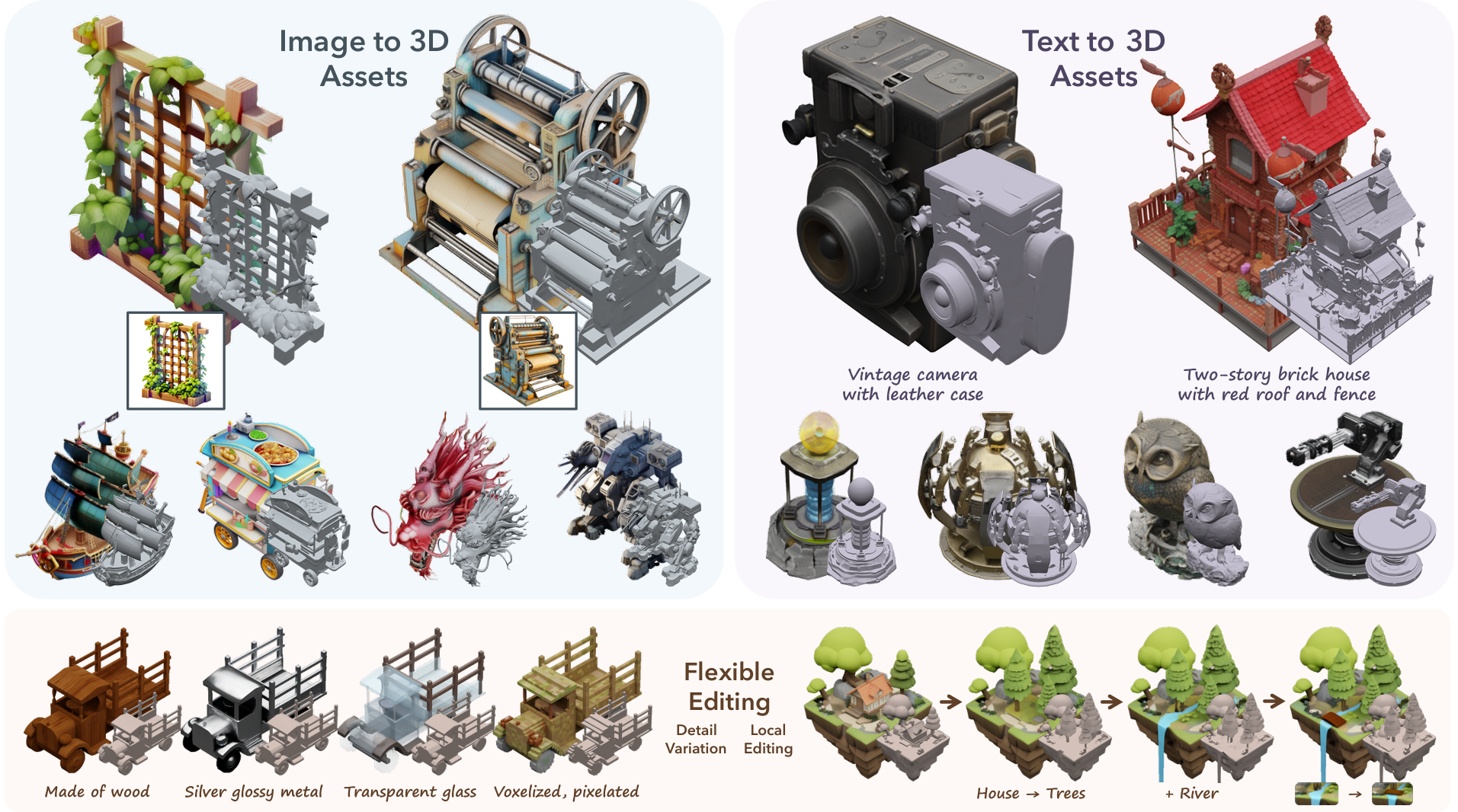 TRELLIS generates textured 3D meshes with PBR materials from single images
| Model | Org | Released | Key Feature | Output | Cost/mesh |
|---|---|---|---|---|---|
| TRELLIS.2-4B | Microsoft | Dec 2025 | 4B params, native PBR, up to 1536³ | Textured mesh with normals | ~$0.03 |
| Hunyuan3D 2.1 | Tencent | Jun 2025 | Production PBR, full weights + training code | High-fidelity textured mesh | ~$0.05 |
| SAM 3D | Meta | Nov 2025 | Single-image to 3D (objects + human body) | Mesh from one photo | ~$0.02 |
| Stable Fast 3D | Stability AI | Aug 2024 | Single image → mesh in ~0.5s | Fast textured mesh | ~$0.001 |
| TripoSG | VAST-AI | Mar 2025 | 1.5B rectified-flow shape gen | High-quality mesh | ~$0.01 |
| TripoSR | Stability / Tripo | 2024 | Fast single-image reconstruction | Mesh (no texture) | ~$0.001 |
| UniRig | Tsinghua / Tripo | 2025 | Auto-rig: skeleton + skinning weights | Rigged, animatable mesh | ~$0.01 |
Try them directly: TRELLIS.2 demo ↗ · Hunyuan3D demo ↗ · InstantMesh demo ↗
See samples: TRELLIS.2 project page ↗ · 3D AI Studio gallery ↗
A workflow that actually works
The approach that's clicking for creators right now chains models together. Start with an image, generated or photographed, doesn't matter. Run it through Stable Zero123 or Wonder3D to get multiple views. Feed those views to InstantMesh or TripoSR for the mesh. Then TRELLIS.2 or Hunyuan3D for proper materials.
TRELLIS.2 from Microsoft is the new leader for production-ready assets. It handles the geometry that breaks other models: thin surfaces, holes, complex topology. The 4B parameter version outputs meshes with real PBR textures, not just vertex colors pretending to be materials.
Stable Fast 3D is about speed. Roughly half a second from image to mesh. The mesh needs cleanup and texturing, but for prototyping? For figuring out if an idea works before you invest hours? Unbeatable. TripoSG is the step up when you want cleaner geometry from a single image.
Hunyuan3D 2.1 is the open Tencent model to use: it ships full weights and training code with production-grade PBR texturing. Note the naming, because it trips people up. Hunyuan3D 2.5, 3.0, and 3.1 all exist but are API-only, with no public weights, so for self-hosting the base generator still tops out at 2.1 (a GitHub thread asking Tencent about open-sourcing 2.5 has gone unanswered as of September 2026). If you'd rather try it than host it, our 3D generator runs Hunyuan3D in the browser. Tencent did open two useful extensions built on 2.1: Hunyuan3D-Omni adds multi-condition control (point cloud, voxel, skeleton, bounding box), and Hunyuan3D-Part decomposes a mesh into editable parts. Its license also excludes the EU, UK, and South Korea, so check terms before you ship in those regions.
SAM 3D (Meta, November 2025) is the newest way in: a single photo becomes a 3D mesh, with separate models for objects and human bodies. Combined with Meta's segmentation work, you can isolate an object in an image and reconstruct just that object.
UniRig (Tsinghua and Tripo, MIT) closes the gap everyone hits right after they have a mesh: rigging. It auto-generates a valid skeleton and skinning weights for an input mesh, so a generated character can actually be animated instead of sitting there as a static prop. Pair it with the auto-animation work in NVIDIA's SOMA-X and a fully generated, fully rigged character stops being a research demo.
Here's the realistic expectation for indie creators: generate concept art with FLUX, run it through InstantMesh for geometry, then texture in Blender or use TRELLIS for automated PBR. You're looking at 30-60 minutes per asset instead of 4-8 hours. Not zero time, but a real difference.
Audio and Music
Audio generation hasn't caught up to images and video yet. But there's enough here to change how you work, especially for prototyping and sound effects.
AI-generated music sample. Describe the mood you want, get music that fits
| Model | Org | Released | What It Does | License | Cost/30s |
|---|---|---|---|---|---|
| ACE-Step 1.5 | StepFun/ACE Studio | Jan 2026 | ~4 min music fast, 19 languages, voice clone | MIT | ~$0.02 |
| Stable Audio 3.0 | Stability AI | May 2026 | Up to ~6 min songs; open Small, Small-SFX + Medium models | Stability Community | ~$0.02 |
| YuE | MAP | Jan 2025 | Full songs from lyrics, vocals + accompaniment | Apache 2.0 | ~$0.05 |
| MusicGen | Meta | 2023 | Text-to-music, controllable | code MIT / weights CC-BY-NC | ~$0.01 |
| DiffRhythm 2 | ASLP-lab | Feb 2026 | Fast full-song generation | Apache 2.0 | ~$0.02 |
| Magenta RealTime | Jun 2025 | Real-time, prompt-steerable music | code Apache / weights CC-BY | ~$0.02 |
Try them directly: MusicGen demo ↗ · AudioCraft playground ↗
See samples: MusicGen examples ↗ · AudioGen samples ↗
What you can actually ship with
MusicGen from Meta is still a practical choice for prototyping game audio. Describe the mood you want, get music that fits, and it runs fine on a 12GB GPU. One license gotcha: the MusicGen code is MIT, but the model weights are CC-BY-NC (non-commercial), so use it to prototype and switch to a commercially-licensed model like ACE-Step or Stable Audio for anything you ship.
Stable Audio's open sound-effects model (Small-SFX) handles footsteps, door creaks, ambient wind, and mechanical sounds, runs locally, and ships under Stability's community license, so it's the open SFX option to reach for when you need sounds you can actually use commercially. It's the one to pick because the other open SFX models come with strings: Meta's AudioGen is CC-BY-NC and TangoFlux is under Stability's non-commercial community license, so both are prototype-only for a shipped game.
Magenta RealTime (Google) is the odd one out in the best way: it's the only open-weights model built for real-time, continuously prompt-steerable music. Instead of rendering a finished track, it generates music live that you can steer as it plays, which is exactly the shape of an adaptive game soundtrack that shifts with what the player is doing. The code is Apache 2.0 and the weights are CC-BY, both fine for commercial use.
YuE is genuinely exciting. It's the first open model that generates full songs with vocals. Theme songs. Background music with actual singing. The quality varies, but it's miles ahead of anything else you can download and run yourself.
ACE-Step is the open music model worth knowing now, and it's moved fast: the 1.5 line (January 2026, with a larger 5B XL variant) supersedes the original May 2025 release and is now MIT-licensed. It generates several minutes of music quickly, supports 19 languages, and handles voice cloning, remixing, and lyric editing. For game prototyping it closes a lot of the gap that YuE and MusicGen left open.
Stable Audio 3.0 (May 2026) is the bigger update for sound. It can generate songs up to roughly six minutes, and Stability shipped open weights for three of the four variants: Small and the dedicated sound-effects model Small-SFX both run on-device, and Medium adds better musical structure and the full track length. Only the Large model stayed API-only. Small-SFX is now the strongest open option specifically for game SFX. The three open models ship under the Stability AI Community License, which lets you use and sell what they generate, with an Enterprise License for companies above $1M in annual revenue, per Stability's announcement. The whole family was trained on licensed data, so the legal footing is cleaner than the music generators with unsettled lawsuits.
Here's the honest take: the gap between open models and closed ones (Suno, Udio) is narrowing but still real for full vocal songs, and those closed tools also carry unsettled training-data litigation. For sound effects, open models (especially Stable Audio's SFX model) are genuinely competitive. For songs you want to ship, expect to iterate heavily, or bring in a musician for final production and use these tools for everything else.
Speech and Voice
Voice generation is well past "good enough for games" now, and that changes what's possible for small teams.
AI-generated game narration with natural speech, proper pacing, and emotion
| Model | Org | Released | Key Feature | License | Cost/min |
|---|---|---|---|---|---|
| Qwen3-TTS | Alibaba | Jan 2026 | 3s voice cloning, voice design, 10 languages | Apache 2.0 | ~$0.002 |
| Chatterbox | Resemble AI | 2025 | Emotion control, cloning from ~5s, 23 languages | MIT | ~$0.003 |
| CSM | Sesame AI | Mar 2025 | Conversational flow, natural pauses | Apache 2.0 | ~$0.005 |
| Fish Speech 1.5 | Fish Audio | 2024 | Zero-shot cloning from 10-30s | code Apache / weights CC-BY-NC-SA | ~$0.002 |
| OpenVoice V2 | MyShell/MIT | Apr 2024 | Emotion/accent control | MIT | ~$0.003 |
| XTTS-v2 | Coqui (community) | 2024 | 17 languages, voice cloning | CPML (non-commercial) | ~$0.005 |
Hear samples: Fish Audio voices ↗ · OpenVoice demo ↗
Making NPCs sound like people
CSM (Conversational Speech Model) from Sesame was built specifically for dialogue. It produces natural pauses. Intonation shifts. The rhythm of actual conversation. Most TTS sounds like someone reading a script, and you can hear it instantly. CSM sounds like someone talking. That difference matters more than you'd think.
Qwen3-TTS (Alibaba, January 2026) is the one to reach for on commercial projects. The whole family is Apache 2.0, it clones a voice from about 3 seconds of reference audio, speaks 10 languages, and supports description-based voice design, so you can spec an NPC voice in plain text instead of hunting for reference recordings. The 0.6B and 1.7B models run on modest hardware.
Chatterbox (Resemble AI) is the expressive-voice pick, and it's MIT-licensed so you can ship it. It clones a voice from about 5 seconds, runs at sub-200ms latency, covers 23 languages, and it's the first open model with an emotion-exaggeration control, so an NPC can actually sound angry or scared rather than flat. Two more Apache-2.0 options fill specific niches: Orpheus (Canopy) takes inline emotion tags like <laugh> and <sigh> that map cleanly to NPC barks and ships a 150M variant for low-end hardware, and Dia (Nari Labs) is built for multi-speaker dialogue with non-verbals like coughs and laughter in a single pass. Mistral's Voxtral TTS (March 2026) is a newer open-weights entrant aimed at voice agents, per Mistral's news page, but read its licence before shipping it.
Fish Speech and OpenVoice handle voice cloning. Record 10-30 seconds of a voice actor, then generate unlimited dialogue in that voice. Think about what this means: you can hire voice talent for key lines, then extend their performance to cover hundreds of variations and ambient dialogue. One license note on Fish Speech: the code is open but the 1.5 weights are CC-BY-NC-SA, so it's a prototyping tool. For shipped games, use OpenVoice (MIT) or Qwen3-TTS (Apache 2.0) instead.
NVIDIA ACE (not fully open, but worth knowing) now supports Qwen3-8B for on-device NPC deployment. Local LLM + local TTS + lip sync, all running on consumer GPUs. This is the stack for real-time NPC conversations that don't need cloud calls.
The approach that makes sense for indie creators: hire voice actors for main characters and the lines that matter most. Use Qwen3-TTS or OpenVoice to extend coverage for ambient dialogue, variations, and all the incidental lines that would otherwise be silent or prohibitively expensive.
World Models and Game Simulation
This is where things get genuinely weird, and genuinely exciting. These models don't generate static assets. They generate experiences that feel like games.
🎮 Play Oasis: AI-Generated MinecraftReal-time world generation with no game engine, just AI prediction
| Model | Org | Released | What It Does | Status | Cost/frame |
|---|---|---|---|---|---|
| DIAMOND | Research | 2024 | Diffusion world model, Atari simulation | Open weights | ~$0.001 |
| Oasis | Decart/Etched | Oct 2024 | Real-time Minecraft generation | 500M weights open | ~$0.002 |
| MineWorld | Microsoft | Apr 2025 | Real-time Minecraft, open Oasis alternative | MIT | ~$0.002 |
| Hunyuan-GameCraft | Tencent | Aug 2025 | Interactive game video, keyboard/mouse control | Tencent Community | ~$0.005 |
| GameGen-X | Research | 2024 | Open-world video generation | Open code + dataset | ~$0.005 |
| NVIDIA Cosmos | NVIDIA | Oct 2025 | Physical AI simulation (Predict2.5) | NVIDIA Open Model License | ~$0.01 |
| Matrix-Game 3.0 | Skywork | Mar 2026 | Real-time 720p interactive worlds, long-horizon memory | Open weights | ~$0.005 |
| Genie 2 | DeepMind | Dec 2024 | Interactive 3D from images | Not released | N/A |
| Genie 3 | DeepMind | Aug 2025 | Real-time 720p worlds, promptable events | Closed (Project Genie) | N/A |
See the research: DIAMOND project page ↗ · Cosmos blog ↗
Try it: Oasis live demo ↗ · Genie 2 examples ↗
Why you should care about this
DIAMOND proved something that changes how you think about game AI. You can train an agent entirely inside a generated world. No real game engine needed for training. The AI plays in a diffusion model's imagination, and then transfers to the real game. The implications here are significant.
Oasis runs a Minecraft-like world in real-time. Frame by frame. No game engine, no textures, no pre-built assets. Just a transformer predicting what comes next. It's a proof of concept, but imagine where this goes. The 500M parameter version is already open.
GameGen-X released the largest dataset for open-world game video. If you want to train your own models or fine-tune existing ones to generate game-like content, this is your starting point.
NVIDIA Cosmos was built for robotics and autonomous vehicles, but the world foundation models work for games too. They understand physics. Object permanence. Spatial relationships. The current open line is Cosmos-Predict2.5, released October 2025 under the NVIDIA Open Model License, which allows commercial use and derivatives.
Hunyuan-GameCraft (Tencent, August 2025) is the most directly game-shaped open world model. It was trained on over a million recordings across 100+ AAA games and unifies keyboard and mouse input into a shared control space, so it generates interactive game video you actually drive rather than just watch. It carries the same Tencent Community License as Hunyuan3D, with the same EU, UK, and South Korea exclusion, so check terms before shipping there. MineWorld (Microsoft, MIT) is the fully-permissive counterpart to Oasis: a real-time Minecraft world model you can download and run without a game engine.
Genie 3 (DeepMind, announced August 2025) is the leap worth noting: the first world model with real-time interaction, generating navigable 720p worlds at 24fps that stay consistent for a few minutes, plus 'promptable world events' that change weather or add objects on command. It opened to the public as Project Genie in January 2026 for Google AI Ultra subscribers in the US. Still closed weights, but it shows where playable, generated worlds are heading.
Matrix-Game 3.0 (Skywork, March 2026) is the open answer to Genie. It's a memory-augmented interactive world model that streams 720p at 40fps in real time and keeps scenes consistent across minute-long sequences. A 5B distilled version handles real-time inference, a larger 2x14B MoE version pushes quality, and the weights are on Hugging Face under Apache 2.0. If you want to experiment with playable generated worlds today instead of waiting on DeepMind, this is the one you can actually download.
For practical game development today, these are still research tools. But if you're working on AI-driven content, procedural generation, or just thinking about where this is all going, this is the frontier.
Large Language Models
LLMs power dialogue, quest generation, and game logic. And the open options now genuinely compete with GPT-4. This wasn't true two years ago.
| Model | Org | Released | Size | Best For | License | Cost/1K tok |
|---|---|---|---|---|---|---|
| DeepSeek-V3 | DeepSeek | Dec 2024 | 671B MoE (37B active) | Reasoning, general | Permissive | ~$0.02 |
| DeepSeek-R1 | DeepSeek | Jan 2025 | Based on V3 | Chain-of-thought | Permissive | ~$0.03 |
| DeepSeek-V3.2 | DeepSeek | Dec 2025 | Sparse attention (DSA) | Reasoning + tool use | MIT | ~$0.02 |
| DeepSeek-V4 | DeepSeek | Apr 2026 | 1.6T MoE (49B active) | Frontier reasoning, 1M context | MIT | ~$0.02 |
| GLM-5 | Zhipu / Z.ai | Feb 2026 | 744B MoE (40B active) | Coding, agentic, tool use | MIT | ~$0.02 |
| GLM-5.2 | Zhipu / Z.ai | Jun 2026 | 753B MoE | Coding, agents, 1M context | MIT | ~$0.02 |
| GPT-OSS | OpenAI | Aug 2025 | 120B / 20B MoE | Reasoning, tool use, on-device | Apache 2.0 | ~$0.01 |
| Kimi K2 | Moonshot | 2025 | 1T MoE (32B active) | Agentic, coding | Modified MIT | ~$0.02 |
| Kimi K3 | Moonshot | Jul 2026 | 2.8T MoE (16 of 896 experts active) | Frontier agentic, coding, 1M context, vision | Kimi K3 License | ~$0.03 |
| Hy3 | Tencent | Jul 2026 | 295B MoE (21B active) | Reasoning, agentic coding, 256K context | Apache 2.0 | ~$0.02 |
| Gemma 3 | 2025 | 1B-27B | On-device, 140 languages, vision | Gemma | ~$0.01 | |
| Gemma 4 | Apr 2026 | E2B to 31B (26B-A4B MoE) | On-device, 140+ languages, vision + audio, 256K | Apache 2.0 | ~$0.01 | |
| Qwen3 | Alibaba | 2025 | 235B MoE (22B active) | Multilingual, code | Apache 2.0 | ~$0.01 |
| Qwen3.5 / 3.6 / 3.8 | Alibaba | Feb-Aug 2026 | 0.8B up to 2.4T-A95B | Multimodal, agentic, Qwen-Max-class open flagship | Apache 2.0 | ~$0.02 |
| Mistral Small 4 | Mistral | Mar 2026 | 119B MoE (6B active) | Reasoning + vision + agentic coding, 256K | Apache 2.0 | ~$0.01 |
| Qwen3-Coder | Alibaba | 2025 | 480B MoE (35B active) | Agentic coding, 256K context | Apache 2.0 | ~$0.02 |
| Llama 4 | Meta | 2025 | Various | Agents, up to 10M context | Llama Community | ~$0.01 |
| Muse Glimmer 30B | Meta | Aug 2026 | ~30B dense | On-device agents, vision, 128K+ context | Apache 2.0 | ~$0.01 |
| Qwen3-VL | Alibaba | 2025 | 2B-235B | Vision + language | Apache 2.0 | ~$0.02 |
| InternVL3 | Shanghai AI Lab | 2025 | 1B-78B | Vision, OCR, UI grounding | MIT | ~$0.02 |
Get started: Qwen3-8B on HuggingFace ↗ · DeepSeek-V3 on HuggingFace ↗ · GLM-5 on HuggingFace ↗
For building games
Qwen3 is the practical choice for most game uses. Apache 2.0 license, meaning you own your integration. Strong multilingual support, which matters if you're thinking about localization. Good at following structured instructions. The 7B and 14B variants run locally on consumer GPUs.
Qwen3.5, 3.6, and 3.8 kept the Apache 2.0 line going through 2026. Qwen3.5 (February 16, 2026) led with a 397B-A17B MoE and then filled in dense 27B, 9B, and 4B variants. Qwen3.6 (April) tuned the same family for stability, and its 35B-A3B is the local sweet spot: 35B of knowledge with only 3B active per token, so it flies on a single 24GB card. Qwen3.8 (August 12-14, 2026) is the big one, described in the Qwen3.8 repo as the first Qwen-Max-class model brought to open release, as a 2.4T-A95B flagship alongside a 27B dense model, both Apache 2.0 with a 262K context.
DeepSeek-V3 matches or beats GPT-4 on most benchmarks. The architecture is clever: only 37B parameters activate per token despite the 671B total. You need serious hardware (multi-GPU), but the quality is frontier-level without the API dependency.
DeepSeek-V3.2 (December 2025) folds reasoning and tool-use into one model and introduces DeepSeek Sparse Attention (DSA) for cheaper long-context inference, with a high-compute Speciale variant aimed at the top reasoning benchmarks. For game logic and dialogue it's a stronger, more agent-capable drop-in than V3.
DeepSeek-V4 (April 2026) moved the open frontier again. V4-Pro is a 1.6T-parameter MoE with only 49B active per token, a 1 million token context window, and selectable reasoning modes, all under MIT. The V4-Flash variant (284B total, 13B active) keeps the 1M context in a package that doesn't demand a full GPU cluster. If you're picking an open model for complex quest logic or long game-state context today, this is where the ceiling is.
GLM-5 (Zhipu AI, February 2026) is the open model to beat for coding and agentic work, and the GLM-5.2 refresh pushed its tool-use and long-horizon planning scores up near the closed frontier. It's a 744B-parameter MoE with 40B active per token, a 200K-token context, and an MIT license. GLM-5.2 itself shipped June 17, 2026 as a 753B MoE with a 1M-token context, still MIT with no regional limits, and GLM-5.3, a post-training refresh on the same base, followed with its weights on Hugging Face under Z.ai's own GLM-5.3 licence rather than MIT, so check that text if you self-host the newest one. Z.ai is the first publicly traded foundation-model company and prices its hosted API aggressively (around $1.40 per million input tokens), but the weights are on Hugging Face if you'd rather self-host. If your game leans on an LLM for quest scripting, tool-calling agents, or code-driven systems, GLM-5 is a strong OpenAI alternative that you fully control.
GPT-OSS (OpenAI, August 2025) is the first open-weight release from OpenAI, and it lands squarely on this guide's theme. The gpt-oss-120b model reasons and calls tools at roughly o4-mini level on a single 80GB GPU, and gpt-oss-20b runs on a 16GB consumer card, both under Apache 2.0. If you want a Western-lab model you can self-host for NPC logic or tool-using agents, this is the one.
Kimi K2 (Moonshot) is the other open agentic heavyweight alongside GLM-5 and DeepSeek. It's a 1-trillion-parameter MoE with 32B active, tuned hard for coding and tool use, and its Modified MIT license only adds restrictions above 100M monthly users, so for indies it's effectively MIT. Reach for it when an agent has to plan across many steps.
Kimi K3 (Moonshot, July 2026) is the biggest open-weight model ever announced, and it lands closer to the closed frontier than any open model before it. It's a 2.8-trillion-parameter MoE with only about 50B active per token (16 of 896 experts), a 1M-token context, and native vision, built on two new attention designs called Kimi Delta Attention and Attention Residuals. Moonshot's July benchmarks had it beating the Claude Opus and GPT-5.5 releases of the time on coding and agentic tasks and trailing only the very top proprietary models, targets that have since moved again with Claude Fable 5.1 and GPT-6 Astra in September. The weights landed on Hugging Face on July 27, 2026 in MXFP4, under the Kimi K3 License rather than MIT. It's permissive for most uses, but a model-as-a-service business above $20 million in revenue over any 12 months needs a separate agreement with Moonshot, and products above 100 million monthly users or $20 million in monthly revenue have to show "Kimi K3" in the interface. Self-hosting a 2.8T model still means a multi-node GPU cluster, so most teams will reach it through the API at $3 per million input tokens and $15 per million output. For agents you can actually run yourself, K2 stays the practical Moonshot pick, but K3 resets what "open" can mean at the top end.
Gemma 3 (Google) is the best fit when you need to run on the player's hardware or localize widely. It comes in 1B, 4B, 12B, and 27B sizes, so it scales from an 8GB card up, handles 140 languages, does function calling, and the 4B-and-up variants see images too, so it doubles as a small vision model. The Gemma license permits commercial use.
Gemma 4 (Google, April 2, 2026) replaces it for new projects and fixes the licence question outright: the whole family is Apache 2.0, per the model card. It ships as E2B and E4B for phones and laptops, a 12B, a 26B-A4B MoE with under 4B active, and a dense 31B, with 128K context on the small models and 256K on the rest, native image input across all sizes and audio on the small ones, and 140+ languages. For an on-device NPC brain that also has to look at a screenshot, the 26B-A4B is the pick.
Meta's Llama line is effectively paused. Llama 4 (April 2025) is still the last Llama, and in April 2026 Meta Superintelligence Labs launched its successor, Muse Spark, as a closed model. Meta came partway back in August 2026 with Muse Glimmer 30B, a roughly 30B dense multimodal model under Apache 2.0 with a 128K+ context and 4-bit builds that fit a 24GB card. It's a strong local agent model, but if you were waiting for a Llama 5, stop waiting and pick from Qwen, Gemma 4, or Glimmer instead.
Hy3 (Tencent, July 2026) is the other big Apache 2.0 arrival. It's a 295B MoE with 21B active and a 256K context, per its model card, and the July release dropped the regional exclusions the April preview carried, so unlike Tencent's Hunyuan3D and GameCraft licences it's usable in the EU, UK, and South Korea.
Qwen3-Coder (Alibaba) is the dedicated open coding model, replacing the older DeepSeek-Coder line for most uses. It's a 480B MoE with 35B active, a 256K native context (extendable to 1M), Apache 2.0, and it's in the Claude-Sonnet class on agentic coding benchmarks. If your game generates or runs code, this is the open ceiling. Europe's Mistral family is a solid self-hostable alternative: Devstral for coding, and Mistral Small 4 (March 16, 2026), a 119B MoE with 6B active that folds reasoning, vision, and agentic coding into one Apache 2.0 model with a 256K context.
Qwen3-VL adds vision understanding, with dense and MoE sizes from 2B up to 235B under Apache 2.0. Useful for games that need to analyze screenshots, understand player-drawn content, or process camera input. The 8B variant runs on a single GPU. InternVL3 (Shanghai AI Lab, MIT) is the other strong open vision-language option, notably good at OCR and UI grounding, which matters if your tooling needs to read game interfaces; Mistral's Pixtral 12B (Apache 2.0) is a lighter commercial-safe pick.
For on-device NPCs, characters that respond in real-time without cloud calls, Qwen3-8B through NVIDIA ACE is the most practical path right now. It runs alongside your game on the player's hardware.
Utility Models
These don't generate content directly, but they make your pipelines work.
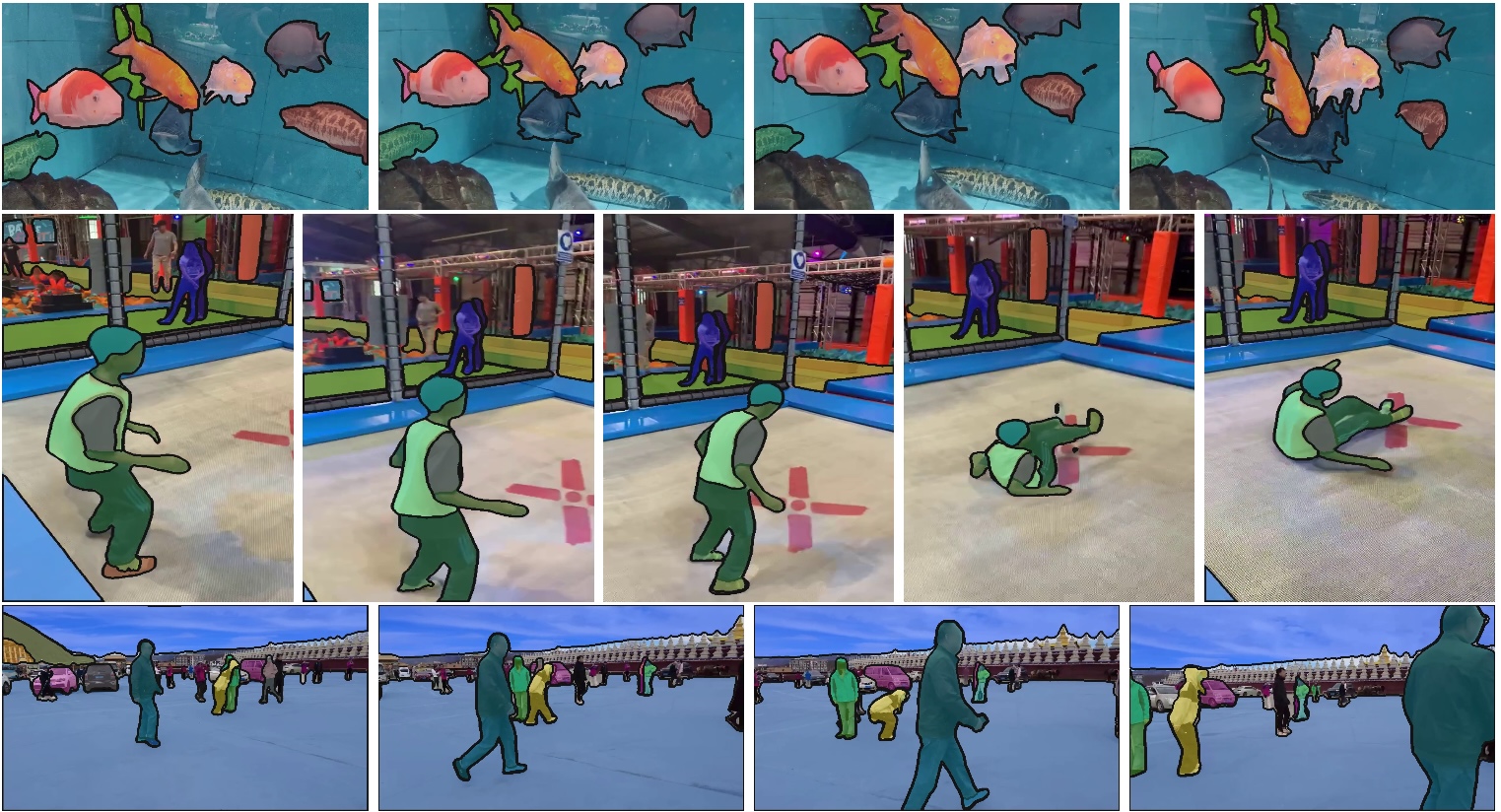 SAM 2 segments any object in images and video. Click once, get a perfect mask
| Model | Org | Released | What It Does |
|---|---|---|---|
| SAM 2 | Meta | Aug 2024 | Segment anything in images and video |
| Depth Pro | Apple | Oct 2024 | Metric depth from single image |
| gsplat | Nerfstudio | 2024+ | Gaussian splatting, CUDA accelerated |
SAM 2 segments objects in video in real-time. Click on something, get a perfect mask. Useful for rotoscoping, compositing, or extracting objects from footage to use as game assets. Try SAM 2 ↗
Depth Pro from Apple produces metric depth maps from single images in under a second. That opens up a lot: converting 2D art to 2.5D with parallax effects, generating depth data for 3D reconstruction, and creating normal maps from flat images. Depth Pro on HuggingFace ↗
gsplat is the fast implementation of Gaussian splatting. If you're capturing real environments for games, whether photogrammetry or environment scans, this is the library that makes it practical.
What I'd Actually Use
If you're starting a game project today, here's the stack that makes sense:
Textures and sprites: FLUX.1 [schnell], Apache 2.0, fast iteration, quality that ships
Concept art: SD 3.5 Large with LoRAs for style control
3D assets: Hunyuan3D 2.1 or TRELLIS.2 for textured meshes, SAM 3D when you're starting from a photo, then Blender for cleanup
Auto-rigging: UniRig or NVIDIA SOMA-X to skeleton and skin generated meshes (both open) instead of relying on Mixamo
Sound effects: Stable Audio's open Small-SFX model, runs locally, commercially licensed
Music: ACE-Step for prototypes, then bring in a composer for final production
Voice: Qwen3-TTS for cloning and ambient dialogue (Apache 2.0), Chatterbox (MIT) when a line needs real emotion, voice actors for the lines that matter
NPC dialogue: Qwen3.6-35B-A3B, Gemma 4 26B-A4B, or Muse Glimmer 30B locally, or a self-hostable cloud LLM (GLM-5.2, DeepSeek-V4, or Kimi K3) for complex reasoning and tool use
Video (cutscenes): Mochi 1 or the Wan 2.2 5B locally, LTX-2.5 or HunyuanVideo-1.5 on cloud when you need final quality
Here's the thing about all of this: the common mistake is trying to use AI for everything. These are tools, not replacements. They compress the tedious parts like iteration, variations, and placeholder assets, so you can spend your time on the creative decisions that actually matter. The parts that make your game yours.
Hardware Reality Check
Let's be honest about what you actually need to run this stuff:
8GB VRAM (RTX 3060, 4060): SD 1.5/SDXL, Wan 2.1 small, AudioGen, Fish Speech, small LLMs (7B quantized). This is gaming laptop territory, and it's enough to get started.
12GB VRAM (RTX 3080, 4070): SD 3.5, FLUX schnell, Mochi 1, MusicGen, TripoSR, Qwen 14B quantized. This is where things get comfortable. Most of the useful models run here.
24GB VRAM (RTX 3090, 4090): Most models at full precision, InstantMesh, larger LLMs, and the 2026 local-agent tier: Qwen3.6-35B-A3B, Gemma 4 31B at 4-bit, Muse Glimmer 30B at 4-bit. If you're serious about this workflow, this is the sweet spot.
48-80GB VRAM (A100, H100): HunyuanVideo, LTX-2, DeepSeek-V3, production-scale generation. Enterprise hardware. You're not buying this, you're renting it.
Cloud instances on RunPod, Lambda Labs, or Modal cost $2-4/hour for A100s. For occasional use, that's cheaper than hardware. Spin up when you need final quality, shut down when you're done.
About the cost estimates in this guide: Per-generation costs assume self-hosted inference on cloud GPUs at ~$2-3/hour (A100) or ~$0.40/hour (RTX 4090). Actual costs vary based on hardware, optimization, and batch sizes. These are ballpark figures for planning, so your mileage will vary.
What's New in 2026
Recently shipped: LTX-2 and LTX-2.3 brought open synchronized audio-and-video with native 4K. Microsoft's TRELLIS.2 (December 2025) became the open img-to-3D leader, and Meta's SAM 3D (November 2025) made single-photo 3D reconstruction practical. FLUX.2 superseded FLUX.1 for image generation, and NVIDIA's SOMA-X brought open auto-rigging and retargeting. The first half of 2026 kept the pace up: Qwen3-TTS (January) gave voice cloning a proper Apache 2.0 home, Zhipu's GLM-5 (February) shipped a 744B open coding-and-agentic model under MIT, Skywork's Matrix-Game 3.0 (March) put a real-time interactive world model in open weights, DeepSeek-V4 (April) pushed open LLMs to a 1M-token context under MIT, Stable Audio 3.0 (May) shipped three open audio models trained on licensed data, and Ideogram released its first open-weight image model (June). Then in July, Moonshot announced Kimi K3, a 2.8T-parameter open-weight model, and its weights landed on July 27 under the Kimi K3 License, the same month Tencent moved the 295B Hy3 to Apache 2.0 and a few weeks after Z.ai shipped GLM-5.2 under MIT (June 17). August was busy on the open side too: Alibaba released Qwen3.8 (a 2.4T-A95B flagship plus a 27B dense model, Apache 2.0), Meta put Muse Glimmer 30B out under Apache 2.0, MiniMax opened the 33B H3 video weights, and Lightricks shipped LTX-2.5. Earlier in the year Google's Gemma 4 (April, Apache 2.0) and Mistral Small 4 (March, Apache 2.0) reset the on-device tier.
The trend to watch: the top labs are increasingly keeping their newest models API-only even when earlier versions were open. Wan went closed at 2.5 and has stayed closed through 3.0 (August 2026), Qwen-Image went closed at 2.0, and Hunyuan3D at 2.5. Meta's Llama successor Muse Spark launched closed in April 2026 before the smaller Muse Glimmer came back open in August, Black Forest Labs is shipping FLUX 3 through its API first with an open FLUX 3 Dev promised for later in 2026, and Skywork announced SkyReels V4 in February without publishing weights. The open ecosystem is still vibrant and fast-moving, but "the latest version is open" is no longer a safe assumption, so check weights availability before you build a pipeline around a model.
The trajectory is clear: every capability that exists in closed models shows up in open models 6-12 months later. The question isn't whether open models will be good enough. They already are for most uses. The question is how fast they become the default.
And here's what that means for creators: the tools that used to require enterprise budgets or monthly subscriptions are becoming something you can just... run. On your own hardware. With no one else's permission.
That's the shift. That's what we're building toward.
Common Questions
What is the best open-source AI model for generating game assets?
It depends on the asset. For 3D models, Hunyuan3D is the strongest open option in 2026. For 2D art and textures, FLUX leads on quality. For sound effects and music, the open audio models have caught up fast. There's no single "best" model because games need many asset types, so most creators chain a few together rather than relying on one.
Are open-source AI models good enough to replace closed APIs?
For most game-asset work in 2026, yes. Open models now match closed APIs on image, 3D, and audio generation, and you can run them on your own hardware with no per-call fees or surprise pricing changes. Closed models still lead on a few frontier tasks like long-form video, but the gap usually closes within 6 to 12 months.
Can I run these generative AI models on my own GPU?
Many of them, yes. Image and audio models run comfortably on a single consumer GPU like an RTX 4090. Larger video and 3D models want more VRAM and often an A100-class cloud GPU. The hardware section above lists what each model needs so you can plan before you commit.
What is the best open source frontier model in 2026?
As of September 2026 the open frontier is a four-way race, and the answer depends on what you can run. Kimi K3 (2.8T MoE) is the largest and scores closest to the closed leaders, but its Kimi K3 License adds conditions for large model-as-a-service businesses. DeepSeek-V4-Pro (1.6T, 49B active) and Qwen3.8-2.4T-A95B are the cleanest licences at that scale, MIT and Apache 2.0 respectively. GLM-5.2 (753B, MIT) is the coding and agent specialist. None of them fit a single GPU, so for anything you host yourself the real "best" is one tier down: Qwen3.6-35B-A3B, Gemma 4 31B, or Muse Glimmer 30B.
What are the best frontier image generation models, open and closed?
Open: FLUX.2 [klein] 4B (Apache 2.0, sub-second) for commercial-safe game art, Qwen-Image-2512 (Apache 2.0) when you need readable text, and FLUX.2 [dev] or Chroma1-HD for maximum quality if the licence fits. Closed: FLUX.2 [pro] and the API-only Qwen-Image-2.0, plus 2026 arrivals like Kling IMAGE 3.0 (up to 10 reference images per Kling's guide) and xAI's Grok Imagine Image 2.0. FLUX 3's image model sits behind BFL's API for now, with an open Dev version promised later in 2026. For game work the open tier is already good enough, so the closed models mostly buy you convenience.
Which open-weights video models allow full commercial deployment, and under what licence?
If you need an open video model you can deploy commercially at enterprise scale with no revenue cap, the safe picks are Wan 2.2 (Apache 2.0, including the 5B and 14B MoE variants), Mochi 1 (Apache 2.0), Step-Video-T2V (MIT), and CogVideoX 2B (Apache 2.0). LTX-2 and LTX-2.5 are free to use commercially under $10M in annual revenue and require a paid agreement above that, which is the "buy access" route Lightricks actually offers. MiniMax H3 is open under the MiniMax H3 Community License but asks users in the USA, EU, UK, and South Korea to apply first, and HunyuanVideo carries Tencent's community licence with regional carve-outs, so read both before committing. Wan 2.5 through 3.0, Veo, Kling, and Seedance have no public weights at all. Our reference video models guide compares the hosted options.
What generative AI should I use for game assets and environments in 2026?
Chain a few specialists rather than hunting for one model. For props and characters, run a FLUX.2 klein or Qwen-Image concept through Hunyuan3D 2.1 or TRELLIS.2 and rig with UniRig. For environments, generate a skybox or HDRI (our skybox generator does this in the browser), build terrain procedurally or with a diffusion pass as in our terrain generation guide, and texture with an image model plus a PBR extractor as covered in our AI texture generators guide. Audio comes from Stable Audio 3.0 Small-SFX and ACE-Step, voices from Qwen3-TTS or Chatterbox. Every model in that chain is open and commercially usable as of September 2026.
What is the best LLM to run locally in 2026?
Pick by VRAM first. On 8GB, Qwen3.5-4B or Gemma 4 E4B. On 16GB, gpt-oss-20b (Apache 2.0, built for 16GB) or Gemma 4 12B. On 24GB, Qwen3.6-35B-A3B is the all-rounder most people should run, with Muse Glimmer 30B at 4-bit for agentic work with vision and Gemma 4 31B quantized when you want the strongest dense model. Above that, DeepSeek-V4-Flash (284B, 13B active) is the smallest way to get 1M-token context on a workstation. All of these are Apache 2.0 or MIT, and Ollama or LM Studio runs each of them with one command.
Is it legal to use AI-generated assets in a commercial game?
Generally yes for open-source models you run yourself, but it depends on the model's license and your training-data assumptions. Always check the specific model license, and disclose AI-generated content where your platform requires it. See our AI-generated content policy for how we handle this.
More Reading
- AI controversy, trust, and the post-AI economy: our position on AI in games
- AI-generated content policy: how we handle AI disclosure
- Best AI Video Models with Reference Image Support: the hosted video models compared
- Best AI 3D Model Generators: hosted Meshy, Tripo, and Rodin against the open models
- Web Games Tech Stack in 2026: WebGL, WebGPU, and Wasm for games
- Browser 3D Open World Tech: using AI-generated 3D assets in browser worlds
- Landscape Generation for Browser Open Worlds: diffusion-based terrain synthesis
- Where to Find Free Game Assets: traditional asset sources alongside AI generation
- Agentic AI code tools: AI for writing game code, not just generating assets
Generation models are more fun when the output is playable.