Arcade › Starfall Salvage
Starfall Salvage
How to play
Click the game above and it runs right here in your browser. No download, no installer, no account needed. Busayo Omoyajowo built it with Cinevva, so it works on a phone or a tablet too.
Discussion
Nobody has said anything about Starfall Salvage yet. Play it, then tell Busayo Omoyajowo what you would add next.
Make your own game
Starfall Salvage was built by Busayo Omoyajowo with the Cinevva game creator: describe the game you want in chat, watch it get built, and play it in your browser minutes later.
Remix Starfall Salvage opens the real game in the creator and forks its actual files, chat and design doc, so you start from the code rather than from a description.
Read the build brief for Starfall Salvage
Cinevva's analyzer read this game's design doc and its source, then wrote the brief below. "Make your own" hands it to the game creator as your opening message, so you start from a real spec rather than a one-line idea.
Create a single-screen responsive HTML5 canvas arcade game titled “Starfall Salvage.” Use a full-viewport canvas with no scrolling, a dark space backdrop: a vertical gradient from deep navy at the top through indigo to nearly black at the bottom, a subtle blue radial glow around the lower center, and roughly 100 small pale blue-white stars of varied size and opacity drifting slowly downward and wrapping back to the top. Keep the visual style clean neon sci-fi, with system sans-serif HUD typography, cyan glows, and simple geometric sprites.

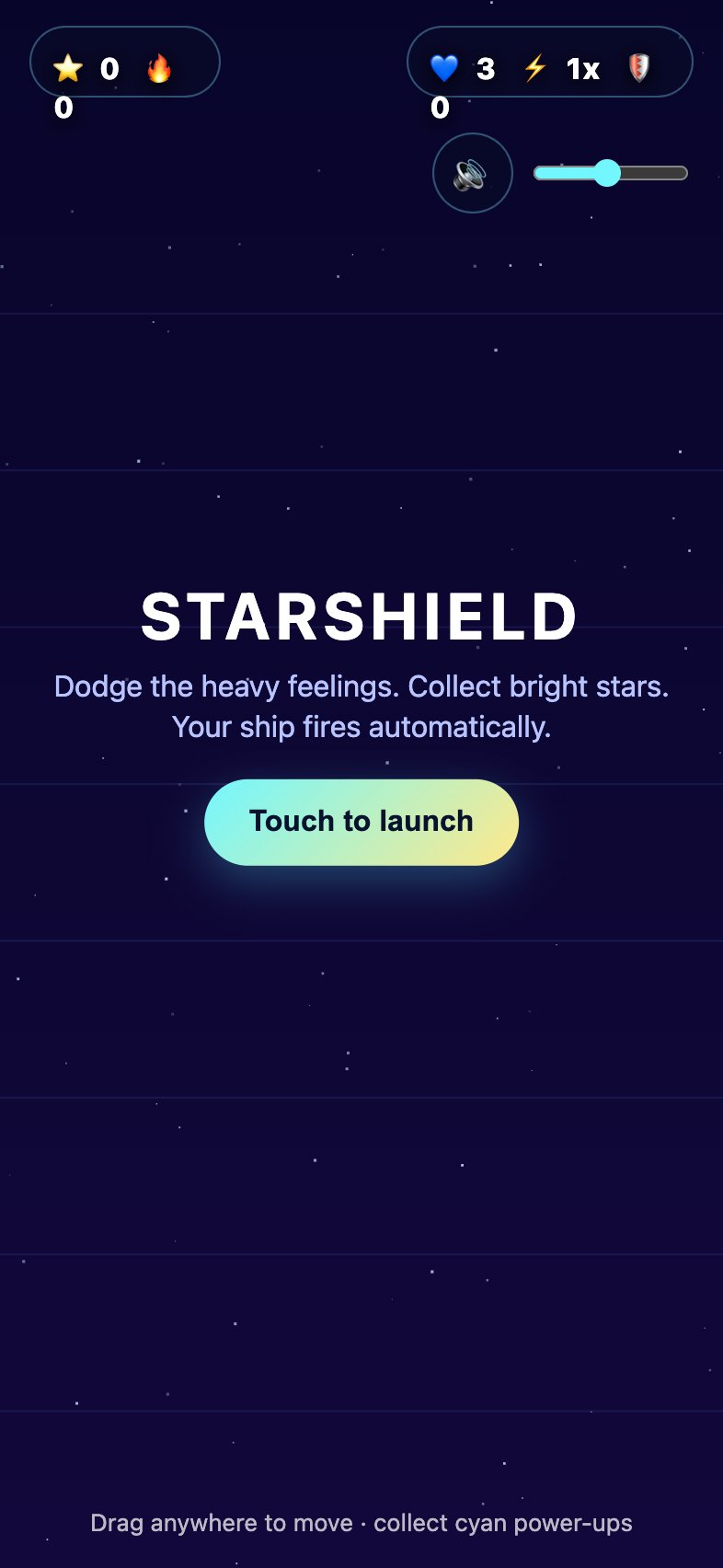
Core game: begin on a menu overlay. The menu shows the small top HUD behind it, a large centered “STARFALL” title, cyan subtitle “SALVAGE THE STARS,” instructions “Drag left to steer  •  Hold right to fire” and “Desktop: WASD / arrows + mouse + Space,” a BEST score line, and a dark rounded rectangular cyan-outlined button labeled “LAUNCH.” Clicking/tapping the button, or pressing Enter when not playing, starts a run. On game over, replace the overlay with “RUN COMPLETE,” “FINAL SCORE [score],” the same control instructions, BEST score, and a “RETRY” button; pressing it resets the run.

The player is a small glowing white/cyan triangular spacecraft located near the lower-middle of the playfield. It points in its aim direction, has a blue-violet cockpit dot and a short animated orange exhaust flame. The player can move in eight directions but is clamped inside the playfield, between x=26 and width-26 and y=82 and height-30. Keyboard movement uses WASD or arrow keys, with acceleration and strong friction so the ship glides briefly but stops quickly. Aim with the mouse cursor on desktop; hold Space (or J) to fire in the aim direction. On touch/mobile, the left side of the screen is a virtual movement area: dragging controls a virtual joystick centered near the lower-left (around x=92, y=height-94), and the right side is a virtual aim/fire area: holding and dragging there aims toward the touch and automatically fires. Render subtle outlined circular “MOVE” and “FIRE” touch hints at the bottom while playing.

The ship fires small bright cyan-white glowing bullets from its nose. Normal fire has roughly a 0.16 second cooldown; a rapid-fire powerup reduces it to about 0.075 seconds. Bullets travel quickly in a straight line and expire after about 1.4 seconds or outside the screen. The player begins each run with 3 lives and brief invulnerability.

Enemies are irregular gray-blue polygonal asteroids with 7–10 uneven points, a light gray-blue outline, slight rotation, and a couple of darker crater spots. They spawn from random edges of the screen and travel inward toward a point near the player with slight angle variation. Spawn frequency increases gradually with wave. Asteroids vary in size, and each large asteroid hit by a bullet awards score proportional to its size, bursts into orange particles, and splits into two smaller asteroids traveling in differing directions. Smaller fragments can also be destroyed for score. Give the player a small impact flash and screen shake on collisions. Asteroids that collide with the player are removed: without a shield they consume one life, trigger red particle effects, brief invulnerability, and shake; with an active shield they consume the shield instead, trigger cyan particles and shake. When lives reach zero, end the run.

Scoring and progression: display a five-digit zero-padded score in bright cyan at the upper-left, with the label SCORE beside it. Destroying an asteroid gives approximately 12 times its size rounded to an integer. Collecting a powerup gives +25. Set WAVE to 1 plus floor(score/180), displayed in gold at the upper-right. Show remaining lives at the upper-right as repeated red diamond symbols, initially three. Persist the best score in localStorage across runs and display it on menu and game-over overlays.

Powerups occasionally spawn in the open playfield after an initial delay and drift slowly downward with slight horizontal motion, bobbing and rotating, and expire after roughly 12 seconds. They are glowing colored circular tokens with a dark letter: cyan “S” for SHIELD, gold “R” for RAPID, and green “+” for REPAIR. Collecting them by touching them triggers colored particles and adds 25 points. SHIELD grants about 8 seconds of protection against one asteroid collision; RAPID grants about 8 seconds of faster firing; REPAIR adds one life up to the maximum of three. If shield or rapid is active, show its name and remaining seconds in small colored text under the wave indicator.

Use bright particle bursts for shooting, asteroid destruction, collisions, powerup collection, and game over. Add a subtle camera shake during impacts. Draw a translucent dark HUD bar across the top, with “STARFALL SALVAGE” at upper-left, score and SCORE beneath it, WAVE at upper-right, active powerup status beneath the wave, and red life diamonds beneath. Keep the playfield uncluttered and preserve the responsive portrait layout shown: on a narrow screen the game fills the viewport, and all coordinates and text scale/use the current canvas dimensions. The overall result should be an accessible neon asteroid-survival shooter with simple geometric canvas rendering, no external assets, and both desktop and touch controls.