Appearance
Skip to content
Arcade › Society
Society
How to play
Click the game above and it runs right here in your browser. No download, no installer, no account needed. savimatty18 built it with Cinevva, so it works on a phone or a tablet too.
Discussion
Nobody has said anything about Society yet. Play it, then tell savimatty18 what you would add next.
Make your own game
Society was built by savimatty18 with the Cinevva game creator: describe the game you want in chat, watch it get built, and play it in your browser minutes later.
Remix Society opens the real game in the creator and forks its actual files, chat and design doc, so you start from the code rather than from a description.
Read the build brief for Society
Cinevva's analyzer read this game's design doc and its source, then wrote the brief below. "Make your own" hands it to the game creator as your opening message, so you start from a real spec rather than a one-line idea.
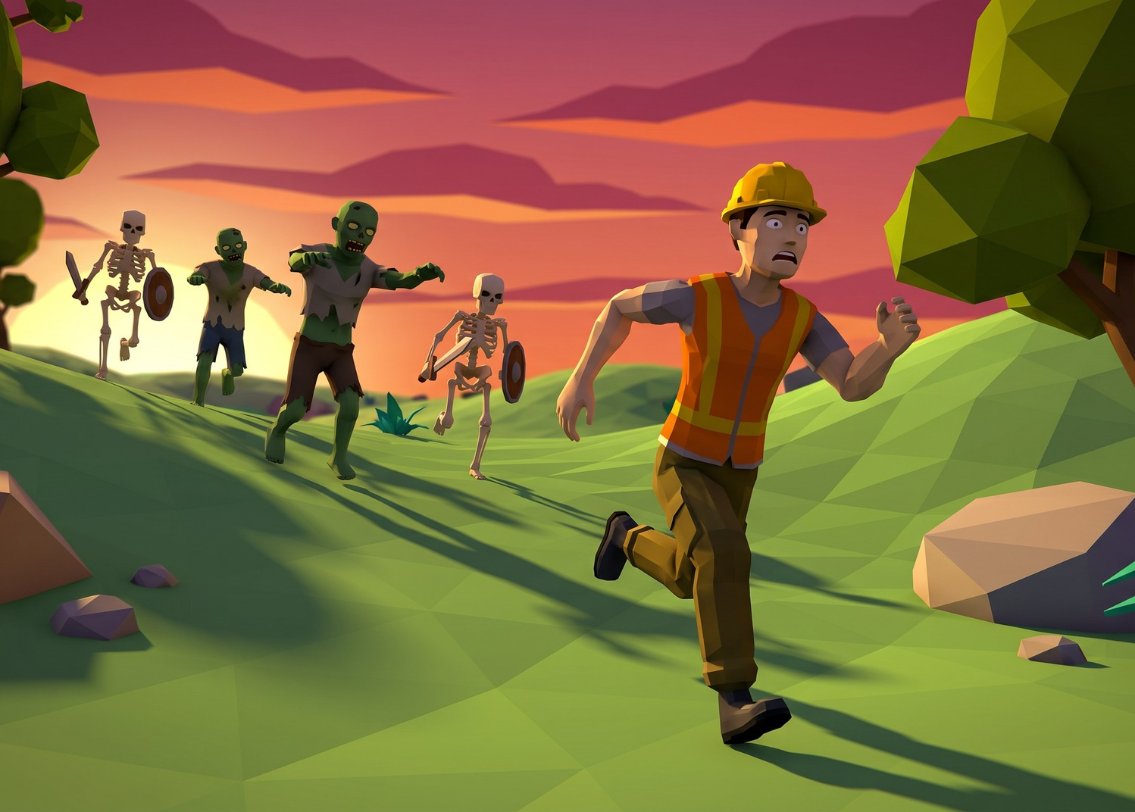
Create a playable browser-based 3D first-person survival horror game titled “Society,” built with Three.js. The player begins behind a full-screen dark translucent story overlay: “SOCIETY,” explaining that they broke away from a suffocating city, can train in the forest, but every day away lets the world rot; they must return stronger, survive the dead city, reach a helicopter, and escape. Use a moody low-poly/primitive 3D aesthetic with a dark blue-black night palette, heavy fog, moon/hemisphere lighting, a forward flashlight cone, vignette, crosshair, occasional red damage flash, eerie silhouettes, glowing eyes, and short message notifications. The camera is first person with WASD or arrow-key movement, mouse/pointer drag to look, E to interact, Space to attack, Shift or Q to jump; include mobile on-screen arrow-pad movement plus Jump, Use, and Hit buttons. The player has gravity and collision against rectangular obstacles, stamina that drains while moving and recovers while still, health, flashlight battery, and four progression stats: Power, Agility, Resolve, and Technique. Show a glassy dark HUD panel at upper left with stage, health/max health, battery percentage, all four stats, training level, dummy progress out of 6, days away, and defeated/total zombies. Show the current objective in a centered top panel and contextual nearby interaction labels; display a bottom message panel for warnings and events.

Structure the game as three sequential first-person stages connected by glowing portal/arch interactables. Stage 1 is “Flight,” a long straight hostile city escape: dark street ground, tall block buildings lining both sides with sparse warm glowing windows, cyan/pink billboard-like signs, streetlight poles, red-brown barricades, fog, stalking black silhouettes with red eyes at the sides, and pursuing shadow agents closing in from behind and damaging the player if they catch up. The player starts around the near end of the street and must run deep toward the far end, where a green glowing torus marks “Enter the forest.” Movement is slightly faster in this escape stage. Include unsettling crossing jump-scare silhouettes and short warnings such as “Run” and “The city is watching you now.” The flashlight battery recharges during this opening escape.

Stage 2 is “Forest,” a dark green forest clearing surrounded by many stylized cone-canopy trees, with a central clearing and a small glowing orange fire-like primitive. Place three wooden training dummies with horizontal arms and red target plates. Around the tree line, place black watcher figures with glowing red eyes that look toward the player, blink, whisper, and can cause minor branch damage if approached. Place three glowing training interactables: Power Drill (3 days; requires 3 clean hits), Footwork (7 days; requires 4 clean hits), and Survival Drill (14 days; requires 5 clean hits). The player must attack dummies at close range while facing them to build dummy progress, up to 6, before using a drill. Attacks consume stamina; training cannot happen during recovery cooldown, below the stamina threshold, or without the required clean hits. A completed drill advances Days Away by its listed amount, consumes stamina, causes health wear, increases the relevant Power/Agility/Resolve and sometimes Technique, raises score and training level, consumes the required dummy progress, and imposes a timed recovery cooldown. Training itself can also increment Technique and Power at hit milestones. Add two rotating battery pickups in the forest that restore flashlight battery. Put a red glowing arch at the far end labeled “Return to society,” leading to the apocalypse city. The forest flashlight drains over time, and its light flickers more as the battery falls.

Stage 3 is “Apocalypse,” a larger ruined city with a blood-red/dark ash skyline, very heavy fog, several intersecting dark roads, blocky ruined buildings, scattered rotated wreckage, red-eyed watcher silhouettes, supplies, and a distant helipad. Set the helicopter on a circular helipad at the far end: a dark round pad with a pale ring, simple blue-gray helicopter body, tail boom, and spinning rotor. The number and threat of zombies must scale with Days Away: spawn up to 68, starting at 20 plus approximately 1.15 per day. Include zombie variants made from primitive bodies and heads: walkers, faster lower-health sprinters, low crawler enemies, and slower high-health high-damage brutes; use muted sickly green/gray/brown bodies, with distinct proportions. Zombies path directly toward the player, face the player, attack within variant-specific ranges, flash emissive red when hit, and have variant-specific damage/speed/health. The player’s melee attack uses derived damage, reach, and cooldown from Power and Technique, can kill zombies, increases score, and must be used to clear the helipad area. Add four rotating medkits around the ruined city that restore health, and three battery pickups that restore light. The apocalypse flashlight drains faster and flickers strongly.

The objective in the apocalypse is to survive, travel to the helipad, and remain inside its radius for 3.5 continuous seconds while no more than 3 living zombies are within 12 units; otherwise reset extraction progress and show “Too many zombies near the helicopter. Clear them out.” On success, pause the game and show an ending card stating that the helicopter lifts the player out, including days trained, training level, and zombies survived. If health reaches zero, show the same ending/restart style overlay with a failure summary including days away, all four stats, and zombies defeated. Include a “Run It Again” restart button. Preserve the oppressive progression tradeoff: training makes the player stronger but increases Days Away, which increases apocalypse severity, zombie count, enemy speed/health, and overall fear. Use atmospheric vignette opacity, threat-based fear, red damage overlays, flashlight battery effects, random jump scares, whisper messages, and stage-specific fog/lighting to communicate danger without adding unrelated systems.