Appearance
Skip to content
Arcade › Pocket Pal Shake
Pocket Pal Shake
How to play
Click the game above and it runs right here in your browser. No download, no installer, no account needed. Keganred3 built it with Cinevva, so it works on a phone or a tablet too.
Discussion
Nobody has said anything about Pocket Pal Shake yet. Play it, then tell Keganred3 what you would add next.
Make your own game
Pocket Pal Shake was built by Keganred3 with the Cinevva game creator: describe the game you want in chat, watch it get built, and play it in your browser minutes later.
Remix Pocket Pal Shake opens the real game in the creator and forks its actual files, chat and design doc, so you start from the code rather than from a description.
Read the build brief for Pocket Pal Shake
Cinevva's analyzer read this game's design doc and its source, then wrote the brief below. "Make your own" hands it to the game creator as your opening message, so you start from a real spec rather than a one-line idea.
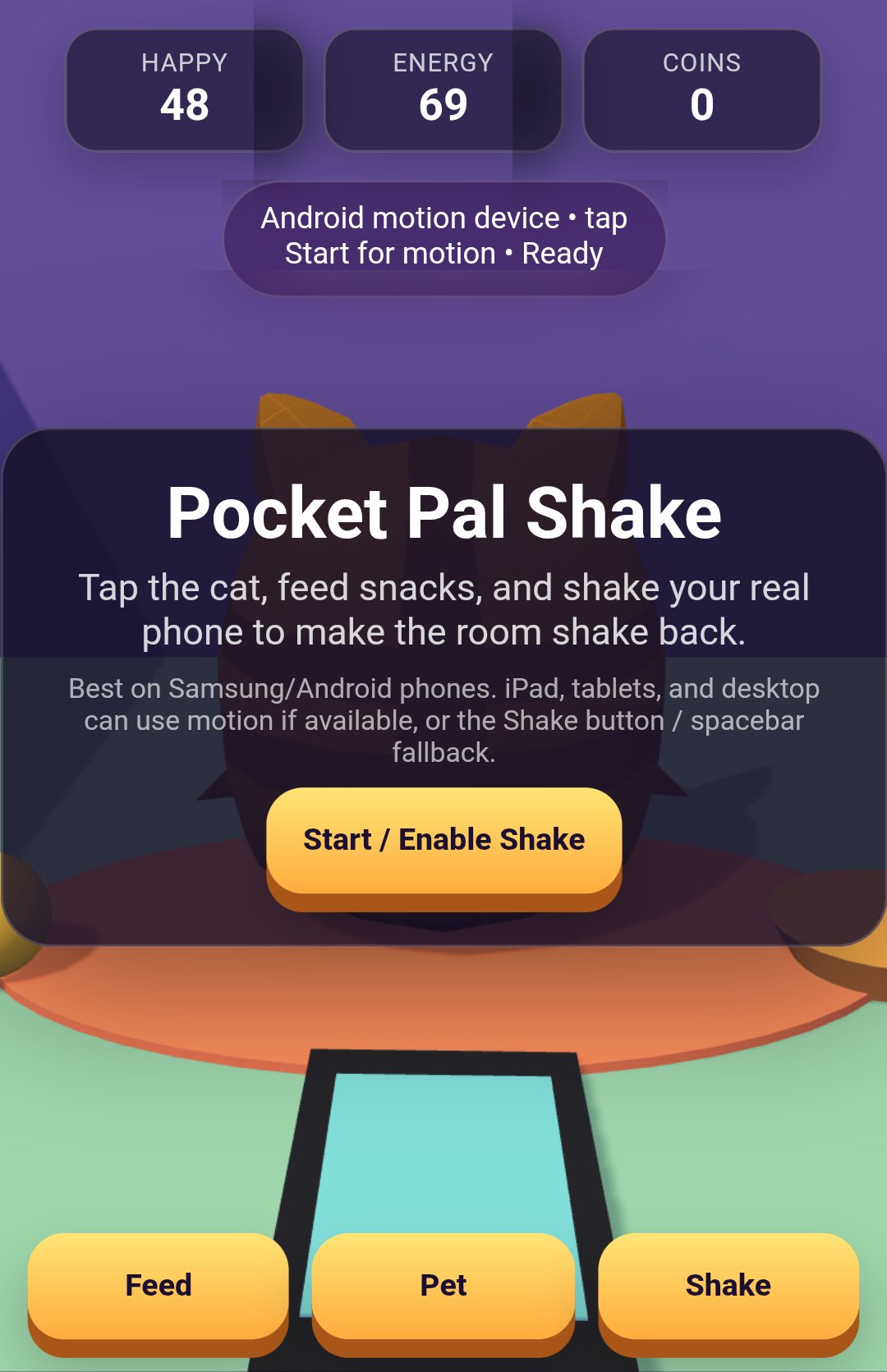
Create a portrait-oriented 3D virtual pet game titled “Pocket Pal Shake.” Use a fixed, close, front-facing camera with a perspective view positioned approximately at (0, 2.25, 8.1), looking toward (0, 0.68, 0), framing a cute full-body orange/brown low-poly chibi cat prominently in the center. The cat should have an oversized round cat head with pointed ears, large pale eyes, dark pupils, small brown nose and mouth, subtle darker forehead/cheek stripes, a small orange torso, lighter oval belly patch with a dark vertical stripe, very short arms ending in round paws, stubby legs with flat yellow-orange feet, and a curled tail. Use a Quaternius-style low-poly animated cat model if available, enlarged as the head/face, combined with simple procedural low-poly body parts for the tiny torso, arms, paws, legs, feet, belly, and tail. The cat stands on an oval coral/orange rug in a mint-green playroom. The room has a mint floor, purple back wall and darker purple side walls, warm directional sunlight, soft shadows, ambient lighting, and fog. Place a yellow toy ball to the left, an orange snack bowl to the right, and a dark phone-shaped rectangular object with a glowing cyan screen in the foreground, visually linking the game to the player’s real phone. Keep the room and camera fixed except for shake effects.

This is an interactive virtual-pet game driven by simple stat management and playful reactions. Start with Happy 50, Energy 70, Hunger 55, Cleanliness 70, Coins 0, level 1, and XP 0/40. Display a HUD with Happy, Energy, Hunger, and Coins at the top, plus a status badge showing level and XP, detected device label, whether real motion is enabled, current mood, current mission, cleanliness while bathing, and the latest action. Stats gradually drain over time: happiness, energy, hunger, and cleanliness. Mood should derive from the stats and actions: curious normally, happy at high happiness, hungry at low hunger, tired at low energy, messy at low cleanliness, sleepy during a nap, and angry during the angry reaction.

On first launch show a start panel titled “Pocket Pal Shake” with the instruction that the player can tap the cat, feed snacks, and shake their real phone to make the room shake back. Include a “Start / Enable Shake” button. Clicking it requests DeviceMotion permission where required, unlocks audio, hides the panel, and reports whether motion is enabled or whether the fallback controls should be used. Detect and label Samsung/Galaxy/SM devices as “Samsung phone/tablet preferred,” Android devices as “Android motion device,” iPads/tablets as “iPad/tablet motion device,” iPhones as fallback-only, Macs as mouse/space fallback, and otherwise use a generic motion/fallback label.

The main controls are HTML-style buttons over the lower part of the screen. Provide an upper action row: Trick, Nap, Toy, Outfit, Mini, Bath. Provide a lower row: Feed, Pet, Talk, Cuss, Shake. Also support keyboard shortcuts: F feed, P pet, R trick, N nap, B toy, O outfit, M mini game, W bath, T talk, C cuss, A angry animation, and Space for the shake fallback. A quick mouse/touch drag across the WebGL canvas is also a shake fallback. Buttons should work even when physical motion sensors are unavailable.

Core shake mechanic: after starting, listen for devicemotion acceleration changes and detect a strong jerk. A real shake or the Shake button/Space/fast canvas drag rewards 1–5 coins based on power, increases happiness by roughly 7 plus power scaling, decreases energy by about 3, adds XP, emits a shake sound, spawns floating pink heart-like reward bubbles, and makes the cat play a jump or dance animation. Add strong temporary shake trauma: visibly wobble the whole room, phone prop, camera, and cat, and brighten the phone screen while the effect decays. Apply a short cooldown so one continuous movement is not counted repeatedly. Use a dice-shake style sound if audio assets are available.

Pet actions: Feed restores roughly 12 energy and 28 hunger, adds a little happiness and XP, briefly scales the snack bowl, plays a positive cat animation, and emits bubbles. Pet increases happiness, briefly pulses/scales the cat, plays a happy dance reaction, and emits bubbles. Tapping/clicking the cat directly should count as a poke: increment a poke count, slightly reduce happiness and energy, show dizzy yellow stars orbiting the head, play a hit/reaction animation, show “Hey!” (or “Quit poking me!” every fourth poke), and award XP. The direct pet hit should work through raycasting with a forgiving central screen fallback.

Trick chooses randomly from spin, jump, wave, and dance. Show a short speech bubble such as “Wheee!”, “Boing!”, “Hi hi!”, or “Dance time!”, increase happiness, spend some energy, award XP, and animate the cat appropriately: spin rotates, jump bounces upward, wave raises and swings one arm, and dance rocks the body. Nap lasts about five seconds, tilts the cat into a sleepy pose, shows “Zzz…”, steadily restores energy and a little happiness, then shows “All rested!” and returns to idle. Toy launches the yellow ball from its left home position across the rug in a short bouncing chase arc, plays a walking/chase animation, adds happiness and XP, costs energy and hunger, and gives 3 coins before returning the ball home.

Outfit cycles through no outfit, a gold crown, dark cool shades, a pink bow, and a blue cape. Each worn accessory costs 8 coins; if the player cannot afford it, show “Need 8 coins!” and do not change it. Equipping or removing an outfit increases happiness, gives XP, shows a short speech bubble, and visibly toggles the simple low-poly accessory geometry on the cat.

Mini starts a Coin Pop mini-game. Hide or replace normal room props as needed only if useful, then spawn 3 or more glowing yellow coin targets in the room, with up to 7 targets as the level increases. The player has approximately 12 seconds plus a small level bonus to tap the coins using raycasting. Each tapped coin disappears, increments the mini score, awards XP, and respawns shortly while other coins float, rotate, and glow. At the timer’s end, hide all targets, award coins equal to the score, increase happiness based on the score, show the result in a speech bubble, and award completion XP. The HUD should show the active countdown and score.

Bath switches into a bathroom mode for several seconds. Change the floor and walls to bright aqua bathroom colors, hide the rug, bowl, phone, and normal room presentation, and show simple low-poly bathroom props: a shower pole and shower head, rounded white tub with blue water, small toilet and tank, white sink and pedestal, blue mirror, and floating translucent soap bubbles. Bath increases cleanliness substantially, adds happiness and XP, costs a little energy, shows “Scrub scrub!”, and bubbles rise and disappear. After the wash, show bath complete and return to the playroom presentation.

Talk uses browser speech recognition when available: show “Listening…” while recording, take the transcript, display it in a speech bubble, and repeat the exact phrase through browser speech synthesis in a high, squeaky voice with pitch around 1.75 and rate around 1.28. Do not censor or replace the words; trim/reduce whitespace and cap the phrase at 220 characters. If recognition is unavailable or fails, open a typed prompt and repeat the typed phrase instead. While listening/speaking, show and animate a small mouth flap on the cat’s face, play a positive animation, increase happiness, award XP, and retain the last phrase. Cuss triggers the angry sequence and then makes the cat repeat one of several silly rude lines via the same squeaky speech synthesis; do not use slurs. The A key triggers the angry visual without speech.

Angry mode lasts about two seconds: raise the arms, stomp and shake the feet/body, rapidly wobble the cat, show slanted dark eyebrows, red rage puffs by the cheeks, a red forehead anger mark, and an open animated mouth. Show an angry speech bubble such as “💢 Grrr!”, award a small amount of XP, then return to idle. Use built-in cat animations such as Idle, Dance, Jump, Walk, Yes, and HitRecieve when available, with procedural body animation as a fallback.

Maintain a rotating mission selected from actions such as Feed your pal, Pet your pal, Tap/poke your pal, Do a trick, Play with the toy, Take a nap, Make him talk, Shake the room, Play Coin Pop, Change outfit, and Wash your pal. Show the current mission in the status badge. When the matching action is completed, award a bonus of about 5 plus the current level coins and additional XP, announce mission completion, and roll a different mission. Almost every action gives XP. When XP reaches the current threshold, level up, increase the next XP requirement using a gradually scaling formula, award bonus coins, happiness, energy, floating bubbles, and a small shake burst. Keep the clean playful low-poly toy-app visual style, rounded simple geometry, bright colorful props, warm lighting, speech bubbles, and responsive touch-friendly UI.