Arcade › Ironfield
Ironfield
How to play
Click the game above and it runs right here in your browser. No download, no installer, no account needed. Quanum built it with Cinevva, so it works on a phone or a tablet too.
Discussion
Nobody has said anything about Ironfield yet. Play it, then tell Quanum what you would add next.
Make your own game
Ironfield was built by Quanum with the Cinevva game creator: describe the game you want in chat, watch it get built, and play it in your browser minutes later.
Remix Ironfield opens the real game in the creator and forks its actual files, chat and design doc, so you start from the code rather than from a description.
Read the build brief for Ironfield
Cinevva's analyzer read this game's design doc and its source, then wrote the brief below. "Make your own" hands it to the game creator as your opening message, so you start from a real spec rather than a one-line idea.
Recreate “Ironfield” as a browser-based 3D third-person/first-person melee battle simulator in Three.js. Start with a full-screen dark blue-green radial-gradient menu overlay and centered translucent charcoal panel with a thin muted-gold border and soft shadow. Display the large uppercase gold title “IRONFIELD”, subtitle “One fighter. A living battle line. Win ground by reading distance, timing, and steel.”, a Role dropdown with Knight — sword and shield, Spearman — longer reach, and Cavalry — mounted mobility, a Battle size dropdown with 120, 240, and 500 soldiers, and an “Enter the battle” button. Show the control hint: WASD move, Shift sprint, Space jump, C crouch, V camera, LMB drag weapon, RMB shield, Esc pause.

On starting, hide the menu and load a stylized low-poly medieval battlefield viewed by a perspective camera with fog. Use a large flat green grass plane, a long tan road running down the center, and a blue river on the right side crossed by repeated straight stone/wood bridges. Scatter many low-poly trees and rocks around the field. Light the world with bright warm directional sunlight, cool fill light, and soft shadows. The playable area is approximately x -46 to 46 and z -70 to 70.

Place one controllable fighter near the friendly side of a long battle line, at roughly (0,0,12), facing toward the opposing army. Load or otherwise represent a low-poly armored knight/soldier character. The first-person camera is attached around the character’s head/chest height and has a centered simple pale-gold crosshair. In first person, show a large hand-held sword at lower right: brown grip, gold crossguard, reflective pale metal blade. Holding the right mouse button displays a round red-brown shield with a gold central boss at lower left. V toggles a pulled-back over-the-shoulder third-person camera; in third person, hide the weapon and shield view models. The Cavalry selection additionally places the character on a large horse and raises the player body/camera; the other role selections still use the same sword interaction shown by the mechanics.

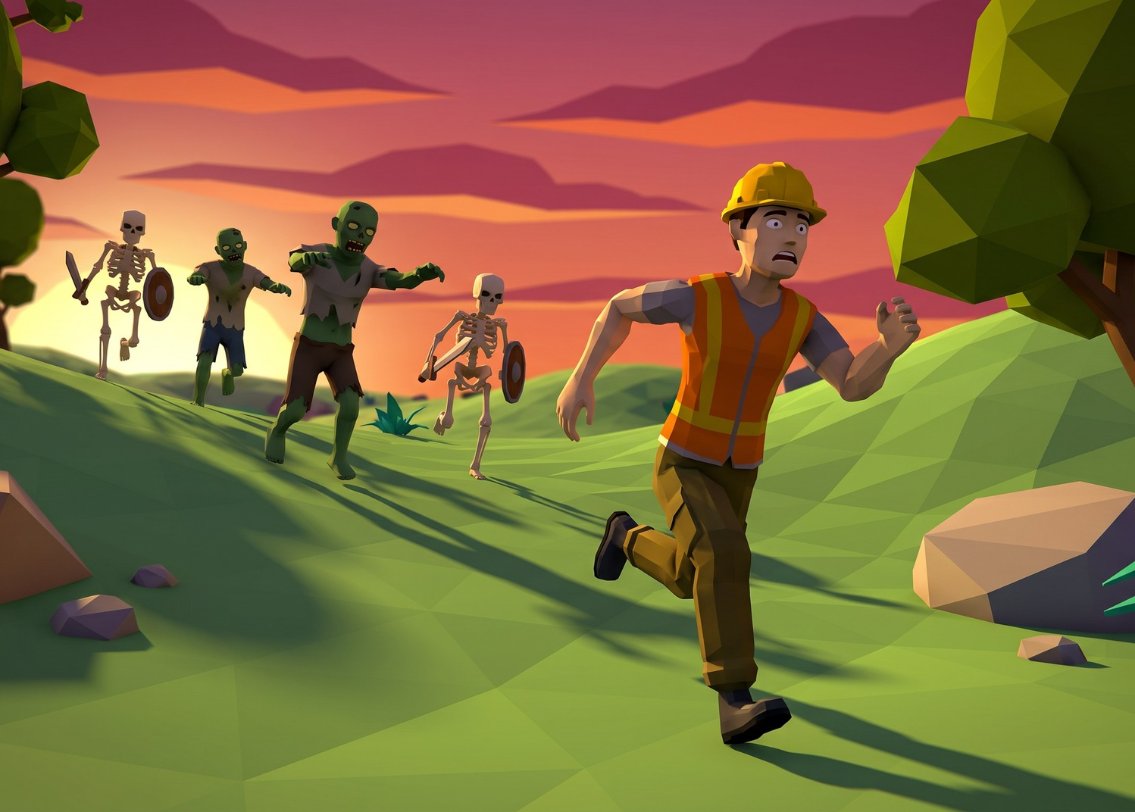
Spawn two opposing massed formations of animated low-poly soldiers using red-team and blue-team character variants. For a selected total of 120, 240, or 500, split the soldiers evenly between red and blue, arranged in broad rows roughly 20 units across on opposite sides of the battlefield (red around z=-30, blue around z=30). Red enemies advance toward and attack the player when near; blue allied soldiers also move toward nearby enemies/player and attack when close. Soldiers should have idle animation, cast shadows, briefly enlarge/flash on being hit, and disappear when killed. The battle is a living crowd rather than a level with discrete rooms.

Implement movement with WASD or arrow keys. Movement is about 3.7 units/sec, or 7 units/sec while Shift is held; sprint drains stamina and stamina regenerates when not sprinting. Space performs a jump with gravity, C crouches by vertically scaling the player, and constrain movement to the battlefield bounds. The camera uses mouse movement while the pointer is locked: horizontal mouse movement turns the view and vertical movement aims up/down with a limited pitch. Clicking the canvas requests pointer lock.

Implement timed sword combat. Left mouse starts a left swing, or holding Shift while clicking starts a thrust. Number keys 1–5 start left, right, overhead, downward, and thrust attacks. Each attack lasts about 0.46 seconds, animating the sword through the corresponding arc. Detect the moving sword tip crossing nearby red enemy bodies within roughly 3.2 units; each hit removes 35 enemy health, increments Score by 1, knocks the enemy slightly forward, and kills/hides it at zero health. Prevent attacks while another swing is active or weapon heat is above 70. Starting a swing sets weapon heat to 100 and it cools rapidly back toward ready. Holding RMB raises the shield and blocks/reduces incoming damage according to the combat logic. Nearby enemies can damage the player, reducing health; health, stamina, and weapon state must visibly update.

Add a fixed HUD after battle start. At top left, show a charcoal translucent bordered badge with gold IRONFIELD branding and text such as “Red [remaining] · Blue [remaining] · Score [score]”. At top right, show HEALTH with a red horizontal meter, STAMINA with a teal meter, and WEAPON with a gold meter plus READY, RECOVERING, or SHIELD UP state. Keep a small pale-gold plus-shaped crosshair in the center. At bottom center, show a dark translucent hint badge: “LMB + move mouse to swing · hold RMB to brace shield · 1 left · 2 right · 3 overhead · 4 downward · 5 thrust · V third person”. At bottom right, show a circular minimap with a gold outline and dark green translucent fill, with a white player dot, red nearby enemy dots, and blue nearby ally dots positioned relative to the player. Use muted natural greens, blue-gray atmosphere, warm gold UI accents, red/brown enemies, and blue allies.

Press Esc to pause/unpause. The pause overlay should darken the whole screen and center a bordered translucent panel reading “Battle paused” and “Take a breath. The line is still moving.” with Resume and Restart battle buttons. Preserve the restrained cinematic low-poly medieval presentation, foggy horizon, shadows, and responsive UI styling across desktop and narrow screens.