Appearance
Skip to content
Arcade › 거리의 결투
거리의 결투
How to play
Click the game above and it runs right here in your browser. No download, no installer, no account needed. It was built with Cinevva, so it works on a phone or a tablet too.
Discussion
Nobody has said anything about 거리의 결투 yet. Play it, then tell the creator what you would add next.
Make your own game
거리의 결투 was built with the Cinevva game creator: describe the game you want in chat, watch it get built, and play it in your browser minutes later.
Remix 거리의 결투 opens the real game in the creator and forks its actual files, chat and design doc, so you start from the code rather than from a description.
Read the build brief for 거리의 결투
Cinevva's analyzer read this game's design doc and its source, then wrote the brief below. "Make your own" hands it to the game creator as your opening message, so you start from a real spec rather than a one-line idea.
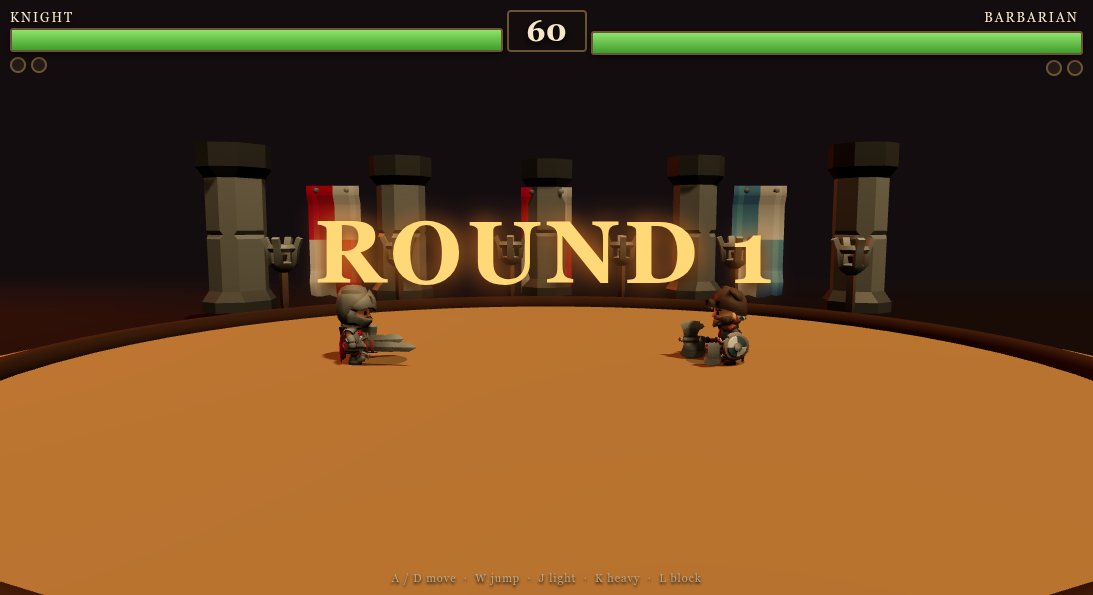
Create a responsive 2D side-view fighting game titled “거리의 결투” (“Duel of the Street”) using a full-screen HTML canvas and an overlaid HUD. The game is a simple one-round rooftop duel: Player 1, a green cartoon humanoid on the left, fights a pink/red CPU opponent on the right. Use a fixed side-on arena with horizontal movement, jumping, punches, kicks, health, weapons, and a 60-second timer.

Visual presentation: Fill the canvas with a vertical dusk gradient, dark navy at the top fading to muted purple near the bottom. Add a large flat golden-orange circular sun/moon at about 78% canvas width and 22% canvas height. The floor is a dark blue city rooftop occupying the bottom portion of the screen, with an orange roof edge line and a few subtle rectangular rooftop highlights; center the text “CITY ROOFTOP” in translucent pale lettering on the roof. Draw both fighters as simple geometric cartoon figures with no sprites: a colored rectangular torso, a peach circular head, a dark navy rectangular headband/hair strip, one small white eye detail, and thick rounded colored limbs. Add a soft black oval shadow beneath each fighter. Player 1 is bright green (#49e582), CPU is coral pink (#ff637f); they face each other automatically. When attacking, extend an arm; kicks extend a peach-colored leg. A sword attack should show a light blue blade, while a hammer attack should show a brown handle and large brown head. Flash the whole screen briefly translucent white when a hit lands.

Gameplay and physics: The canvas adapts to the browser viewport; place the ground at roughly 79% of the height. Player 1 starts at 25% of the canvas width and CPU at 75%, both at ground level, with 100 health each. Keep fighters within approximately 40 pixels of either horizontal edge. Horizontal acceleration can be direct velocity control: A/left moves left and D/right moves right at about 330 pixels/second, with facing changing to the direction of travel and friction when released. W/up jumps only while grounded, with an upward velocity around 760; gravity is about 1900 pixels/second squared. The CPU faces the player, moves toward them at about 205 pixels/second until roughly 115 pixels apart, sometimes jumps when far away, and attacks automatically when within weapon reach, choosing punch more often than kick. CPU uses the sword by default; Player 1 uses the fist by default.

Attack rules: attacks have a short animation of about 0.32 seconds and cannot start while another attack is active or during cooldown. Player punch uses the selected weapon’s base damage and reach; kick adds 4 damage and has a slightly longer cooldown. Only apply one hit per attack during its active window, when the opponent is within horizontal weapon reach and within about 80 vertical pixels. On hit, reduce health without going below zero, knock the opponent backward based on attacker facing, and launch them upward. Weapon choices are selectable during the fight: fist (Korean label “주먹”, 8 damage, 105 reach, 0.42 second cooldown, peach weapon color), sword (“검”, 16 damage, 145 reach, 0.58 second cooldown, pale blue blade), and hammer (“해머”, 24 damage, 118 reach, 0.86 second cooldown, tan/brown weapon color). Hammer knockback is stronger than fist/sword. The player’s selected weapon changes both damage/reach/cooldown and the drawn weapon; highlight the selected weapon button in yellow.

HUD: At the top, show two outlined health bars with a centered large timer. Player health is a green-to-yellow horizontal fill on the left, CPU health is a pink-to-orange fill on the right and drains from the right side. Label them “PLAYER 1” in pale green and “CPU” in pale pink. Start the timer at 60 and count down in real time, displaying the ceiling integer. Center a huge bold shadowed “FIGHT!” message near the upper-middle at the start. Near the bottom center, display the Korean control hint: “A/D 이동 · W 점프 · J 펀치 · K 킥 · 무기 선택 가능”.

Controls: Desktop keyboard uses A/D to move, W to jump, J to punch, and K to kick. Also provide touch controls over the lower screen: a dark translucent three-button directional pad with up, left, and right arrow buttons at bottom-left, and two large circular attack buttons at bottom-right labeled “펀치” and “킥”; pointer/touch presses should trigger the same actions. On desktop make touch controls partially transparent until hovered. Place weapon selection buttons near the top center below the HUD, labeled “무기”, “주먹”, “검”, and “해머”.

End conditions: the round ends immediately when either health reaches zero or the timer reaches zero. Compare remaining health at timeout: show “YOU WIN!” in pale green if Player 1 has more, “CPU WINS!” in pale pink if CPU has more, or “DRAW!” in yellow if equal. Hide weapon selection after the round, show a Korean restart button “다시 싸우기”, and allow it to reset both fighters, health, timer, attacks, and the initial “FIGHT!” state. Use bold system UI typography, dark outlines/shadows, rounded white-bordered buttons, and a clean arcade-fighting-game interface matching the supplied screenshot.