Appearance
Skip to content
Arcade › Dancing Cubes
Dancing Cubes
How to play
Click the game above and it runs right here in your browser. No download, no installer, no account needed. Joel Manuel built it with Cinevva, so it works on a phone or a tablet too.
Discussion
Nobody has said anything about Dancing Cubes yet. Play it, then tell Joel Manuel what you would add next.
Make your own game
Dancing Cubes was built by Joel Manuel with the Cinevva game creator: describe the game you want in chat, watch it get built, and play it in your browser minutes later.
Remix Dancing Cubes opens the real game in the creator and forks its actual files, chat and design doc, so you start from the code rather than from a description.
Read the build brief for Dancing Cubes
Cinevva's analyzer read this game's design doc and its source, then wrote the brief below. "Make your own" hands it to the game creator as your opening message, so you start from a real spec rather than a one-line idea.
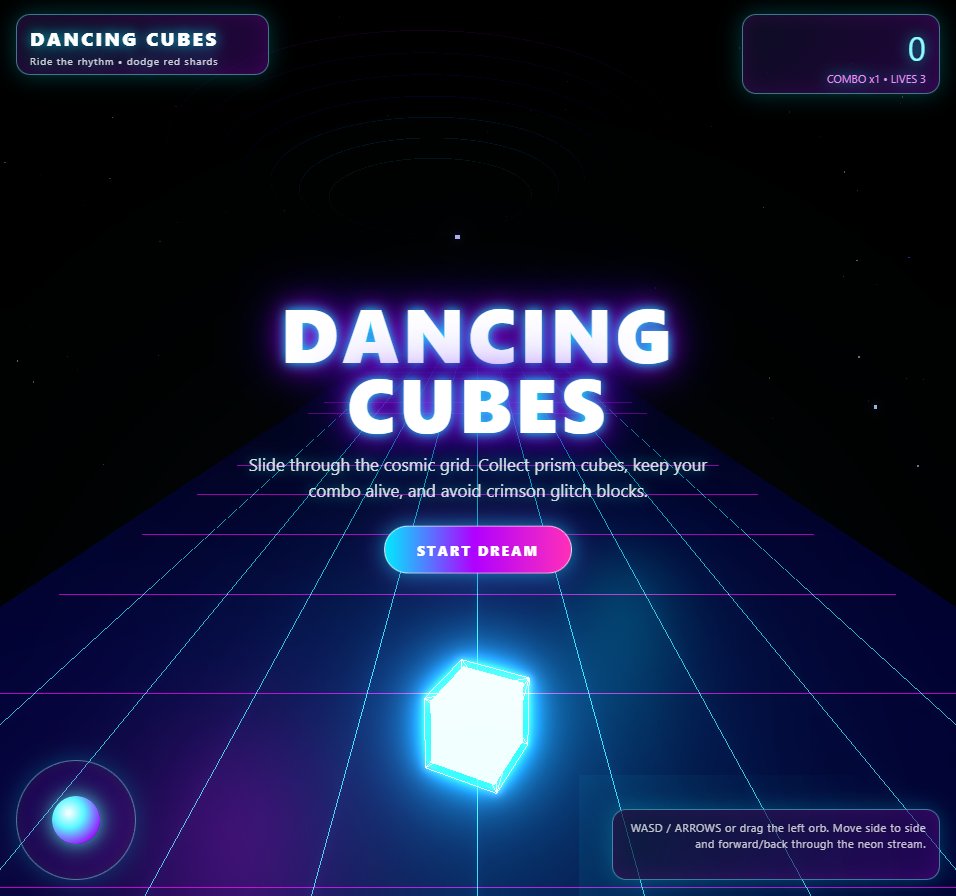
Create a playable 3D rhythm-action endless game titled “Dancing Cubes.” Use a third-person perspective in a neon cosmic/dream setting: a dark purple-black foggy space scene filled with small cyan, magenta, lavender, and pale stars, a glowing retro-futurist floor grid extending into deep perspective, and large alternating cyan/magenta luminous rings in the distance. Render glossy emissive objects with strong bloom and colorful lighting (cyan and magenta point lights, purple ambient light), giving the whole scene an arcade synthwave appearance.

The player is a bright white glossy cube/prism with a strong cyan emissive glow, cyan wireframe edges, and a faint magenta wireframe halo. Place it near the foreground, initially around the center of a wide play area. The player continuously rotates and subtly pulses/bobs to the rhythm. Let the player move horizontally with A/D or left/right arrows, with optional forward/back movement using the normal third-person controls/WASD; constrain horizontal position to roughly -7 to +7 and depth to a short area around the foreground. On mobile, provide a visible circular neon joystick in the lower-left with a draggable glowing cyan/purple thumb. The camera should follow from behind/above at a close third-person distance, gently tracking the player and adding a subtle beat pulse: tiny vertical/depth/roll movement and a slight field-of-view expansion on every beat.

Gameplay is an endless stream of cubes approaching from far ahead (around z=-63 to -72) toward the player (positive z), moving faster gradually as elapsed time increases. Spawn an item every approximately 0.34–1.15 seconds, with the interval shortening over time. Randomize each item’s horizontal position across the play field and its vertical position around the floor, and make each one float sinusoidally, rotate, and slightly scale-pulse as it approaches. There are three item types: cyan collectible cubes/prisms, smaller bright cyan objects worth 10 points; gold collectible cubes, worth 35 points and acting as valuable combo multipliers; and larger red/magenta glitch hazard cubes, initially appearing less often but increasing to a capped probability of about 28% as time passes. Give every cube a bright contrasting wireframe outline.

When the player intersects a cyan or gold cube, remove it and emit a burst of small glowing particles. Award base points multiplied by the current combo: cyan +10, gold +35. Increase combo by 1 for cyan and by 2 for gold. The game runs on a steady half-second beat. If a collectible is hit within about 0.085 seconds of the beat, award double points, add one extra combo, show a brief glowing “PERFECT BEAT” message near the top center, and make a brighter particle/audio response. If a non-hazard collectible passes behind the player without being collected, reset combo to 1. Red hazards do not award points: on collision, subtract one life, reset combo to 1, flash a red particle burst, and grant about one second of invulnerability with the player blinking. Start with 3 lives; when lives reach zero, stop play and show a game-over overlay reading “DREAM BROKEN,” the final zero-padded score, and a “RESTART” button. During play, missed collectibles should continue disappearing after passing the player, while hazards can also pass harmlessly if avoided.

Include simple rhythm audio using Tone.js or an equivalent browser synth after user interaction: a soft half-second kick pulse, bright notes for collected cyan/gold items (gold higher), a low hit sound on hazard collision, and extra high notes on perfect timing. Audio begins from the Start button or Space key.

Build the HUD as fixed HTML overlay over the canvas. Top-left: a bordered translucent dark panel with cyan glow reading “RHYTHM ACTION // 01,” “DANCING CUBES,” and “Ride the rhythm • dodge red shards.” Top-right: a matching panel showing a six-digit zero-padded score starting at “000000,” plus “COMBO x1 • LIVES 3” in pink. At the top/right or lower-right show the instruction “WASD / ARROWS TO MOVE,” “SPACE TO START AUDIO • JOYSTICK ON MOBILE.” Put a tiny pulsing cyan/magenta beat indicator at the top center and the temporary “PERFECT BEAT” label beneath it.

On the initial menu, keep the animated 3D world visible behind a full-screen translucent radial dark overlay. Center a large two-line title “DANCING CUBES” in bold white uppercase text with cyan offset shadow on one side and magenta offset shadow on the other, producing a chromatic glitch effect. Under it show: “Collect cyan prisms, chase gold multipliers, and dodge the red glitch blocks as the beat pulls the dream faster.” Add a prominent bordered gradient button labeled “START DREAM.” Clicking it or pressing Space starts/reset the game with score 0, combo 1, lives 3 and hides the menu. Use a responsive layout, Orbitron-style geometric sci-fi typography, cyan/pink/purple gradients, luminous borders, dark translucent panels, and responsive mobile sizing.