Appearance
Skip to content
Arcade › Critterwild
Critterwild
How to play
Click the game above and it runs right here in your browser. No download, no installer, no account needed. aussie style built it with Cinevva, so it works on a phone or a tablet too.
Discussion
Nobody has said anything about Critterwild yet. Play it, then tell aussie style what you would add next.
Make your own game
Critterwild was built by aussie style with the Cinevva game creator: describe the game you want in chat, watch it get built, and play it in your browser minutes later.
Remix Critterwild opens the real game in the creator and forks its actual files, chat and design doc, so you start from the code rather than from a description.
Read the build brief for Critterwild
Cinevva's analyzer read this game's design doc and its source, then wrote the brief below. "Make your own" hands it to the game creator as your opening message, so you start from a real spec rather than a one-line idea.
Create a browser-based 3D third-person adventure game titled “Critterwild: Gem Frontier” (the in-game title is “Critterwild”). Begin with a full-screen dark teal/blue-green overlay menu over the game world. Center a rounded rectangular card with a translucent deep teal background, thin mint border, and soft shadow. Show the small uppercase text “ORIGINAL BROWSER ADVENTURE”, a large white “Critterwild” heading, and this description: “Explore a living frontier, duel wild creatures, earn gems, and roll a randomized power code. This is an original creature-adventure slice—not an official Pokémon game.” Below it, show three selectable starter cards in a three-column layout: “⚡ Voltling” with “Fast shock attacks”, “🔥 Emberclaw” with “Heavy strike damage”, and “🌿 Mosskin” with “Steady explorer”. Voltling is selected initially with a mint border and brighter green-teal background. Add a full-width mint button labeled “Enter the frontier”. Make the menu responsive so the choices stack on narrow screens.

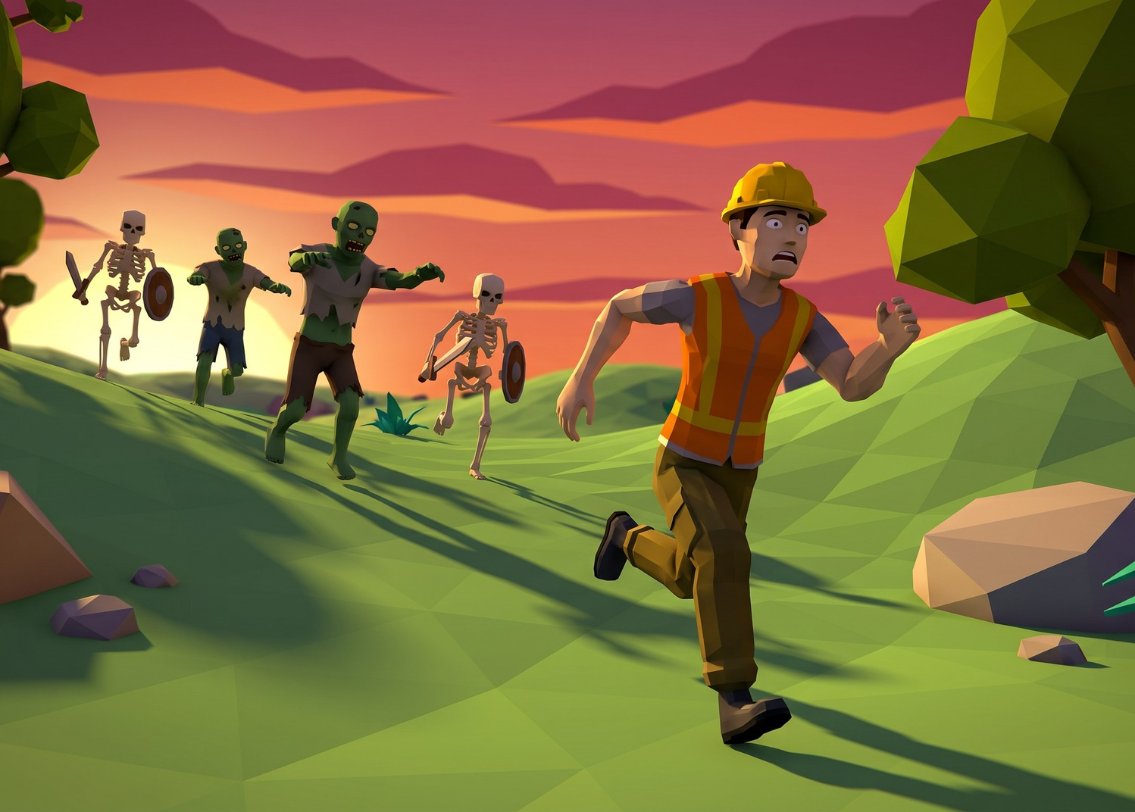
After starting, hide the menu and show a low-poly/stylized 3D wilderness rendered with Three.js. Use a large circular green frontier ground, a tan rectangular village path running through the area, and a round blue lake toward the right/back side. Use a soft mint/blue-green sky-colored background with matching atmospheric fog, warm directional sunlight, ambient hemisphere lighting, shadows, and an angled third-person perspective camera following the player from behind at roughly 8 units away. The camera should orbit/follow the player and support standard third-person movement and jumping through the game’s third-person controls; movement speed is 6, jump speed is 9, and gravity is -22.

The player is a cute animated monster model, initially placed near the front of the path, recolored according to the selected starter: bright pale cyan for Voltling, orange/coral for Emberclaw, or light green for Mosskin. Use a cute animated alien-like creature model as the player, with looping animation, casting and receiving shadows. Populate the frontier with stylized low-poly environmental assets: trees around the perimeter and in the distance, bushes, and scattered rocks. Specifically place trees approximately at (-18,-10), (-12,-25), (17,-8), (28,-25), (22,13), and (-24,15); bushes near (-5,-5), (8,-28), (19,5), and (-20,-23); rocks near (-3,-2), (12,-6), (-16,-17), and (25,-10). Include a blue lake centered approximately at (24,-19).

Place four animated wild creatures as enemies: cactus-like “Cactoid” creatures at approximately (-7,-10) and (10,-17), and bat-like “Nightwing” creatures at approximately (15,3) and (-14,-25). They face toward the player and slowly move toward the player when within 10 world units. Each enemy starts with 2 HP, has a looping animation, and is defeated after two successful attacks. Keep defeated enemies hidden rather than removing them from the scene.

Overlay a HUD above the 3D scene. At top left, show a dark translucent rounded pill with a gem icon and “0 gems” followed by “·” and the selected starter name, such as “💎 0 gems · Voltling”. At top right show another dark translucent pill with a crossed-swords icon and the status text “Explore the wilds”. At the bottom-right, show a mint primary button labeled “Spark Strike” and a darker outlined secondary button labeled “Cheat Code Lab · 25💎”. Display centered toast notifications near the top when events occur.

Implement the core interaction exactly: Spark Strike searches for the nearest living wild creature within 4 world units. If none is close, show the toast “Move close to a wild creature”. If one is close, reduce its HP by 1, play its hit-receive animation if available, and show “Hit! One more strike” while it remains alive. On the killing blow, hide the enemy, award 10 gems, award 100 score internally, and show “Wild [enemy name] defeated +10 gems”. Start the game with 0 gems and score 0. The top HUD updates the gem count and starter name.

Implement the Cheat Code Lab button: it costs 25 gems and does nothing if the player has fewer than 25, showing “Need 25 gems”. If affordable, subtract 25 gems and randomly choose one label from: “SUPER JUMP”, “SUPER SPEED”, “WATER WALKING”, “GHOST MODE”, “TIME FREEZE”, “METEOR STRIKE”, “DOUBLE JUMP”, or “RARE CREATURE FINDER”. Put the selected label in the top-right status in place of the normal status and show “Unlocked [label]!”. Only SUPER SPEED should actually change the controls (movement speed to 11), and only SUPER JUMP should actually change the controls (jump speed to 15); the other results can remain as displayed labels with no extra implemented effect. Use a clean, polished dark teal UI with white text, mint accents, rounded cards/buttons, and a cozy low-poly creature-adventure visual style. Ensure touch-friendly buttons and responsive layout on mobile screens.