Appearance
Skip to content
Arcade › Cinevaa AI
Cinevaa AI
How to play
Click the game above and it runs right here in your browser. No download, no installer, no account needed. Stormix built it with Cinevva, so it works on a phone or a tablet too.
Discussion
Nobody has said anything about Cinevaa AI yet. Play it, then tell Stormix what you would add next.
Make your own game
Cinevaa AI was built by Stormix with the Cinevva game creator: describe the game you want in chat, watch it get built, and play it in your browser minutes later.
Remix Cinevaa AI opens the real game in the creator and forks its actual files, chat and design doc, so you start from the code rather than from a description.
Read the build brief for Cinevaa AI
Cinevva's analyzer read this game's design doc and its source, then wrote the brief below. "Make your own" hands it to the game creator as your opening message, so you start from a real spec rather than a one-line idea.
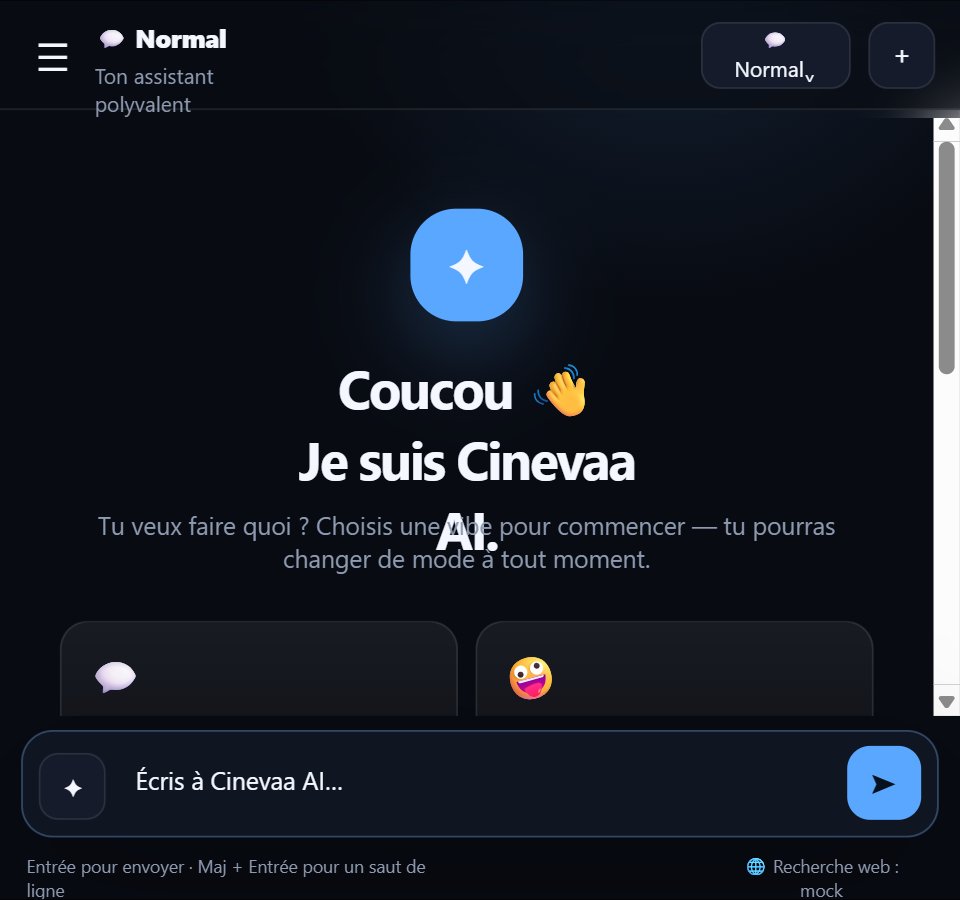
Rebuild a responsive French-language web app/game called “Cinevaa AI”, presented as a polished local AI chat companion rather than an arcade scene. Use a dark navy/black interface with subtle radial purple glow, thin blue-gray borders, rounded cards, cyan/violet accents, and soft neon shadows. On desktop, use a fixed left sidebar about 282px wide and a large main panel; on mobile, hide the sidebar behind a hamburger menu and show a compact top bar with the CINEVAA brand and settings button.

Branding and layout: the sidebar has a ✦ logo tile, “CINEVAA”, and “AI • 100 % LOCAL”, a prominent violet gradient “+ Nouvelle conversation” button, a RÉCENTES conversation list with up to eight saved chats, a MODES list, and bottom actions for “🧠 Mémoire locale” and “⚙️ Paramètres”. The main header displays “CINEVAA AI”, a green “● HORS LIGNE” indicator, the current mode title, a “⇩ Sauvegarder” button on desktop, and a green check status orb. The initial central welcome card says “TON IA. TON UNIVERS.” and “Salut, je suis Cinevaa.”, explains that it works without API, account, or Internet, shows a friendly emoji avatar, and provides quick-action buttons: “🎲 Lance un dé”, “💡 Une idée de jeu”, “🧠 Un quiz”, and “📚 Explique-moi un truc”. At the bottom, provide a rounded textarea placeholder “Écris quelque chose à Cinevaa...”, microphone button, purple send arrow, and a note indicating local responses, keyboard sending, and memory status.

Core interaction: users type messages and send with the arrow or Ctrl/Cmd+Enter. Append user and assistant messages as chat bubbles with timestamps; user bubbles are right aligned with a violet gradient, assistant bubbles are left aligned in dark panels with an emoji avatar. Show a short “🤔 Cinevaa réfléchit...” thinking state before replies. Persist conversations, selected mode, memory, and game state in localStorage so the app is genuinely offline and survives reloads. Starting a new chat creates a blank conversation; the first user message becomes a truncated chat title. Allow selecting saved chats from the sidebar.

Implement eight selectable modes, each with an icon, label, and title: NORMAL / Conversation générale (💬), DÉJANTÉ / Mode déjanté (🤪), PROF / Mode professeur (📚), IDÉES / Générateur d’idées (💡), CRÉATIF / Atelier créatif (✍️), QUIZ / Quiz local (🧠), JEU / Zone de jeux (🎮), and EXPÉRIMENTAL / Laboratoire expérimental (🧪). Selecting a mode immediately inserts an introductory assistant message and changes the header title. Normal replies should be rule-based and local, with varied responses for greetings, thanks, goodbyes, identity questions, and fallback questions. The assistant identifies itself as Cinevaa and explicitly explains that it uses local intents, rules, response variants, local memory, calculations, built-in facts, and mini-games—not an external API.

Include the actual rule-based activities: recognize basic arithmetic expressions using +, -, *, /, ×, ÷, %, parentheses and decimal commas, then return a locally computed formatted result. Include built-in factual answers for France, the Sun, water, the Internet, Mars, Molière, Python, and algorithms. Include a dice roll command returning a random 1–6 result. Include rock-paper-scissors in French with random computer choice and win/loss/draw result. Include a riddle activity with a random riddle, answer checking, and an “indice” hint. Include a five-question local multiple-choice quiz: Mars as the red planet, 9×7, author of The Little Prince, largest ocean, and the programming language represented by a snake; show question number, choices 1–3, track score, give right/wrong feedback, and show the final score. Include a mini RPG called “Le Slime Cosmique”: initialize player at 20 PV and slime at 18 PV, then accept “attaque”, “soin”, or “fuite”; attacks deal random damage and the slime retaliates, healing restores a random amount up to max health, and show victory/defeat/flee outcomes. These game states must persist locally.

Mode-specific behavior: in ideas mode, generate one of several fixed idea seeds such as a cooking game in a space station, habits becoming quests, a city where shadows talk, a robot gardener, or a museum whose objects tell different histories, then suggest a gameplay loop with a short mission, risky choice, visible consequence, and strange reward. Prof mode gives simple explanations with a definition/example/practice framing. Creative mode generates a short mysterious story about memories as fireflies and a midnight door. Crazy mode gives playful absurd responses involving a cosmic toaster, expert hamsters, or an interdimensional banana. Experimental mode gives a playful hypothesis about the user’s message.

Memory and utility UI: infer and store a user name from phrases such as “je m’appelle”, “mon nom est”, “appelle-moi”, or “tu peux m’appeler”; retain a small list of preference statements and recent topics. Show memory status in the composer. The memory modal must explain that data stays in local storage, show remembered name, preference count, recent topic count, and an “Effacer” control. The settings modal must state “CINEVAA AI — 100 % LOCAL”, show conversation count, allow changing the remembered name, and provide reset-all conversations. The save/export modal should show a read-only text summary of the current conversation and a copy button. Use toast notifications for copied, erased, and saved actions. The microphone button should not pretend to use a service; show a toast that dictation depends on the browser and the user can type to remain fully local.

Keep all copy and labels in French. Make the interface polished and accessible with responsive sizing, keyboard-friendly buttons, auto-growing textarea, scrollable conversation area, modal backdrop/close behavior, hover states, and a clean empty-state welcome card. Do not add remote networking, accounts, external APIs, server calls, or unshown combat graphics; the experience is a self-contained conversational UI with text-based mini-games and local persistence.