Appearance
Skip to content
Arcade › Astral Reach
Astral Reach
How to play
Click the game above and it runs right here in your browser. No download, no installer, no account needed. It was built with Cinevva, so it works on a phone or a tablet too.
Discussion
Nobody has said anything about Astral Reach yet. Play it, then tell the creator what you would add next.
Make your own game
Astral Reach was built with the Cinevva game creator: describe the game you want in chat, watch it get built, and play it in your browser minutes later.
Remix Astral Reach opens the real game in the creator and forks its actual files, chat and design doc, so you start from the code rather than from a description.
Read the build brief for Astral Reach
Cinevva's analyzer read this game's design doc and its source, then wrote the brief below. "Make your own" hands it to the game creator as your opening message, so you start from a real spec rather than a one-line idea.
Create a browser-based 3D space-flight game titled “Astral Reach.” Use a very large third-person perspective space scene rendered in a dark, almost black environment with subtle deep-blue exponential fog. Populate the background with roughly 12,000 small white-to-gray stars spread through a huge spherical volume, plus two extremely faint translucent purple/blue nebula spheres. The camera is a 75-degree perspective camera with a very far view distance, normally positioned behind and above the player ship, looking toward the ship’s forward direction.

The player controls a detailed metallic sci-fi spacecraft, approximately 1.6x scale, initially positioned near the central space station at world coordinates around (1200, 420, -800). Start it with a slight tilted orientation. Use a third-person chase camera offset about 11 units upward and 38 units behind the ship; keep a small circular white crosshair fixed at the center of the screen. Mouse-look is enabled after clicking the canvas to lock the pointer: horizontal mouse movement changes yaw and vertical movement changes pitch, with pitch clamped to roughly +/-1.35 radians. The ship’s forward direction is its local negative Z axis.

Implement inertial six-degree-style space movement rather than instant stopping. W applies forward thrust (about 92 acceleration), S reverse thrust (about -48), A/D strafe left/right (about +/-72), Q/E move vertically (about +/-64), and holding either Shift key multiplies normal thrust by about 2.8. Space acts as a brake by repeatedly reducing velocity to 82%. Apply slight continual space drag (velocity multiplied by about 0.996 each frame). Apply gravity from the nearest planet only within about 3,200 units, pulling toward that planet with strength increasing as the ship approaches. R immediately resets velocity to zero. Show small cyan/blue point-like thruster particles behind the ship while W or S is held.

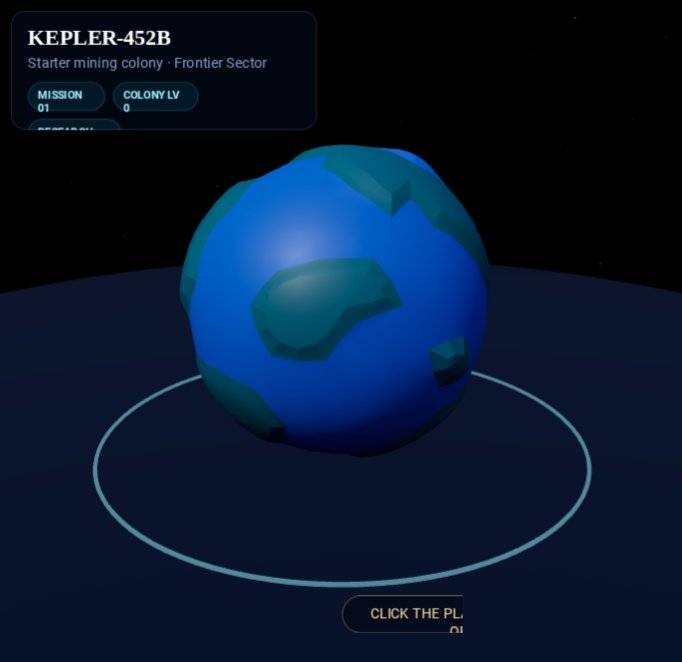
Build a solar-system slice with these visible bodies: Terra, a lush green planet of radius about 850 at the origin, with a faint blue translucent atmosphere; Vulcan, a red-brown rocky planet of radius about 720 at approximately (6200, 1200, -4800), with a faint reddish atmosphere; and Eos, a distant blue-gray/icy planet of radius about 310 near (19200, 2800, 15200). Add a small glowing pale-yellow sun at approximately (-3200, 1100, 2800), surrounded by a faint orange glow. Use directional warm sunlight, low ambient blue light, and a blue/dark hemisphere light so the planets and ships have shaded, dimensional surfaces and soft shadows. Planet collisions should not destroy the ship: if it intersects a planet, push it back to just outside the surface and reflect/reduce its velocity for a soft bounce.

Place a large modular space station near the starting ship at about (1450, 380, -650). Construct it from multiple wall-and-door modules arranged in a ring of seven pieces around a central raised hub, giving it a small city-like orbital-station silhouette. Add a second detailed NPC spacecraft near the station/central region. Have this NPC patrol continuously along a broad looping path: its X and Z coordinates oscillate over time, its Y position gently bobs, and it continually faces the player ship. Near Vulcan, add a field of roughly 14 irregular rocky asteroids with varied scales, rotations, and positions distributed around the planet.

Add simple landing-zone props: scattered large green grass/forest-like modular objects on Terra and Vulcan surfaces. The player may land only when close enough to the nearest planet (distance less than planet radius + 95) and moving slowly (speed below 28). Press L to land when eligible. On landing, snap the ship to the nearest point on the planet surface at radius + 4, stop all velocity, orient it flat against the surface, and switch to a surface mode. In surface mode, W/S move the ship across the surface at about 22/14 units per second and A/D shift it laterally at about 18 units per second; continually constrain it back to the planet surface radius + 3.5. Use a closer angled surface camera offset about 28 upward and 52 behind the ship. While landed, pressing L takes off: leave surface mode, apply an upward velocity of about 38, move slightly away from the surface, and return to space mode. When landing, add several nearby modular wall/building props around the landing position.

Create a minimal monochrome HUD in the upper-left with four stacked readouts in a clean system sans-serif style over semi-transparent black rectangles: “SPEED: 0 m/s” (updated from current velocity), “DIST TO [NEAREST PLANET]: [distance]” (updated continuously), “MODE: SPACE” or “MODE: LANDED ON TERRA/VULCAN/EOS,” and the static location line “SYSTEM: SOL-2 | SECTOR: 01.” At the lower-left show compact instructions in white text: “CLICK to lock mouse | W/S thrust | A/D strafe | Q/E vertical | SHIFT boost | SPACE brake” followed by “L to land / take off when near planet | R reset velocity.” Keep the canvas full-screen, hide page scrolling, use a black page background, and retain the sparse cinematic presentation: most of the screen is dark space with distant stars, planets, station, asteroids, and ships gradually becoming visible as the player flies.