Appearance
Skip to content
Arcade › Arena 56
Arena 56
How to play
Click the game above and it runs right here in your browser. No download, no installer, no account needed. ps2163 built it with Cinevva, so it works on a phone or a tablet too.
Discussion
Nobody has said anything about Arena 56 yet. Play it, then tell ps2163 what you would add next.
Make your own game
Arena 56 was built by ps2163 with the Cinevva game creator: describe the game you want in chat, watch it get built, and play it in your browser minutes later.
Remix Arena 56 opens the real game in the creator and forks its actual files, chat and design doc, so you start from the code rather than from a description.
Read the build brief for Arena 56
Cinevva's analyzer read this game's design doc and its source, then wrote the brief below. "Make your own" hands it to the game creator as your opening message, so you start from a real spec rather than a one-line idea.
Rebuild “Arena 56” as a browser-based 3D 1v1 fighting game using Three.js. The game opens on a dark, polished menu titled Arena 56 with the subtitle describing a fast 3D fighting game slice, a 56-character roster, animated 3D rigs, mobile support, and best-of-three arena duels. Provide buttons for “Choose Fighter” and “Quick Random Match.”

Fighter selection must show all 56 fighters in a selectable grid: generate them from 8 archetypes with 7 variants each. The archetypes are Tempo striker, Heavy bruiser, Balanced duelist, Long-reach tactician, Counter specialist, Rushdown brawler, Technical hybrid, and Aerial skirmisher. Use the actual roster identity and presentation style: unique futuristic names such as Rift Vale, Nova Jett, Bram Forge, Sable Cross, Lyric Pike, Kestrel Noon, Blitz Mercer, Orin Slate, and Skye Nox; every fighter has a style, short lore description, four visible stats (Power, Speed, Reach, Guard), a named special move, an individualized palette of primary/secondary/accent colors, and slight body-proportion variations (height, shoulder width, limb length, and bulk). The selection screen should have a dark glassmorphism panel, colored swatches on each tile, a preview card with a simple colored fighter silhouette, lore/style text, and horizontal stat bars. Selecting a fighter highlights its tile; the CPU chooses a different random fighter unless the match is rematched.

The fight takes place in a circular futuristic arena viewed from a fixed third-person perspective behind and slightly above the stage, with a perspective camera that subtly follows the midpoint and spacing of the combatants. Use a deep navy/black background with blue atmospheric fog and a blue gradient dome/backdrop. The stage is a broad dark circular platform with a slightly raised cylindrical base, a dark blue central circular plate, and a glowing cyan-blue ring around its edge. Surround it with 12 evenly spaced tall dark-blue cylindrical pillars topped with warm cream/gold glowing spherical lamps. Add dim abstract crowd/light bars around the sides in cool blue and warm red/orange colors. Use strong warm directional light, cool ambient hemisphere lighting, soft shadows, metallic/rough stage materials, and a glossy arcade presentation. On impacts, pulse the glowing ring and floor, briefly brighten the arena feedback, and emit small colored hit-spark particles that fly outward and fall.

Build each fighter procedurally from mesh parts rather than using images: a stylized humanoid made from box-like pelvis, torso/chest, upper arms, forearms, thighs, shins, feet, a spherical head, and a small block of hair. Apply the fighter’s primary, secondary, and accent palette to the parts. Vary proportions according to the selected fighter’s body data, add a faint translucent colored ring/aura beneath each character and a soft shadow disk. Place the player on the left and the CPU rival on the right, facing each other. Animate idle bobbing/twisting, walking arm/leg swings, jumping poses, punches, kicks, specials, blocking, hurt reactions, and a knock-out fall by rotating the procedural rig parts. Fighters should turn to face the opponent automatically.

Implement a best-of-three match: each round starts with both fighters at 100 health, player around x=-2.8 and CPU around x=2.8, a 99-second timer, and a centered announcement such as “Round 1” followed by “Fight!”. Win a round by reducing the opponent’s health to zero for a KO, or when time expires, award the round to the fighter with greater remaining health (player wins ties). After a short delay, start the next round with fresh health and positions; the first fighter to win two rounds ends the match and displays a Victory or Defeat result panel with the two fighter names/styles. Include Rematch and New Fighter options.

Use the actual combat rules: desktop player controls are A/D or Left/Right to move, W or Up Arrow to jump, J to punch, K to kick, L to hold block, and I to trigger the special. On responsive/mobile layouts, show touch controls with left/right arrows, jump, block, punch, kick, and special buttons. Punches are quick, kicks are slower but have more reach and damage, and specials are the strongest/longest attacks but have a roughly 2.8-second cooldown. Attack timing has startup, active, and recovery phases; allow one hit per attack. Power scales damage, speed affects movement and some special startup, reach extends attack range, and guard greatly reduces blocked damage. Punches use approximately 7 + power*5 damage with about 1.1 + reach*0.65 range; kicks use about 10 + power*6 damage with about 1.28 + reach*0.9 range; specials use about 15 + power*10 damage with about 1.45 + reach*0.95 range. A successful hit causes hit-stop, hitstun, knockback, upward lift, a brief white flash on the struck fighter, particles, and a floor pulse. Blocking is only grounded and facing the incoming attack, substantially reducing damage and knockback, and displays a brief “Guard!” announcement. Keep fighters within horizontal arena bounds and prevent them from overlapping closely.

The CPU should be an AI rival that periodically chooses an intent based on distance and health: approach when far away, sometimes retreat at close range, sometimes block, and otherwise attack. It should use punch at close range, kick at moderate range, special when available and in range, jump occasionally in response to an airborne player, and move toward or away from the player as appropriate. Include combat states idle, walk, jump, punch, kick, special, block, hurt, and KO, with action animations and state transitions matching the rules above.

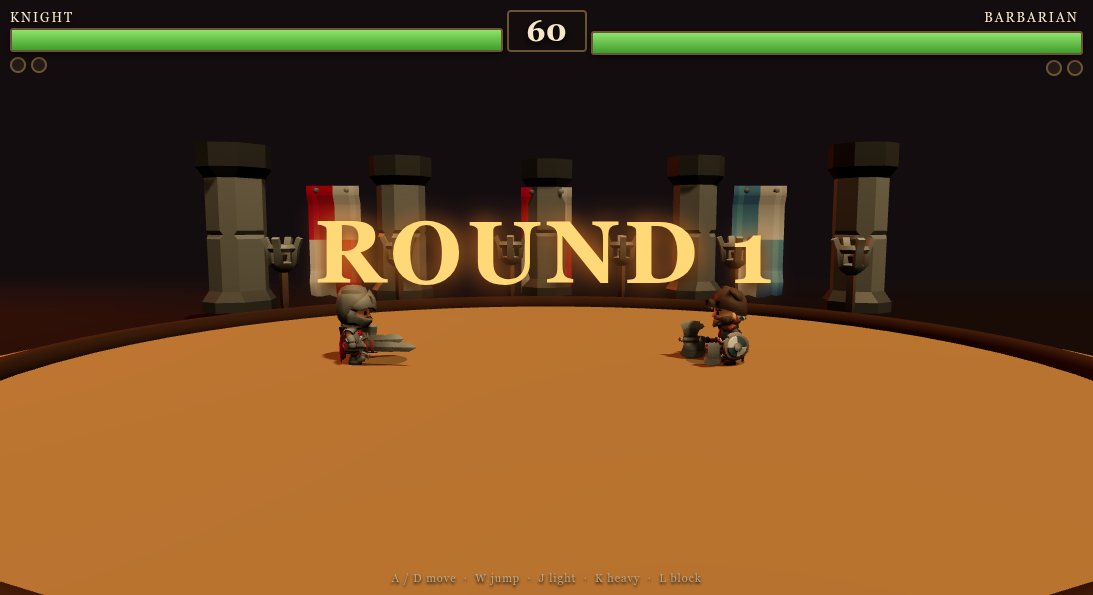
The in-fight HUD must remain as a clean overlay over the 3D scene. Across the top show a left player card and right CPU card with fighter names, colored health bars (warm red/orange for the player and cyan/green for the CPU), and two round-win dots per side. Center them with a glass panel showing the current Round label and large countdown timer. Show temporary centered announcements for Round, Fight!, Guard!, KO!, and Time Up!. On desktop include a small bottom control hint; on smaller screens replace it with touch controls. Use responsive dark translucent panels, rounded borders, blur, cool blue/cyan accents, warm gold highlights, and high-contrast white typography throughout. Do not add local multiplayer, sound/music, stage hazards, multiple arenas, character portraits, combo chaining, or character-specific special behavior beyond the stat/palette/name variation and the shared attack framework, because those are not part of the implemented game.