Arcade › After the Bell
After the Bell
How to play
Click the game above and it runs right here in your browser. No download, no installer, no account needed. Reni built it with Cinevva, so it works on a phone or a tablet too.
Discussion
Nobody has said anything about After the Bell yet. Play it, then tell Reni what you would add next.
Make your own game
After the Bell was built by Reni with the Cinevva game creator: describe the game you want in chat, watch it get built, and play it in your browser minutes later.
Remix After the Bell opens the real game in the creator and forks its actual files, chat and design doc, so you start from the code rather than from a description.
Read the build brief for After the Bell
Cinevva's analyzer read this game's design doc and its source, then wrote the brief below. "Make your own" hands it to the game creator as your opening message, so you start from a real spec rather than a one-line idea.
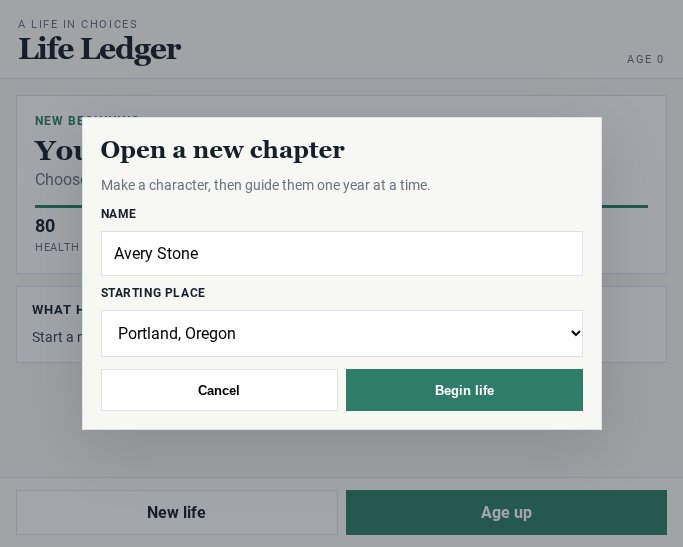
Recreate “After the Bell” as a browser-based, choice-driven teenage life simulation with a dark, polished, responsive dashboard UI. The game is 2D UI rather than a physical world: no avatar movement or action combat. Use a deep navy/black radial-gradient background, glassy blue-gray panels with rounded corners and subtle borders/shadows, white and muted blue-gray text, purple-to-pink accent gradients, purple buttons, green/red notification accents, progress meters, and emoji icons. On small screens collapse the desktop layout into a vertical responsive layout and hide the left life panel. Begin with a full-screen character-creation modal/card titled “After the Bell.” It should explain that the player builds a teenage life where people remember, routines happen automatically, and meaningful choices shape the year. Provide fields for name (default Alex), age select with 14 freshman, 15 sophomore, 16 junior, 17 senior (default 15), birthday date, gender (nonbinary, girl, boy, custom), appearance (streetwear, athletic, artsy, classic, alt), starting location (Maplewood, Harbor City, Pine Ridge, Lakeview), personality (curious, bold, kind, funny, driven, impulsive), family situation (steady home, busy guardians, blended family, single guardian, more independent), difficulty (story/forgiving, standard, hard/more pressure), and interests checkboxes allowing up to four from Music, Sports, Art, Games, Science, Fashion, Writing, Cooking. The large primary button reads “Begin sophomore year” (even if another age is selected). Starting should hide the creator and reveal the life dashboard. The main dashboard has a top header with the game title, a changing subtitle (“A year that will remember you,” or context text if stress is high or a rumor is active), and a date pill showing weekday, month, and day. Beneath it is a horizontally scrollable navigation bar with HOME, SCHOOL, PEOPLE, RELATIONSHIPS, ACTIVITIES, MONEY, INVENTORY, PHONE, MAP, STATS, and SETTINGS. Use a three-column desktop layout: left “Your life” panel, central current screen, and right “People & memory”/notification panel. The left panel shows a purple gradient hero card with the player name and a bio such as age, year, location, and appearance. Under it, show stat cards with numeric values and horizontal meters for Health, Happiness, Energy, Stress, Intelligence, Confidence, Reputation, Popularity, Discipline, Grades, Social life, and Cash. Initial state should resemble the code: health 86, happiness 65, energy 78, stress 22, intelligence 61, confidence 52, reputation 55, popularity 39, discipline 60, grades 68, social 45, cash 48. Keep values generally clamped from 0 to 100 for ordinary stats. The right panel lists five key people with emoji avatars, names, roles/traits, and trust values, plus a scrollable notification log of dated story changes with General/School/Friends/Family/Phone/Trouble/Money/etc. categories and green/red styling. The HOME screen is the core loop. Show a highlighted story event card with title, narrative text, and exactly three large stacked choices. Each choice has an emoji, a bold action label, and a smaller consequence-flavored description. Meaningful events include surprise quizzes, Maya asking for advice, rumors, parties, sketchy offers behind the gym, teacher opportunities, group-chat bullying, weekend jobs, family arguments, club fair decisions, Leo asking for help, and social-media posts. Choices alter stats, money, trouble, followers, skills, family trust, and individual relationship trust/friendship, and add a short entry to the notification/memory log. Include contextual event selection: trouble can expose the underground offer, no club can trigger the club fair, low grades can trigger teacher help, and high social can trigger the party. If the player ignores an event by advancing, log that people noticed and clear it. At the bottom of the central panel provide a primary “Continue day” button and secondary “Save moment” button. Continuing runs an automatic daily routine: energy recovers, stress reduces, health changes based on stress, happiness fluctuates slightly, a job may earn money, low energy can hurt grades, grounding can reduce social life, trouble can cause reputation loss and detention, and a friend’s trust can shift randomly. Then increment the day and weekday, occasionally begin a new month, age the player and year at the birthday interval, grant a small weekly grade check, potentially award detention for high trouble, generate the next event, and rerender. Saving writes the current story to local storage; Settings includes “Start a new life” to clear the save. Implement these navigation screens and actions faithfully: - SCHOOL: show High school or Middle school based on age, grades/intelligence, detention and suspension counts, and buttons for Study (grades and academics skill up, energy down, stress up), Participate in class (grades, discipline, confidence up), and Skip a class (grades/discipline down and trouble up). - PEOPLE and RELATIONSHIPS: list Maya Chen (loyal best-friend energy), Jordan Reyes (competitive captain/rival), Sam Okafor (observant creative wildcard), Riley Brooks (driven quiet overachiever), Ms. Park (fair English teacher), and Leo Torres (protective older sibling), with emoji avatars, roles/opinions, trust meters, and a Text button. Texting increases that person’s trust/friendship and social life and logs that they remember the outreach. - ACTIVITIES: card buttons for Study, Practice music, Exercise, Hang out, Make something, and Do a chore, with the visible descriptions and corresponding stat/skill effects. Practice music can add a “song draft” inventory item; exercise raises health and athletics while reducing stress and energy; hanging out raises social/happiness but costs money; chores raise discipline/family trust while costing energy. - MONEY: show cash and whether there is no job or a cafe job; allow looking for a job, buying something for0 (adds “new outfit”), and buying a gift for $8 (adds “gift for a friend”), with insufficient-funds messages. - INVENTORY: display chip-style items initially including phone, school supplies, and hoodie, with the note that items may unlock choices, change impressions, or become gifts. - PHONE: show four card-like options: Messages (can generate/activate an event), Calls (raise social life and cost energy), Social media (raise followers and popularity), and Calendar (switch to stats/timeline view). - MAP: show the starting location and four destinations as cards: School campus, Corner café, Riverside park, and Town center. Visiting costs energy and logs ordinary travel/time spent. - STATS: show skill meters for academics, creativity, music, athletics, social, cooking, organization, and leadership, plus a timeline summary with day, month, age, and number of memories. - SETTINGS: show current difficulty and explain that ordinary routines are simulated so the story can focus on meaningful moments, plus the new-life reset. Track the player’s persistent state: name, age/year/day/month/weekday, location, personality, interests, family situation, difficulty, all displayed stats, skills, job/club/grounded/detention/suspension/trouble/followers/attendance flags, inventory, people relationships, memories, notifications, current event, and used events. The experience should feel like a warm but tense coming-of-age dashboard about school, friends, family, ambition, mistakes, secrets, and being remembered; present consequences through text and changing meters rather than inventing combat, exploration, or cinematic scenes.More free browser games