Qwen-Image-2.1 generates sprites with a real alpha channel, under a license that says non-commercial
Alibaba's Qwen team put Qwen-Image-2.1 on Hugging Face and ModelScope on September 20 with no keynote and barely a blog post. It's a single model for text-to-image and image editing with 7B parameters in its visual generation component, and the feature that makes it interesting for games is that it generates images with a real alpha channel. Ask for a sticker, a prop, or a character cutout and you get RGBA back, not a subject on a white background you then have to matte out. Model card, GitHub.
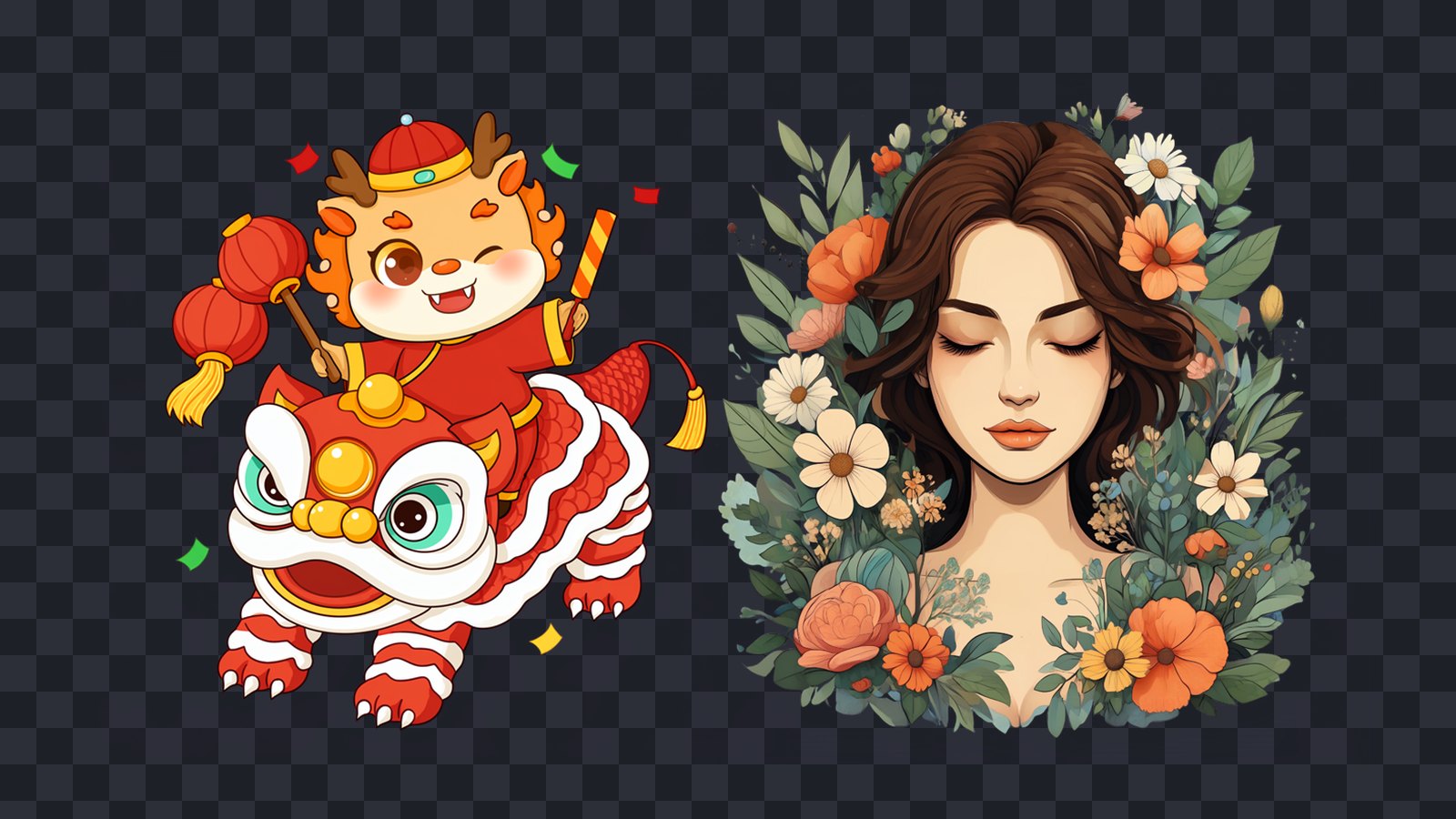
Two RGBA outputs from the release examples, placed on a checkerboard. Images: Qwen team, Alibaba.
What it does
The model handles three jobs that used to need three tools. It generates regular or transparent images from text. It edits, with up to ten reference images so you can keep a character or product consistent across shots, and local edits you specify by circling a region, painting over it, or supplying a mask. And it extracts: give it a photo and ask for the subject as a transparent layer, and it returns the cutout with the alpha already there.
Output is native 2K. The default square is 2048 by 2048, and the 16:9 preset is 2752 by 1536, generated at that size rather than upscaled. The Qwen team credits a mixed-granularity attention scheme and prefix KV cache reuse for keeping inference cost low at that resolution. ComfyUI shipped support on day one and describes the model as fitting comfortably on consumer cards, and The Decoder reports it running on an RTX 3090. For transparent output the recommended prompt is blunt: you tell the model in plain text that this is an RGBA image with an alpha channel and a transparent background, and it complies. ComfyUI blog, The Decoder.
The benchmark, and the discount
The one chart in the README ranks 30 image models on the Qwen team's own overall score. Qwen-Image-2.1 sits seventh at 60.28, behind GPT Image 2.5, GPT Image 2, Grok Imagine 2.0, Qwen's closed Image 3 Pro, Meta's Muse Image, and Microsoft's MAI Image 2.5 Pro, and ahead of Nano Banana 2.0 and every Seedream. The point the chart is really making is in the second row: the closed models above it don't publish parameter counts, and the open models below it are much larger. FLUX 2 Max and Pro are 32B, Qwen-Image-2512 is 20B, Hunyuan Image 3.0 is 80B. A 7B model scoring above all of them is the claim.
It's a vendor benchmark, scored by the vendor, on a scale the vendor designed, so it gets the usual discount. What we can say from the examples is that text rendering and multi-reference composition look as good as the chart implies, and that the transparency is real: the alpha edges on the release samples are clean rather than a halo of near-white pixels.
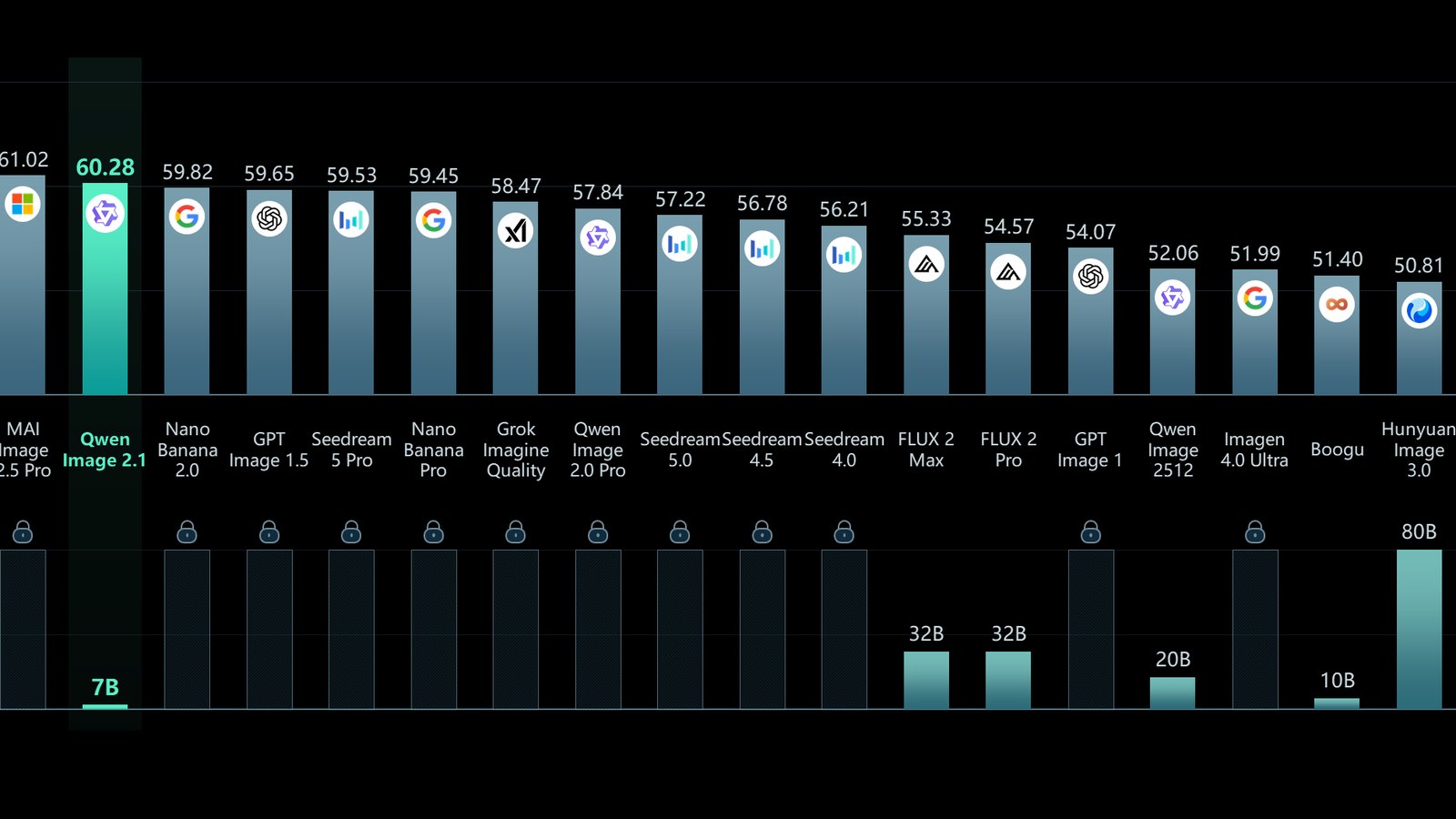
The README chart: score on top, parameter count below, locks for models that don't disclose it. Image: Qwen team, Alibaba.
Read the license before you build on it
The first Qwen-Image, in August 2025, shipped under Apache 2.0. This one ships under the Qwen Research License Agreement, dated the same day as the release, which grants use for non-commercial purposes only and points commercial users to a separate negotiated license. Open weights, yes. Open for your game's asset pipeline, no, unless your game is a hobby project or you go and get the other license.
That matters more for this model than most, because its best feature is a production feature. Transparent sprites, icons, and cutouts are things you ship, not things you experiment with. A studio that wires this into its pipeline on the strength of the Hugging Face download and finds out about the license at launch has a problem.
Why this lands on us
Sprites and UI art are the images our creators ask for most, and the alpha channel is where every general-purpose image model has let them down. Our image tool runs on Flux, which generates a subject on a background, and the background removal that follows is the step that produces fringed edges and lost detail on hair, fire, and glass. A model that generates the alpha in the first place removes that step, and the release samples suggest it removes it well.
We can't host this one for you. The license rules out running it as a paid service, and a research license that forbids commercial use also rules out the outputs going into a game you sell. So the honest advice is the same as for every model release we cover: the technique will spread, and the next open image model with a permissive license will very likely have native RGBA too, because Qwen just showed it working at 7B. Until then, our sprite and tileset guide covers the sources you can ship today, and the game asset licenses guide explains why "open weights" and "free to use" aren't the same sentence.