World Labs' Atlas is one model that generates, reconstructs, and simulates 3D worlds
Fei-Fei Li's World Labs published Atlas on September 1, calling it "a world model for spatial intelligence." Strip the tagline and the technical claim is specific: Atlas is one multimodal autoregressive diffusion transformer, pretrained from scratch, that natively takes text, images, video, camera poses, and depth as input, and produces images, video, point clouds, and 3D Gaussian splats as output. Not a video model with a 3D head bolted on, and not a reconstruction model with a generator in front. One network.
World Labs says Atlas "will power future versions of Marble," its scene-generation product that launched last November, and that it improves with training compute in the way language models have. Access is by request for selected partners. There's no pricing and no public API.
Three jobs, one model
The first job is camera-controlled generation. Give Atlas an image and a camera path, and it renders video along that path for up to a minute at 1440p. Because the camera is an explicit geometric input rather than a text hint, the model can't wander. World Labs ran human preference tests against five current video models on camera-controlled generation and reports evaluators picked Atlas 75% of the time over MiniMax H3, 81% over Gemini Omni Flash, 86% over Happy Horse 1.1, 93% over FLUX 3, and 94% over Seedance 2.5.
The second job is reconstruction, and this is the part I'd pay for today. Feed Atlas anywhere from one to over a hundred photos of a real place and it produces a point cloud or a Gaussian splat scene, with camera positions recovered. World Labs claims it beats models built specifically for 3D reconstruction, including Pi3X and VGGT, on mean absolute relative error across standard benchmarks such as DTU, ETH3D, KITTI, and ScanNet, and that with two or three images it "delivers faithful results and outperforms specialized 3D models." Because reconstruction and generation live in the same network, it can also extrapolate: hand it one street-level photo and it will produce an aerial view of the block that isn't in any input.
The third job is simulation. Atlas can reframe a captured video from three to five new camera angles, model rigid, articulated, and deformable objects being interacted with, and render RGB and depth from a robot's point of view. World Labs ran five robot platforms in Atlas-generated environments for an hour each without human intervention. "The world and the robot's view of it come from the same model," the post says, and that's the sentence that explains why the company raised the money it did.
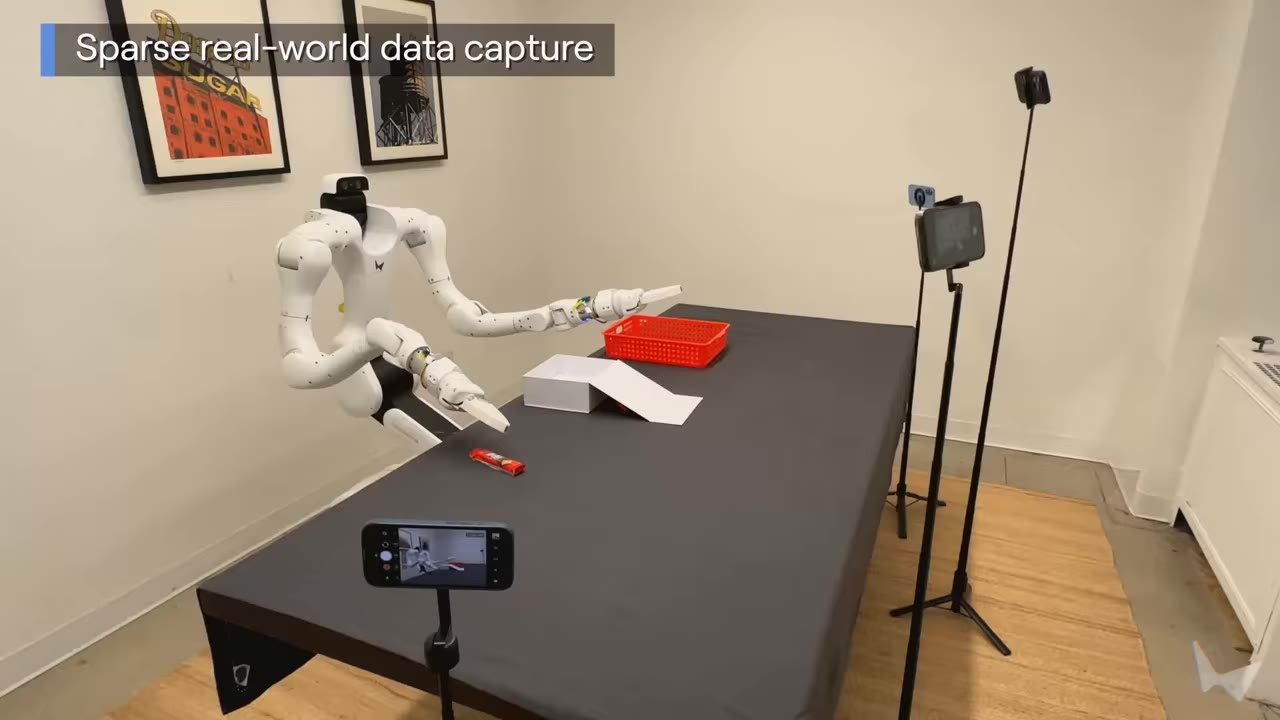
Atlas as a real-to-sim tool: the environment and the robot's sensor view come from one model. Image: World Labs.
The usual discount
These are vendor numbers on vendor-chosen tests, and World Labs says as much, acknowledging that "no single benchmark captures what Atlas can do." The preference tests are against video models on a task, camera control, that Atlas was designed around and they weren't. The reconstruction comparisons are more meaningful because they're on public datasets with published metrics, but nobody outside the early-access list has run them independently yet.
Context matters for reading the announcement too. World Labs raised a $1 billion Series B in February from Autodesk, Andreessen Horowitz, Nvidia, and AMD at a reported $5 billion valuation. The robotics angle traces back to SceniX, which the company acquired in July. Atlas is the product of that money and that acquisition, and it's being presented to partners and future investors as much as to users.
What it means if you make games
We've been tracking world models all year because they're the most credible challenge to the way games are built. MIRA ran a playable Rocket League match with no engine in July, and Google's Genie line keeps getting longer horizons. Atlas comes at the problem from a different direction. It doesn't try to be the game loop. It tries to be the thing that produces the world the game loop runs in.
That's more useful to us, and probably to you, in the near term. Splats and point clouds don't have collision, navigation, or gameplay attached, so "generate a 3D world" still means "generate a backdrop" until someone solves the conversion to meshes and colliders. But reconstruction from two or three phone photos into a scene you can fly a camera through is the environment-art shortcut every small team wants. If Atlas does that as well as the benchmarks say, the interesting engineering question becomes how to get gameplay geometry out of a splat, and that's a problem we'd rather have than the one we have now.
The honest status: it's a strong paper with a request form. We'll write about it again when someone outside World Labs has run it.