Meshy 7 ships with something rarer than a new model: a way to check it
Meshy launched Meshy 7 on August 10 and announced it publicly on August 12. It's a new image-to-3D foundation model, and the company tuned it for a single property: geometry alignment, meaning how closely the shape it generates matches the image you handed it.
That's a narrower pitch than these releases usually make, and a more useful one. Most image-to-3D announcements are carried by turntable renders of a hero asset, which tell you the model can produce something impressive and nothing about whether it produced the thing you asked for. Anyone who has fed concept art into a 3D generator knows the failure that actually costs you time. The mesh looks good. It isn't your design.
The benchmark is the interesting half
Alongside the model, Meshy published the method behind a geometry benchmark and its first results. Meshy 7 scores 81.0% on overall proportion, 79.7% on spatial distribution, and 59.8% on surface details, leading four competing image-to-3D models on all three. The widest margin is surface detail, 5.3 points clear of the next best, under single-view conditions. Tests covered a front view, a raised top-quarter view, and four-view combinations. That single-view gap is where the separation happens, because with multi-view input the field closes to roughly two points.
Nobody tested clears 60% on surface detail from a single image. That number is the honest headline of the release, and it's a fair description of where this technology sits: proportions are mostly solved, fine surface geometry is not.
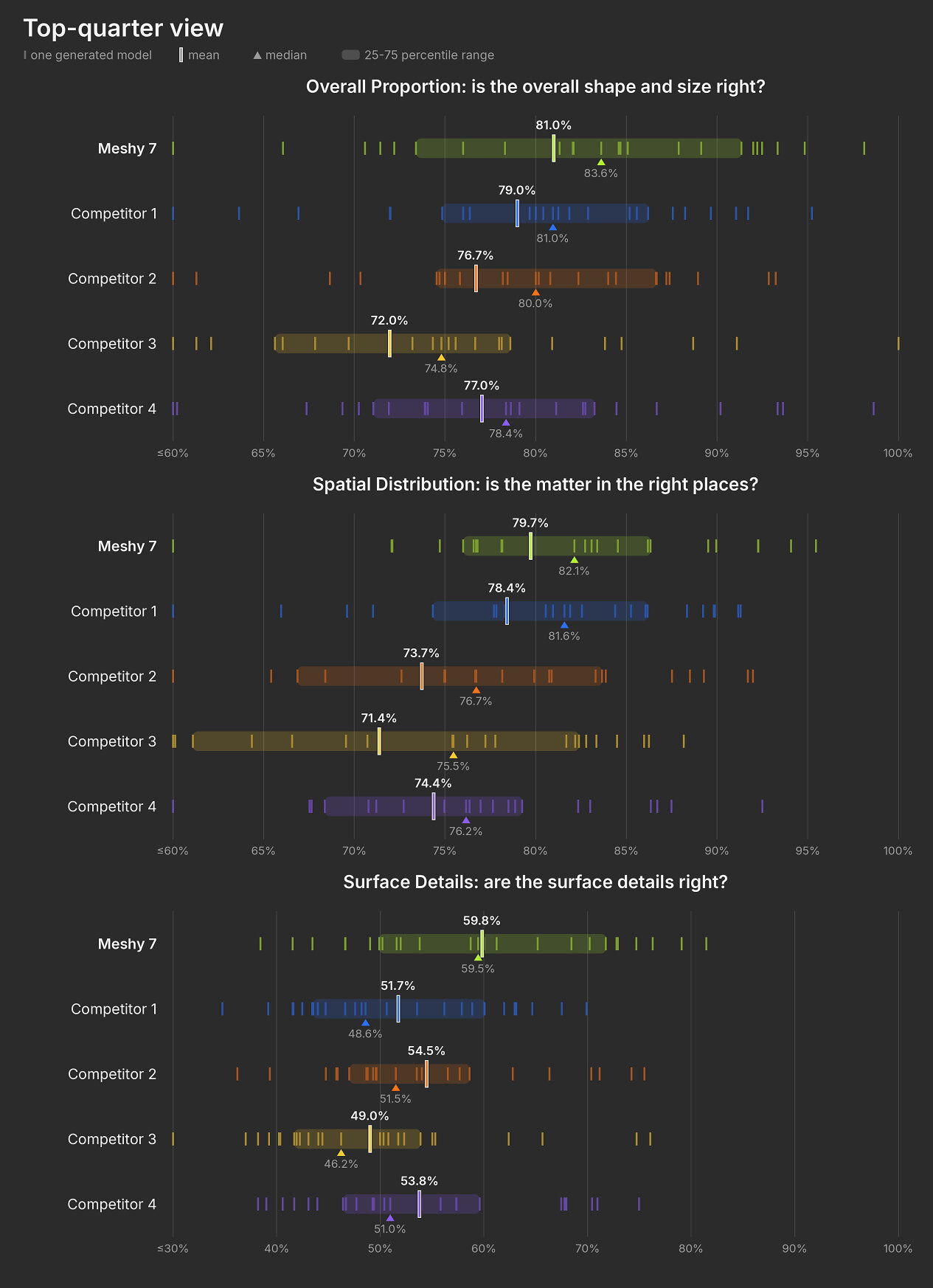
Meshy's published geometry benchmark, scoring Meshy 7 against four unnamed competitors. Chart: Meshy.
The methodology is what earns attention. Meshy scored generated geometry directly against reference models held out of training, rather than running human preference votes or letting a vision-language model judge. Comparing geometry to geometry sidesteps having to estimate the source camera, and it stops a model from hiding proportion errors by rescaling along an axis until the silhouette matches. On the model side, the image encoder now reads the input at several scales and takes higher resolution, so fine shape survives into generation instead of getting averaged away, and the training data was rebuilt so each sample corresponds exactly to its target geometry with style, lighting, and background stripped out.
The obvious caveat applies with full force. These are vendor numbers on a benchmark the vendor designed, against four competitors it declined to name. Unite.AI put it well in its writeup: the usual discount applies. Meshy says the benchmark itself ships separately after launch, and that's when the claim becomes testable, because the question isn't whether Meshy 7 wins on references Meshy picked. Texture is a separate problem with its own alignment story, and Meshy says a texture benchmark is coming later.
What it means if you're generating props
We run image-to-3D in production, so this is a practical matter rather than a leaderboard argument. Tencent's Hunyuan3D line and Tripo both sit in our stack, and we've written before about what Meshy is building beyond assets.
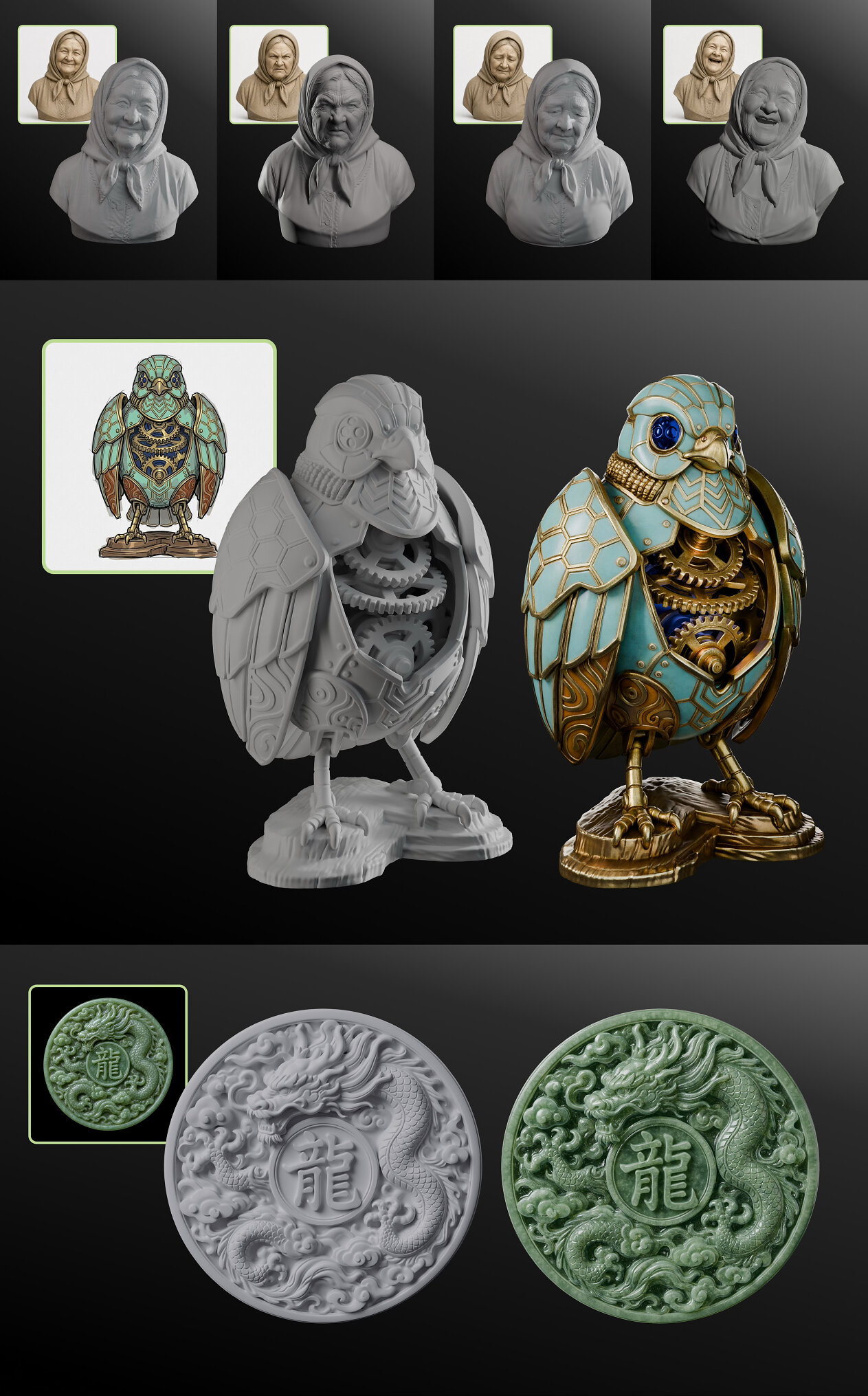
Reference image, raw geometry, then textured result, across expressions, hard-surface mechanics, and relief carving. Images: Meshy.
Alignment is the metric that matters most for game content, and it's underrated because it's unglamorous. A prop that's beautiful but 20% too wide breaks the moment it lands in a scene next to a door frame someone already built. A character whose proportions drift from the concept art forces the rig to be redone. When you're generating a dozen props for one level, the cost of a near-miss isn't the render, it's that you have to notice the near-miss and go around again. Every point of proportion accuracy is a retry somebody doesn't have to run.
The other reason to watch this: geometry scored against held-out references is a measurement anyone can adopt. If the benchmark lands as described and other labs run it, image-to-3D gets a shared yardstick instead of a gallery of best-case renders. That would be worth more to people shipping games than any single model release, including this one.
Meshy 7 is available across subscription tiers, with model downloads gated to Pro and above. Ultra Mode is single-view for now, with multi-view said to be close behind. The company raised close to $400 million in a Series B at a $1.5 billion valuation, which is the context for shipping a foundation model and a benchmark in the same week.