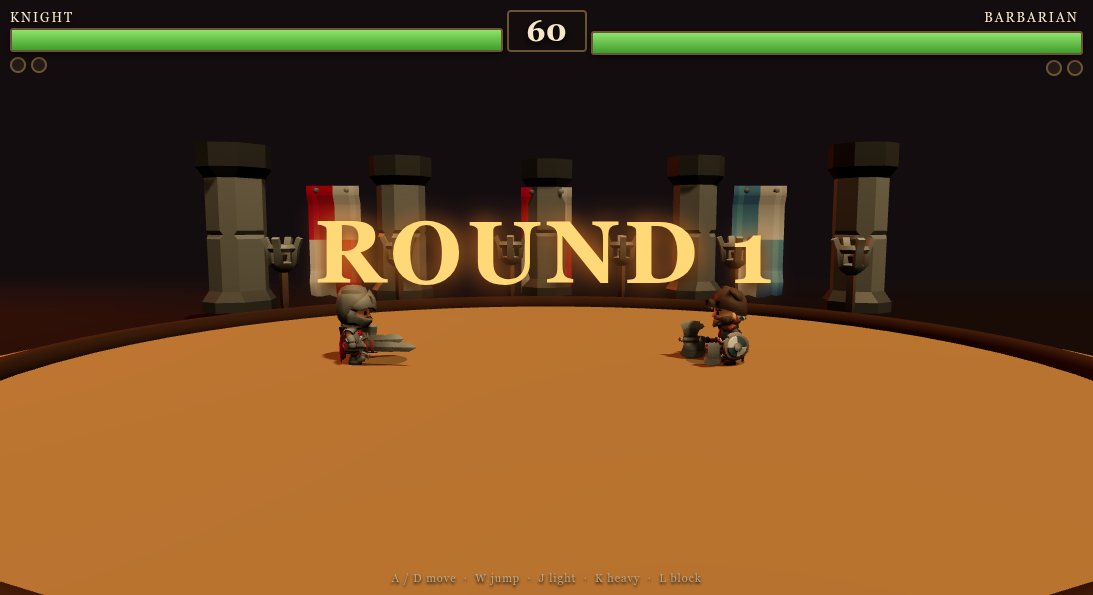
Click the game above and it runs right here in your browser. No download, no installer,
no account needed. lunarrefractionstudios built it with Cinevva, so it works on a phone or a tablet too.
Discussion
Nobody has said anything about Street Champ yet. Play it, then tell lunarrefractionstudios what you would add next.
Make your own game
Street Champ was built by lunarrefractionstudios with the
Cinevva game creator: describe the game you want in chat, watch it get
built, and play it in your browser minutes later.
Remix Street Champ opens the real game in the creator and forks its actual files, chat and design doc, so you start from the code rather than from a description.
Read the build brief for Street Champ
Cinevva's analyzer read this game's design doc and its source, then wrote the brief
below. "Make your own" hands it to the game creator as your opening message, so you start from a
real spec rather than a one-line idea.
Create a playable third-person 3D arcade fighting game titled “Street Champ.” Use a low-poly, stylized city at dusk/night: dark blue-gray asphalt ground, foggy deep navy background, cool ambient lighting with warm directional sunlight, long shadows, simple street lamps with blue-white lights, dashed white road markings, several parked low-poly cars, and commercial skyscraper/building models arranged around a compact city block. Keep the camera elevated behind and slightly above the player, smoothly following the player in the city; during fights use a closer elevated camera centered on the cage.
The player is a stylized low-poly punk fighter with red spiky hair, and the opponent is a stylized low-poly SWAT-armored fighter. Start in free-roam City mode with the player near the lower side of the street and the octagonal street-fight cage ahead. The player can walk around the bounded city block, with collision against parked cars, street lamps, and building areas. Place a large dark octagonal/octagon-like fight floor in the street, surrounded by eight short dark semi-transparent fence panels/rails, with a bright white circular center mark. Place a bright blue square gym upgrade pad off to one side beside a dark kiosk with a blue sign.
Core loop: explore the city, walk onto the blue gym pad and press Use to purchase an upgrade, or walk into the cage and press Use or Punch to start a one-on-one round. Display an initial centered instruction message: “Walk to the blue gym pad for upgrades, or step into the cage to fight.” At the gym, each purchase costs $30 plus

0 for every prior combined Power/Speed increase (cost = 30 + (Power + Speed - 2) * 20). If the player has enough cash, alternate/increment the lower stat: increase Power when Power is no higher than Speed, otherwise increase Speed; restore up to 25 player HP and show a purchase confirmation. If there is not enough money, show the required cost.
When a fight starts, place the player and rival on opposite sides of the cage. The player has 100 HP, a stamina meter starting at 100, and the rival has 100 + 10 per round (capped at 160) HP. The rival automatically turns toward and advances on the player inside the cage, then attacks at close range with punches or kicks on a cooldown. Rival attacks deal 8 + 2 per round damage, reduced to 28% of that amount while the player is blocking. Keep both fighters constrained inside the cage.
Implement combat controls: J or the on-screen PUNCH button performs a punch, K or KICK performs a kick, and L or BLOCK raises a brief guard. Punches cost 13 stamina, have about a 0.55-second cooldown, deal 8 + Power*2 damage when they connect, and reach about 1.35 units. Kicks cost 22 stamina, have about a 0.9-second cooldown, deal 14 + Power*3 damage and reach about 1.75 units. Attacks should only land after a short punch/kick animation delay and should miss with a visible message if the fighter is too far away. Blocking lasts roughly half a second and costs 6 stamina. Stamina regenerates over time, more slowly during fights. Use the loaded fighter animations for idle, running, punching, kicking, blocking/neutral guard, and hit reactions, and play a heavy impact sound when a hit lands.
When the rival reaches zero HP, end the fight, return to City mode, award cash equal to $45 + 20 per completed round, increment Wins and advance the round, restore the rival’s displayed HP for the next fight, and show a win/reward message. When the player reaches zero HP, end the fight, return to the city, set player HP to 70, and show a message saying the player was dropped and should train. After a fight, place the player back near the city area and leave the cage available for the next round.
HUD: use a large translucent dark panel across the upper-left/top area. Show “STREET CHAMP” in bold white uppercase, a mode label on the right (“City” in cyan, or “Fight R#”), and a long horizontal player HP bar with a green-to-yellow-to-orange/red gradient. Below it show “Power 1 · Speed 1 · Cash $30 · Wins 0” initially; while fighting append “Rival HP [value] · Stamina [value].” Update the values live. Show contextual instruction/status text in a centered translucent panel beneath the top HUD, including upgrade, cage, hit, miss, guard, win, and defeat messages.
Desktop controls: WASD or arrow keys to move, J punch, K kick, L block, E or Space use/interact. Mobile controls: a large translucent circular virtual joystick at bottom-left with a cyan thumb, and four large labeled buttons at bottom-right arranged in a 2x2 grid: USE, BLOCK, KICK, and a red PUNCH button. Make buttons high contrast with white bold uppercase text. Use smooth movement, animation blending, shadows, fog, and a clean low-poly 3D presentation. Expose game state with mode, cash, round, Power, Speed, player HP, rival HP, stamina, wins, fightActive, player/rival positions, current animations, and last action, and allow those values/positions to be patched externally.