Appearance
Skip to content
Arcade › Shadow Warriors
Shadow Warriors
How to play
Click the game above and it runs right here in your browser. No download, no installer, no account needed. Govind Rajput built it with Cinevva, so it works on a phone or a tablet too.
Discussion
Nobody has said anything about Shadow Warriors yet. Play it, then tell Govind Rajput what you would add next.
Make your own game
Shadow Warriors was built by Govind Rajput with the Cinevva game creator: describe the game you want in chat, watch it get built, and play it in your browser minutes later.
Remix Shadow Warriors opens the real game in the creator and forks its actual files, chat and design doc, so you start from the code rather than from a description.
Read the build brief for Shadow Warriors
Cinevva's analyzer read this game's design doc and its source, then wrote the brief below. "Make your own" hands it to the game creator as your opening message, so you start from a real spec rather than a one-line idea.
Rebuild a browser-playable 3D fighting game titled “Shadow Warriors: Ultimate Combat.” Use Three.js or an equivalent WebGL framework with a full-screen canvas and a fixed HTML HUD overlay. The game is a best-of-three, one-player-versus-AI duel between two named ninja fighters: the player “KAI RYU” in a teal/green identity color and the opponent “MIRA VALE” in a pink/coral identity color. Use two humanoid animated ninja character models (male for Kai and female for Mira if suitable assets are available), with idle, walk/run, punch, kick/slash, hit, block/defeat-style animation states. Keep the visual style grounded in the reference: dark cinematic blue-black background and fog, bright cool rim lighting mixed with warm directional light, soft shadows, and a stylized low-poly dojo arena viewed from a slightly elevated side/isometric angle.

Construct the arena as a large square fighting platform: a dark blue-gray structural floor beneath a warm brown/tan square ring surface, four dark reddish-brown corner pillars, several blue wall/backdrop blocks along the rear edge, and glowing mint/teal boundary rails on all four sides. Place the fighters near the center, initially separated horizontally, and constrain them to a rectangular combat area: broad left-right movement and limited forward/back depth movement. Use a perspective camera that tracks the midpoint between the fighters and adjusts distance slightly as they separate, maintaining a readable side-on duel view. Add ambient hemisphere lighting, a strong warm directional key light with shadows, a cool blue fill/rim light, atmospheric fog, and subtle circular shadows beneath each fighter. Fighter-facing should orient each character toward the other.

The central gameplay loop is real-time melee combat against an AI opponent. Give each fighter 100 maximum health. The player can move Kai with A/D horizontally and W/S in depth. Holding Shift performs a fast dash by multiplying movement speed. Holding L blocks; blocking reduces incoming attack damage to one quarter, with a minimum of one damage, and blocked hits briefly stun/knock back the defender. The player’s attacks are triggered on key press and have wind-up/start, active hit, and recovery timing, so hits only connect during their active windows. Implement these attacks with the following approximate values and readable feedback: J light punch, 6 damage, range 1.45, quick timing, knockback 2; K heavy punch, 12 damage, range 1.55, slower timing, knockback 3.2; U light kick, 8 damage, range 1.65, knockback 2.4; I heavy kick, 14 damage, range 1.8, slower timing, knockback 3.8. Use punch animation for punches and a slash/kick-like animation for kicks. Attacks should only affect the opponent if horizontal distance is within the attack range and depth separation is less than about 1.25. On impact, apply hit stun, horizontal/depth knockback, a brief colored aura/flash around the victim, and a short status message such as “HIT 12,” “TAKEN 6,” or “BLOCKED.”

Give each fighter a special meter starting full at 100. It regenerates gradually while the fighter is not blocking; successful player hits add roughly 12 meter and taking damage adds roughly 8 meter. Pressing O when full consumes the meter and performs “SHADOW BURST,” a stronger close-range attack dealing 18 damage with range 2.4 and knockback 4. The special should use a punch-like animation and the gold/orange special visual identity shown by the HUD controls. The AI Mira should automatically approach Kai when far away, retreat slightly when too close, make small depth adjustments, attack at close range using a random mix of the four standard attacks, and occasionally block. Make the AI somewhat more aggressive when her health is below 45. Prevent attacks during hit stun, an existing attack, or recovery cooldown. Keep fighters from overlapping with simple horizontal separation.

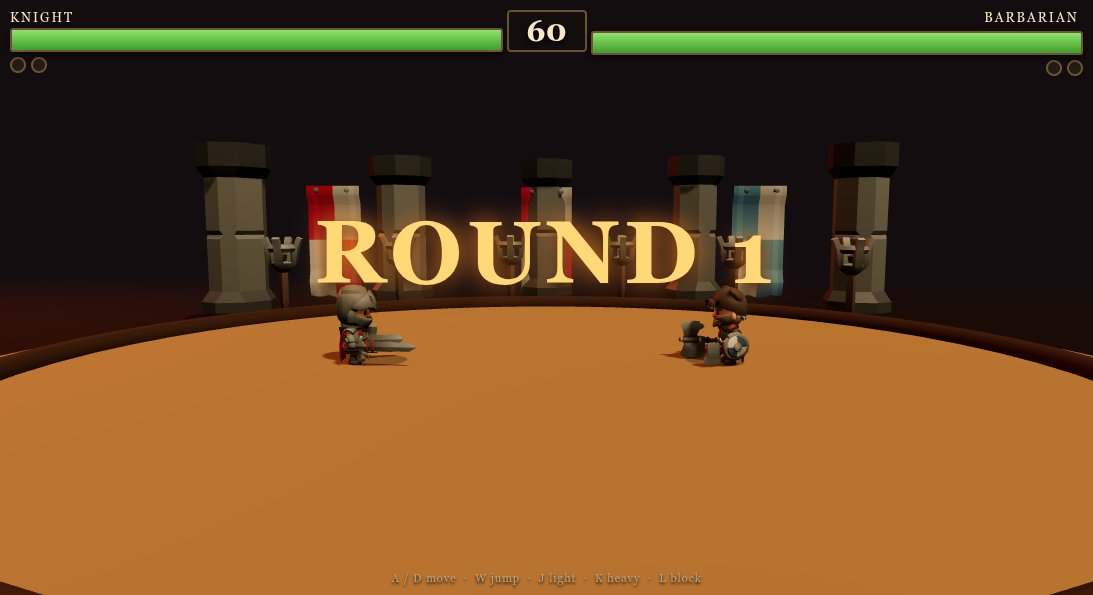
Each round lasts 60 seconds. If a fighter reaches zero health, the other fighter wins the round. If time expires, award the round to the fighter with equal-or-higher health. Reset both fighters, positions, health, and timer for the next round. The first fighter to win two rounds ends the match and displays a result panel with “VICTORY” or “DEFEAT” and the final round score, plus REMATCH and MAIN MENU buttons. Include a round transition message such as “ROUND 1,” “ROUND WON,” or “ROUND LOST.”

Build the HUD exactly as a clean, high-contrast overlay: at the top, show KAI RYU on the left, a mint/green health bar, a coral/pink health bar, and MIRA VALE on the right. Center above/between them show “ROUND 1 / 3 · 0-0” (updating round and score), and beneath it a large white 60-second countdown timer. Show transient combat status text near the upper center. Include a small upper-right hint reading “Q target lock · Esc pause.” Include a bottom help line explaining the best-of-three duel and active attack windows. At the bottom center, show translucent touch controls for left/right movement plus PUNCH, KICK, and SPECIAL, suitable for pointer/touch input. The touch buttons need to trigger the same A/D/J/U/O actions; they are supplemental controls, not a replacement for keyboard play.

Start on a polished centered main menu panel over the visible dojo: dark translucent navy rounded rectangle with a subtle blue border/shadow, large spaced uppercase “SHADOW WARRIORS” title, subtitle “Ultimate Combat — original browser fighting slice,” primary gradient teal-to-blue PLAY MATCH button, and TRAINING button. Beneath the buttons display the control guide: “A/D sidestep · W/S depth · Space jump · Shift dash” and “J/K punches · U/I kicks · L block · O special,” matching the reference UI. TRAINING may use the same combat setup but announce “TRAINING MODE.” Add a pause overlay opened with Escape, containing “PAUSED,” “Take a breath, warrior.” and RESUME, RESTART, and MAIN MENU buttons. Include a Q target-lock toggle state as a supported UI/control concept, but do not invent extra gameplay systems beyond the described duel. The displayed Space jump hint may remain a control-slot/UI hint if no jump behavior is implemented; the core implemented movement is horizontal/depth movement and dash. Ensure the game is immediately playable from index.html without a build step, responsive to desktop and touch-sized screens, and visually preserves the dark blue cinematic dojo, mint player accents, coral enemy accents, centered panels, health meters, round score, timer, and side-angle 3D camera.