Arcade › After Hours
After Hours
About After Hours
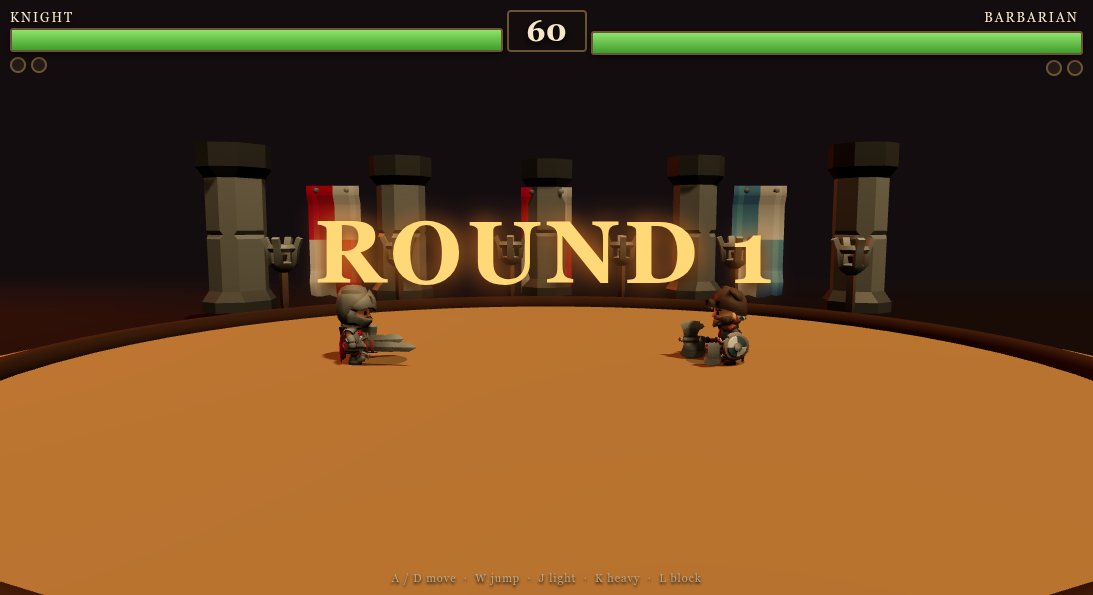
a very nice fighting game suitable for children of all ages ,the game is made up of only two characters
How to play
Play right here in your browser without an account or download. Follow the controls shown in the game, and use Play fullscreen for a larger view.
Reviews & feedback
Join Discord ↗No reviews yet. Be the first to share one.
Make your own game
After Hours was built by Saviour Jacob with the Cinevva game creator: describe the game you want in chat, watch it get built, and play it in your browser minutes later.
Remix After Hours opens the real game in the creator and forks its actual files, chat and design doc, so you start from the code rather than from a description.
Read the build brief for After Hours
Cinevva's analyzer read this game's design doc and its source, then wrote the brief below. "Make your own" hands it to the game creator as your opening message, so you start from a real spec rather than a one-line idea.
Create “After Hours,” a playable 3D arcade street-fighting game in a portrait-friendly, full-screen layout. Set the scene in a narrow, rain-dark industrial alley at night: nearly black-purple sky and fog, wet charcoal pavement with subtle reflective streaks and a thin pale center line, tall close-packed factory buildings on both sides with scattered dim pink windows, metal pipes, dumpsters/bins, and a few streetlamp poles with glowing pink bulbs. Place a handful of bright neon signs down the alley, including pink and cyan signage. Light the scene with moody cool moonlight and contrasting pink/cyan neon, soft shadows, and atmospheric depth. Use a slightly elevated, frontal 3D camera looking toward two full-body human fighters facing one another across the alley, with a close-enough framing to read their actions; keep the camera centered between them and track their midpoint horizontally as they move. Use animated, stylized realistic modular human characters: Charlie, the player on the left, and a hoodie-wearing rival on the right. The fighters can move only laterally along a narrow horizontal fighting space, stay facing each other, and cannot pass through one another; use idle, run, punch, kick, hit-reaction, and roll/dash animations where available.

The game opens paused behind a centered dark translucent title card with a thin pink border and subtle pink glow. Show a large uppercase pink “AFTER HOURS” heading, the invitation “One last round in the alley. Read your rival, guard the opening, and hit back before the streetlights go out.”, a wide pink-to-purple button labeled “STEP INTO THE ALLEY,” and a small muted caption identifying it as an original arcade-style street-fight slice versus AI. Starting the round removes the card, resets both fighters to 100 health and starts a 60-second round labeled “NIGHT SHIFT • [remaining seconds] SEC.”

Build a one-on-one real-time fight against a simple AI rival. Player movement is left/right; attacks are punch and kick; holding block guards against attacks from the direction the fighter faces; dash/roll quickly shifts the player forward toward the rival. Punches are faster, have shorter cooldown and deal less base damage; kicks are slower, have a longer cooldown and deal more. Attacks only connect at close range, so communicate an out-of-range attempt with a brief “TOO FAR” message. Successful consecutive hits build a timed combo, increasing subsequent damage, and show short arcade feedback such as “POW!”, “KICK!”, or “N HIT COMBO!” A correctly facing block prevents damage and displays “BLOCKED.” Hits briefly stun/knock back the target and give a very brief hit-stop and camera shake. The rival should approach when too far away, choose punches more often than kicks at close range, and sometimes block when the player is preparing an attack. The round ends when a fighter’s health reaches zero; if the timer runs out, the fighter with more health wins. Show an end overlay with a winner/knockout message and a “FIGHT AGAIN” button, allowing another round.

Overlay a compact arcade HUD at the top: two dark angular panels, CHARLIE on the left and RIVAL on the right, each with a numeric health value and a horizontal health bar. Use a warm pink/orange fill for Charlie and violet/pink for the rival. Center the round label and countdown between the top and lower screen area. Put brief keyboard instructions near the bottom: “A / D move · J punch · K kick · hold L to block” and “Land hits to build a combo.” On touch devices, show usable large controls at bottom right: left and right movement buttons, plus PUNCH, KICK, BLOCK (hold), and DASH; hide these controls on wide desktop layouts. Support equivalent keyboard controls: A/D or arrow keys to move, J or Space for punch, K for kick, hold L to block, and Left Shift to dash. Use a cohesive neon-noir arcade aesthetic with pink/purple typography and gradients, dark translucent panels, and clear responsive controls. Do not add other modes, weapons, stages, or mechanics.