Appearance
Skip to content
Arcade › Mission Control
Mission Control
How to play
Click the game above and it runs right here in your browser. No download, no installer, no account needed. Jostin Joel López Cordovez built it with Cinevva, so it works on a phone or a tablet too.
Discussion
Nobody has said anything about Mission Control yet. Play it, then tell Jostin Joel López Cordovez what you would add next.
Make your own game
Mission Control was built by Jostin Joel López Cordovez with the Cinevva game creator: describe the game you want in chat, watch it get built, and play it in your browser minutes later.
Remix Mission Control opens the real game in the creator and forks its actual files, chat and design doc, so you start from the code rather than from a description.
Read the build brief for Mission Control
Cinevva's analyzer read this game's design doc and its source, then wrote the brief below. "Make your own" hands it to the game creator as your opening message, so you start from a real spec rather than a one-line idea.
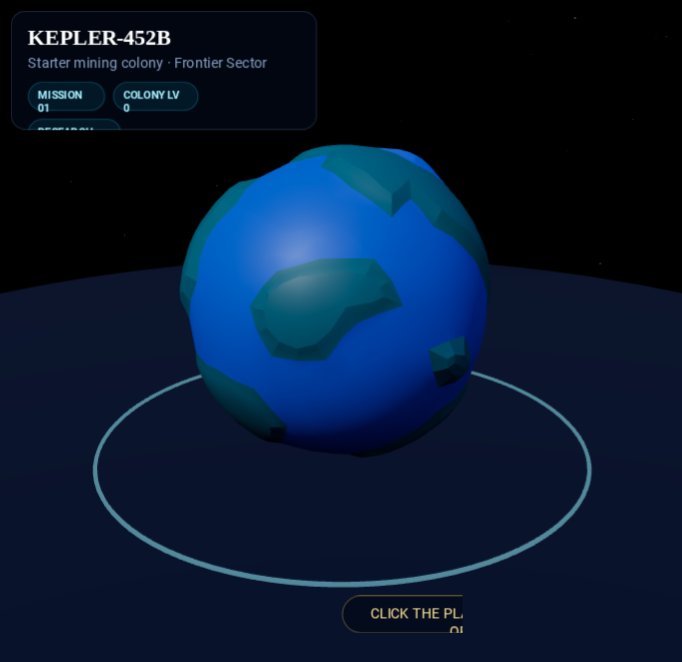
Create a polished browser-based 3D mission-planning game titled “Mission Control.” The experience is an interactive spacecraft configuration and launch simulation, not a traditional movement game. Use a fixed, cinematic perspective camera looking at a circular launch platform in deep space. The scene should have a nearly black/navy background with atmospheric fog, many small blue-white stars, a large dark blue planet partially visible in the distant lower-left/background, and a broad metallic blue-gray cylindrical platform with a thin glowing cyan guidance ring on its top. Light the scene with cool blue fill light, a strong white directional key light, and a blue-violet rim light; use soft shadows, reflective/metallic materials, antialiasing, and a slightly cinematic tone-mapped look.

Place a stylized low-poly golden/yellow crewed spacecraft at the center of the platform. It is a compact rounded capsule/bee-like craft with a large bright cyan-blue front window, gold framing and side fins/panels, and dark mechanical details. Add a small stylized astronaut/crew figure beside or just behind the craft, in an idle pose. The ship should gently bob and slowly rotate while idle. When a valid mission is launched, animate it rising vertically from the platform over roughly 18 seconds, continuing to rotate faster as it climbs several world units. Do not add player flight controls: the only gameplay interaction is choosing a mission, toggling spacecraft modules, and pressing launch.

Overlay the 3D scene with a dark translucent glass-like HUD. At the top, show the cyan uppercase brand “ORBITAL DESIGN BUREAU” on the left and a glowing green status dot with “SIMULATION ONLINE” on the right. On the left, show a bordered panel titled “Mission Control,” with the subtitle “Assemble a crewed craft, then send it beyond the moon.” Include a “CHOOSE MISSION” section with three selectable mission cards:
- “Lunar Relay” — “Deploy a comms beacon around the moon.” — “Needs 60 fuel · 20 science · 1 crew”
- “Mars Survey” — “Scan a dust basin and return the core data.” — “Needs 85 fuel · 45 science · 2 crew”
- “Titan Descent” — “Dive through methane clouds and sample the lakes.” — “Needs 100 fuel · 65 science · 2 crew”
The Lunar Relay card is selected initially with a cyan border. Selecting another mission resets any launch-in-progress state and selects that mission.

Below it, add a “CONFIGURE SPACECRAFT” section with a two-column grid of toggle buttons. The six modules and their exact displayed labels are: “⛽ Fuel Tank” with “+35 fuel”; “✦ Science Lab” with “+30 science”; “◉ Crew Pod” with “+1 crew”; “↟ Booster” with “+25 fuel”; “⌁ Relay Dish” with “+15 science”; and “⬡ Heat Shield” with “safe return.” Active modules use a purple/violet highlighted background and border; inactive modules are dark blue. The initial active selection is Fuel Tank, Science Lab, and Crew Pod. The underlying base readiness is 25 fuel, 0 science, and 0 crew, so the initial displayed totals are 60 fuel, 30 science, and 1 crew. Fuel Tank and Booster add fuel, Science Lab and Relay Dish add science, Crew Pod adds one crew, and Heat Shield has no numeric effect. Module toggles are allowed before launch and locked while a mission is in progress.

Add a “READINESS” section with three compact stat boxes showing the current totals as large numbers and the labels FUEL, SCIENCE, and CREW. Add a full-width gradient cyan-to-violet button labeled “LAUNCH MISSION.” Clicking it should check the current mission’s fuel, science, and crew requirements. If requirements are not met, do not launch and show a small temporary notification reading “Need more systems for [mission name].” If valid, set the mission in progress, show a temporary “Ignition sequence started” notification, disable the launch button, and change its label to “MISSION IN PROGRESS.”

At the lower-right, show a bordered “LIVE TELEMETRY” box in a monospace style with lines for “ALT [value] km,” “VEL [value] km/s,” and “SYS [value].” While idle, altitude should read 0000420 km, velocity 0.0 km/s, and system status NOMINAL. During launch, interpolate altitude from 420 km to 384400 km based on launch progress and interpolate velocity from 0.0 up to 11.2 km/s. When the ship completes its ascent, show a temporary notification formatted “MISSION COMPLETE — [mission reward]”; set system status to SUCCESS; and change the button text to “MISSION COMPLETE.” Use these exact mission rewards: Lunar Relay = “Signal lock achieved”; Mars Survey = “Ancient water traces found”; Titan Descent = “Organic chemistry confirmed.”

The UI should be functional with clear hover/focus states, rounded dark-blue cards, cyan selected mission border, violet active module states, and a cyan/violet launch gradient. Use a responsive layout: on narrow screens, move the control panel to the bottom, make it wide and shorter with compact mission cards, hide the telemetry box, and keep the top status bar visible. Preserve the atmospheric sci-fi command-center aesthetic shown in the reference: spacious starfield and spacecraft dominating the right side, with the translucent control panel occupying the left side. Do not invent additional weapons, enemies, scoring, navigation, fuel consumption, or player movement; the core loop is select mission → assemble sufficient systems → launch → watch the ascent → receive the mission result.”,