Arcade › Les Lames d’Aube
Les Lames d’Aube
About Les Lames d’Aube
How to play
Play right here in your browser without an account or download. Follow the controls shown in the game, and use Play fullscreen for a larger view.
Reviews & feedback
Join Discord ↗No reviews yet. Be the first to share one.
Make your own game
Les Lames d’Aube was built by Soutenance Justy with the Cinevva game creator: describe the game you want in chat, watch it get built, and play it in your browser minutes later.
Remix Les Lames d’Aube opens the real game in the creator and forks its actual files, chat and design doc, so you start from the code rather than from a description.
Read the build brief for Les Lames d’Aube
Cinevva's analyzer read this game's design doc and its source, then wrote the brief below. "Make your own" hands it to the game creator as your opening message, so you start from a real spec rather than a one-line idea.
Rebuild “Les Lames d’Aube,” a French-language, single-player 3D arena-fighting prototype. Use a fixed, slightly elevated perspective camera looking toward a compact circular stone arena. The scene has a charcoal/navy twilight background and fog, a broad dark-violet round floor on a low cylindrical dais, a thin glowing amber-gold circle inset around the fighting area, and twelve evenly spaced short hexagonal stone/bronze pillars around the perimeter. Warm directional light and cool ambient light give the arena a moody golden-hour fantasy look. Keep the camera fixed; fighters face one another near the center, with the player on the left and CPU opponent on the right.

Provide two selectable animated 3D fighters: Aurore, a gold-armored female knight / “Chevalière solaire” with warm amber accent, and Bram, a blue-toned male soldier / “Sentinelle d’acier” with pale blue accent. Use animated knight and soldier models with idle, run/walk, attack, victory and defeat animations where available; use a simple colored humanoid placeholder if models cannot load. The fighter selected by the player starts on the left and the other fighter is the CPU opponent on the right. The game is an automatic one-on-one bout, not a weapon or projectile combat system: movement is horizontal across the arena, attacks are close-range strikes, and the CPU advances toward the player and attacks when close.

Start at a menu overlay with a dark translucent rounded panel, elegant warm-gold and muted blue-gray text, and French labels. Show the title “LES LAMES D’AUBE” and subtitle “Prototype de combat — version navigateur / mini-jeu”. Include COMBAT and HISTOIRE tabs. In COMBAT, show “CHOISIS TON COMBATTANT” and two selectable character cards with icon, name, title, and “MODÈLE 3D ANIMÉ”; visually accent the selected card. Explain local combat against a game-controlled opponent and list the PC controls: A/D or left/right arrows to move, F to strike, G to guard. Add the large “LANCER LE COMBAT” button and a small note that this demo has two playable fighters and a 25-character roster is planned. HISTOIRE opens a chapter selection screen titled “CHRONIQUES DES 52 CHAPITRES”, showing the chosen fighter’s short bio and a 6-column grid numbered 01–52. Only chapter 1 is playable; the other chapter entries are visibly unavailable, and the screen says “Chapitre 1 disponible · les 51 suivants sont à créer”. The button starts chapter 1.

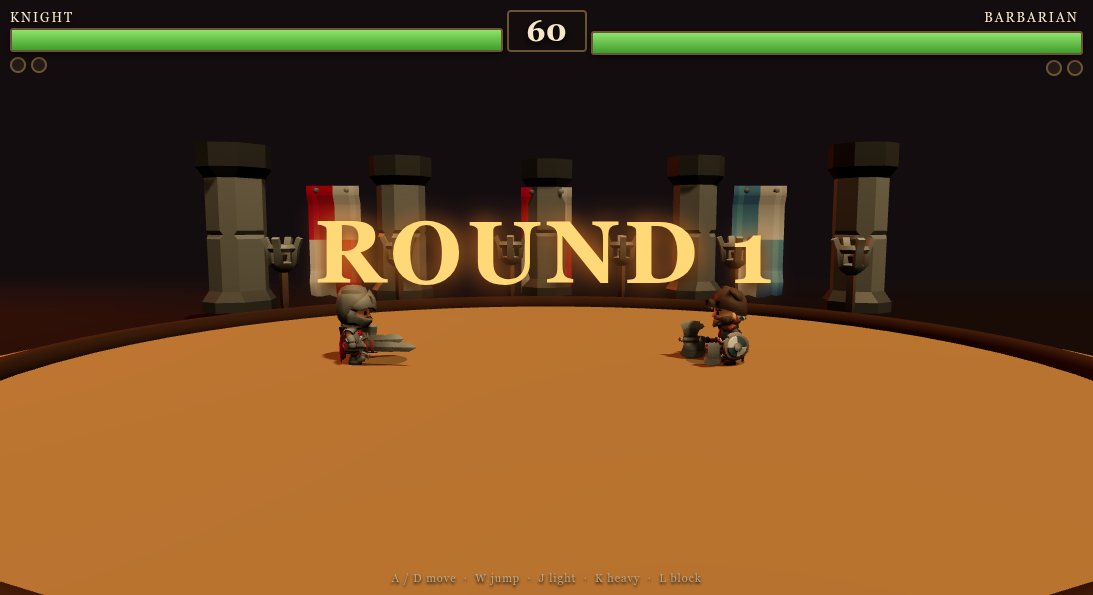
During combat, display each fighter’s name and a colored horizontal health bar at the top: amber for the player and light blue for the opponent, with remaining time centered between them. Each fighter begins with 100 health and the round lasts 60 seconds. The player moves left/right at a steady speed, constrained to their side of the arena. Holding F repeatedly attacks with a short cooldown; a successful player strike at close range removes 13 enemy health. The CPU periodically makes decisions, closes distance when far away, and attacks at close range; its successful strike removes 10 player health. G or the on-screen GARDE button blocks incoming CPU hits while held. Show touch-friendly on-screen controls along the bottom: left and right arrow buttons, GARDE, and FRAPPE. They should work by pressing/holding, as should keyboard controls; release guard/movement when the key or pointer is released. Include a small hint about touch controls and keyboard controls. If played in story mode, add “HISTOIRE · CHAPITRE 1” below the timer.

End the round when either health bar reaches zero or the timer runs out. A health-zero loss gives “Défaite”; defeating the opponent gives “Victoire !”. At timeout, the fighter with at least as much health wins. Show a centered dark translucent result panel over the arena with the result, a brief line (“Combat terminé.” or “Fin du chapitre 1 de la démo.”), and REJOUER and MENU buttons. Rematch resets health and timer while retaining the mode; MENU returns to combat selection.

Keep the presentation clean and readable on desktop and mobile, with a responsive canvas-drawn interface, rounded dark panels, understated borders, warm gold/terracotta action buttons, and compact French typography. Do not add multiplayer, extra fighters, playable story chapters beyond chapter 1, stages, equipment, magic, projectiles, combos, or other systems not described here.