Appearance
Skip to content
Arcade › Iron Man Interface
Iron Man Interface
How to play
Click the game above and it runs right here in your browser. No download, no installer, no account needed. minecraft internet built it with Cinevva, so it works on a phone or a tablet too.
Discussion
Nobody has said anything about Iron Man Interface yet. Play it, then tell minecraft internet what you would add next.
Make your own game
Iron Man Interface was built by minecraft internet with the Cinevva game creator: describe the game you want in chat, watch it get built, and play it in your browser minutes later.
Remix Iron Man Interface opens the real game in the creator and forks its actual files, chat and design doc, so you start from the code rather than from a description.
Read the build brief for Iron Man Interface
Cinevva's analyzer read this game's design doc and its source, then wrote the brief below. "Make your own" hands it to the game creator as your opening message, so you start from a real spec rather than a one-line idea.
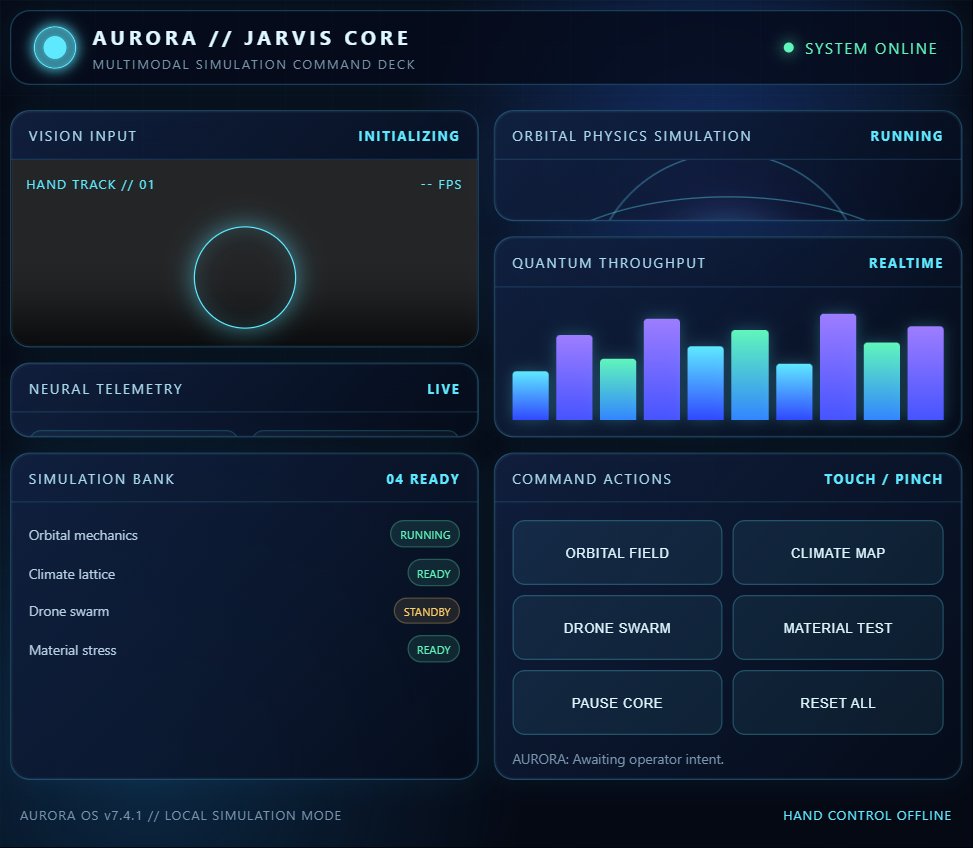
Recreate a browser-based 3D interactive demo titled “Iron Man Interface.” Use Three.js or an equivalent WebGL 3D engine with a full-window canvas, antialiasing, shadows, and a dark futuristic laboratory scene. The player controls a red-tinted humanoid Iron Man-style suit shown in third person. Place the suit on a large dark blue-gray floor bounded by simple dark walls; use cool blue ambient/directional lighting and a nearly black background. Add a large glowing desktop-sharing display mounted ahead of the player, plus a desk and laptop near the display and a sci-fi robot arm prop off to the right. The visual style should be deliberately low-poly/simple 3D with a cyan terminal/HUD overlay, thin cyan borders, translucent navy panels, monospace text, and cyan glow/shadows similar to a sci-fi monitoring interface.

The suit starts in the lab and the camera follows behind it at roughly 3.5 units distance and 2.1 units height, looking slightly ahead. Support WASD movement: W/S move the suit forward/backward relative to its facing direction, while A/D rotate it left/right. Clamp movement to a small rectangular area (approximately x -4..4 and z -4..-0.5). Use a loaded humanoid animation if available, otherwise a simple idle animation; tint the visible suit red, and allow its facing/body position to update as it moves. Support mouse-drag body tracking: while holding the left mouse button and moving the mouse, adjust a bounded yaw and pitch. Use yaw to subtly turn the tracked suit and camera view, and pitch to affect the camera’s look height. Show a double-click reset that returns tracking to a centered/default pose. The body-tracking display should derive its text from the controls: Pose is STANDING normally, WALKING while W or S is held, LEANING FORWARD for a sufficiently positive pitch, or LOOKING UP for a sufficiently negative pitch; Arms is RAISED while A or D is held and otherwise IDLE; Head is CENTER unless yaw is substantially left/right, then LEFT or RIGHT. Animate the ARC percentage around the high 90s.

The large in-world desktop screen must be an interactive canvas/texture, approximately 512x320 content mapped onto a rectangular 3D plane. Draw a dark blue desktop frame with a title bar reading “DESKTOP SHARE - IRON MAN LINK,” a grid, and four colored moving objects inside it: a red rectangle labeled Person, a blue circle labeled Coffee Mug, a green rectangle labeled Laptop, and a yellow triangle labeled Vehicle. Move all four continuously in different directions and bounce them off the inner screen bounds. Clicking the 3D screen should raycast into it, map the hit point to desktop coordinates, and identify the nearest object within a reasonable radius. On a successful click, add a console message such as “IDENTIFIED: Person — HUMAN - Body tracking match 87%,” with equivalent database results for the mug (“COFFEE MUG - 94% confidence”), laptop (“LAPTOP - 99% match (desktop icon)”), and vehicle (“VEHICLE - Moving car detected 76%”). Increment a unique detected-object count only once per object. Clicking empty screen space should report “SCAN: No clear moving object at target. Retrying...”.

Implement the HUD as fixed HTML overlay above the 3D canvas and make it non-blocking except for its controls. At the top center show: “IRON MAN SUIT v7.2 | ARC: [value]% | CAMERA: ACTIVE | BODY TRACK: ON.” At upper left show a BODY TRACKING panel with Pose, Arms, and Head values. At upper right show a DESKTOP SHARING panel with Status and “Objects detected: [count]”, followed by cyan buttons “SCAN & IDENTIFY” and “CLEAR.” Status should read “LIVE - 4 MOVING” while the objects are active. At the bottom, span almost the full width with a translucent console panel that initially reads “IRON MAN SYSTEM ONLINE” and “Waiting for desktop stream...”. Add instructional messages after startup: “[SCAN] SYSTEM READY. Click screen to identify moving objects.” and “[SCAN] Use WASD + mouse to move suit (body tracking).” Keep the console to its most recent few lines.

The SCAN & IDENTIFY button should be rate-limited to prevent rapid repeats, append “SCANNING DESKTOP STREAM...”, then after a short delay identify/list all four current moving objects, add each to the detected set, update the count to 4, and briefly brighten/flash the desktop display. The CLEAR button should reset the detected set and count to 0 and replace the console with “CLEAR - Database reset.” Ensure clicking HUD buttons does not accidentally raycast into the 3D screen. Make the layout responsive while preserving the HUD’s fixed terminal look; use black background, cyan borders/text and glow, translucent dark-blue panels, yellow scan labels, and green status text.