Appearance
Skip to content
Arcade › Orbit Toss
Orbit Toss
How to play
Click the game above and it runs right here in your browser. No download, no installer, no account needed. rennerellistx built it with Cinevva, so it works on a phone or a tablet too.
Discussion
Nobody has said anything about Orbit Toss yet. Play it, then tell rennerellistx what you would add next.
Make your own game
Orbit Toss was built by rennerellistx with the Cinevva game creator: describe the game you want in chat, watch it get built, and play it in your browser minutes later.
Remix Orbit Toss opens the real game in the creator and forks its actual files, chat and design doc, so you start from the code rather than from a description.
Read the build brief for Orbit Toss
Cinevva's analyzer read this game's design doc and its source, then wrote the brief below. "Make your own" hands it to the game creator as your opening message, so you start from a real spec rather than a one-line idea.
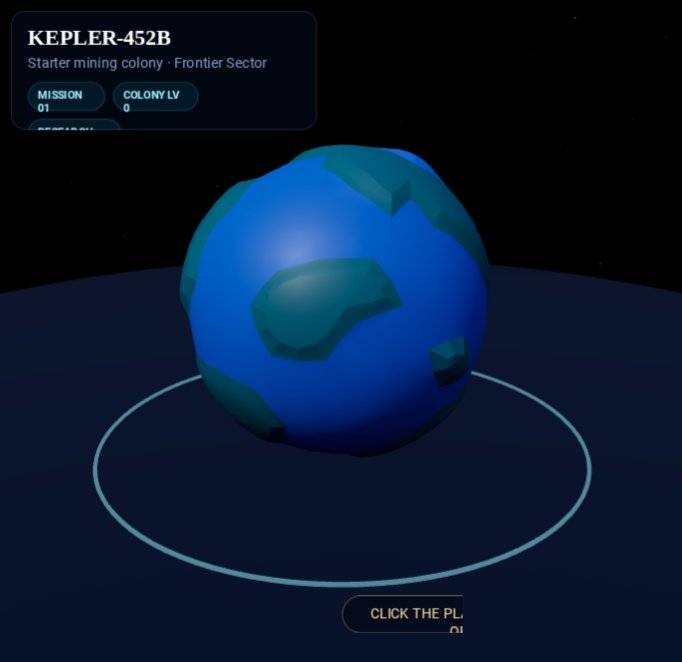
Create a third-person 3D arcade game titled “Orbit Toss.” The player is a blocky humanoid character standing on and running around the surface of a very small spherical planet. Use a stylized low-poly presentation: the planet is mostly deep blue with a green land-cap covering its upper portion, a thin translucent warm-gold ring around it, and a circular arrangement of small brown/tan faceted rocks around the planet’s equator. Light the scene brightly with cool ambient light and a warm directional sun, with a dark navy/purple space background and atmospheric fog. Keep the camera behind and slightly above the character, following them as they move across the curved surface; aim toward the character and show enough of the planet and surrounding space to make the spherical terrain clear. The character should be an animated blocky humanoid, upright relative to the local planet surface, with idle and walking animations.

Core mechanic: the player runs around the tiny planet, then chooses a launch angle and throws a red ball into low-gravity orbital flight. The ball’s initial velocity is tangent to the planet surface plus an outward/upward component based on the selected angle. Simulate gravity pulling the ball toward the planet’s center; show the red ball flying around the planet along a curved trajectory until it falls back and hits the surface. During flight, render a glowing/pale yellow trajectory line behind or along its predicted path and a small yellow marker at the current ball position. Hide the ball after impact. Measure the throw distance from the launch position to the impact position and retain the best distance; the goal is to find an angle that produces the longest throw/orbit before impact. Prevent another throw while the current ball is flying.

Controls and interaction: WASD or arrow keys move the character along the curved planet surface, with W/up moving forward and S/down backward relative to the character and A/D or left/right strafing around the surface. The character should conform to the planet curvature and face its movement direction. Press Space or click/tap the large THROW button to launch. Provide a horizontal range slider for the throw angle, constrained from 12° to 70°; display the selected angle next to “Throw angle” (the normal initial value is 42°, though the control should reflect the current slider setting). The button changes to “FLYING” while a throw is in progress and returns to “THROW” after impact.

HUD: overlay the game with a translucent dark rounded panel in the upper-left. Show the title “ORBIT TOSS” in large uppercase warm yellow text, the instruction “Run around a tiny planet. The ball falls toward the planet's center — just like a space platform.”, a large cyan distance readout initially “0.0 m,” and a status/instruction line initially “WASD / arrows to move · Space to throw.” During a throw show “Orbiting...” and after impact show either “New best throw!” when the result establishes a new record or “Try a different angle.” Otherwise keep the latest distance visible. Add a small translucent upper-right tip panel reading “Low gravity” and “High style.” Place a dark rounded control bar centered along the bottom with the angle label, orange-accent range slider, and orange/yellow gradient THROW button. Make the layout responsive so the controls fit on narrow screens. Use clean modern system UI typography, rounded panels, subtle borders/shadows, and no debug overlays.