Arcade › Duel Arena
Duel Arena
About Duel Arena
How to play
Play right here in your browser without an account or download. Follow the controls shown in the game, and use Play fullscreen for a larger view.
Reviews & feedback
Join Discord ↗No reviews yet. Be the first to share one.
Make your own game
Duel Arena was built by Corey Alfaro-Ortiz (Student) with the Cinevva game creator: describe the game you want in chat, watch it get built, and play it in your browser minutes later.
Remix Duel Arena opens the real game in the creator and forks its actual files, chat and design doc, so you start from the code rather than from a description.
Read the build brief for Duel Arena
Cinevva's analyzer read this game's design doc and its source, then wrote the brief below. "Make your own" hands it to the game creator as your opening message, so you start from a real spec rather than a one-line idea.
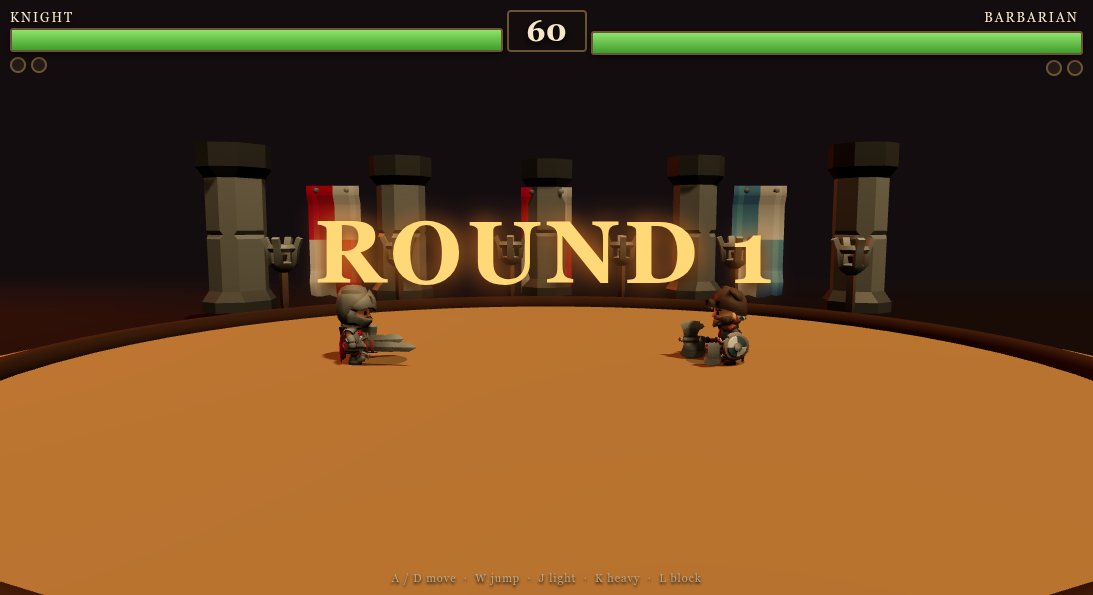
Create “Duel Arena,” a compact 3D one-on-one fighting game presented in a fixed, side-on view. Use a dark navy nighttime arena with a circular raised fighting platform: a charcoal blue-gray outer cylinder and inner stage, thin luminous cyan concentric ring markings, a small center ring, and eight dark faceted pillars spaced around the perimeter, each topped with alternating cyan and pink glowing beacons. Add a dim navy backdrop, soft fog, cinematic blue ambient/rim lighting, warm directional key light, and visible character shadows. Keep the camera centered on both fighters from slightly above and in front, looking toward the arena, with the whole duel stage framed consistently. The two fighters are animated humanoid ninja characters, a male ninja for the player on the left and female ninja for the CPU opponent on the right, facing each other. Use idle, run, punch, kick, jump, and hit-reaction animation states where available; fighters move along the horizontal axis, turn to face one another, and stay within the arena bounds.

At first show a centered translucent dark navy start card over the dimmed gameplay view, with a thin pale blue border and rounded corners. It reads “DUEL ARENA,” briefly explains taking on the CPU, landing attacks, blocking, and keeping health up, and has a bright orange-to-pink gradient FIGHT button. Show a small controls reminder below. During play, show a fixed HUD across the top: green player health bar labeled YOU on the left, centered gold “ROUND 1,” and orange-to-pink CPU health bar labeled CPU on the right. Put a cyan/purple energy meter beneath the player bar. Near the top center show a concise control hint. Place touch-friendly controls along the bottom: left/right movement buttons on the left, and BLOCK, charge, PUNCH, KICK, and BLAST buttons on the right, styled as rounded dark blue controls with cyan/blue or pink/orange accents.

Start each bout with both fighters at full 100 health and positioned facing each other near the center. The player can move left/right with arrow keys or held on-screen buttons; punch with A or the PUNCH button; kick with D or KICK; hold Space or the charge button to fill energy from 0 to 100; press L or BLAST to fire a cyan glowing orb projectile once energy is at least 30%; and hold K or BLOCK to defend. A projectile travels horizontally toward the CPU and damages it on contact. A punch has short range and moderate damage; a kick has slightly longer range, higher damage, and a longer cooldown. Attacks only connect when the opponent is within range and grounded. Blocking reduces melee damage and substantially reduces blast damage. Implement a simple CPU opponent that advances toward the player, occasionally blocks, and attacks when close; the player must manage spacing, defense, and attacks to defeat it. Update health and energy bars as values change. When either fighter reaches zero health, stop the bout and show a centered result card saying YOU WIN or CPU WINS with a short message and a FIGHT AGAIN button that resets health, positions, energy, and bout state. Use clean, bold, high-contrast typography and polished arcade-fighting-game presentation. Do not add extra rounds, character selection, arena hazards, or other mechanics.