Appearance
Skip to content
Arcade › Clash Yard
Clash Yard
How to play
Click the game above and it runs right here in your browser. No download, no installer, no account needed. Archie Crisp built it with Cinevva, so it works on a phone or a tablet too.
Discussion
Nobody has said anything about Clash Yard yet. Play it, then tell Archie Crisp what you would add next.
Make your own game
Clash Yard was built by Archie Crisp with the Cinevva game creator: describe the game you want in chat, watch it get built, and play it in your browser minutes later.
Remix Clash Yard opens the real game in the creator and forks its actual files, chat and design doc, so you start from the code rather than from a description.
Read the build brief for Clash Yard
Cinevva's analyzer read this game's design doc and its source, then wrote the brief below. "Make your own" hands it to the game creator as your opening message, so you start from a real spec rather than a one-line idea.
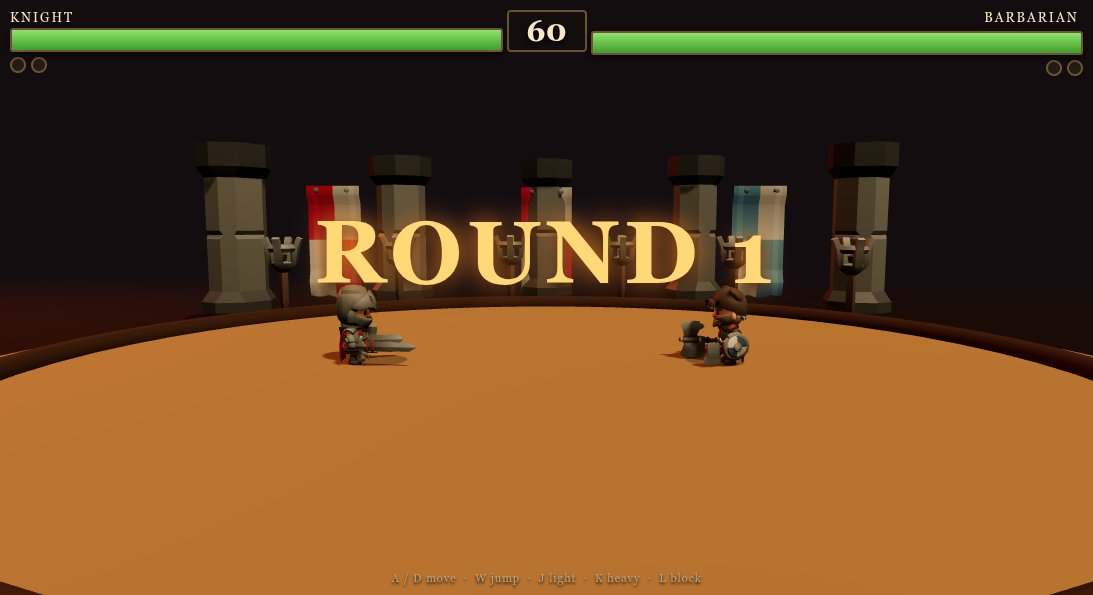
Create a browser-playable one-player 3D side-view arena fighting game titled “Clash Yard.” Use Three.js or an equivalent 3D engine with a fixed perspective camera that looks toward a compact rectangular platform from the front, with a slight camera follow: center the view between the two fighters, raise/zoom out slightly when they spread apart, and keep the fighters readable in the middle of the screen. The scene should have a stylized low-poly/blocky Kenney-like look. Build a warm stone arena platform with a thick dark gray-brown beveled-looking base over a larger brown dirt disc, a wide dark blue rear wall/backplate, distant simple stone arches, a row of gray stone back-wall blocks, four tan stone columns around the platform corners, two red-and-gold hanging banners on the back wall, and two small gray-blue statues near the rear left and right. Use soft shadows, a blue-to-warm sunset gradient sky/background, light fog, and warm directional lighting. Add circular soft shadows beneath both fighters and small bright orange/yellow cubic hit sparks on impact, plus a heavy punch impact sound when attacks land.

The player controls the left fighter, initially around x=-2.05, while a simple AI-controlled rival starts on the right around x=2.05. Keep the fight on a horizontal lane bounded approximately from -4.2 to 4.2, with only a small depth offset between the fighters. Use blocky humanoid character models (Kenney-style character assets if available), with a warm orange player accent and cool cyan/blue rival accent; provide simple placeholder box characters until models load. Fighters face one another and use idle, walk, jump/static, punch, kick, and die animations when available. Each fighter has 100 health.

Core goal and round rules: win by reducing the rival’s health to zero before the 60-second round timer reaches zero. If the player is knocked out, the rival wins. If time expires, the fighter with more health wins, or show Draw when health is equal. After a KO or timeout, show an end overlay and allow the player to restart a fresh round with the Fight button, by pressing a key, or by touching a control. At initial load show a “Clash Yard” start overlay explaining the goal and a Fight button.

Implement movement and combat precisely as follows. Keyboard controls: A or Left Arrow moves left, D or Right Arrow moves right, W, Up Arrow, or Space jumps, F punches, and G kicks. On touch devices show large bottom-left LEFT, RIGHT, and JUMP buttons, and bottom-right PUNCH and KICK buttons. Left/right buttons are held movement controls; jump, punch, and kick are taps. Support safe-area spacing and prevent touch scrolling. Fighters move at about 4.7 horizontal speed, smoothly accelerate, cannot leave the stage bounds, and cannot overlap closer than about 0.95 units. Jump with vertical velocity about 10.8 under gravity about 28; kicks cannot be started while airborne. Fighters automatically face the opponent when not actively moving.

Combat has two attacks. Punch: 12 damage, approximately 1.4 unit forward reach, 4.4 knockback, quick startup about 0.08 seconds, active window about 0.12 seconds, and total recovery/end around 0.32 seconds. Kick: 18 damage, approximately 1.7 unit reach, 6.2 knockback, startup about 0.12 seconds, active window about 0.14 seconds, and total recovery/end around 0.42 seconds. An attack can hit only once during its active window, only in the fighter’s facing direction, and only when the opponent is within reach and within about 1.3 vertical units. A landed hit subtracts health, launches the opponent with horizontal knockback and about 3.8 vertical velocity, briefly stuns them for about 0.24 seconds and prevents repeated hits for about 0.28 seconds, while spawning roughly 10 orange/yellow cubic sparks and playing the impact sound. Attacks lock normal movement during their attack timing; kicks should feel slower and stronger than punches. Show short status feedback such as “PUNCH landed,” “KICK landed,” or a warning about the rival’s attack window, and update a contextual hint encouraging pressure, spacing, and backing away after a kick.

The rival AI should be intentionally simple: walk toward the player when farther than about 1.45 units, back off slightly when closer than about 0.95, occasionally strafe/jump when within about 2 units, and attack when within about 1.75 units and its cooldown is ready. Choose kicks more often at longer range and otherwise randomly choose punch or kick, with an attack cooldown randomized around 0.5–0.95 seconds. The AI must obey the same attack, stun, movement, spacing, and health rules as the player.

HUD: place a translucent dark rounded top bar with the player health panel labeled “YOU” on the left, the rival health panel labeled “RIVAL” on the right, and a centered large timer beginning at 60. Health bars should be rounded horizontal fills, with the player using a pink/red-to-orange gradient and the rival a cool blue/cyan gradient; shrink each bar as health is lost, with the rival bar visually filling from the right. Under the top bar, show a centered dark pill with the keyboard hint “A/D move · W jump · F punch · G kick.” Near the bottom center show a dark translucent rounded hint pill such as “Keep pressure on the rival — kicks hit harder but take longer.” The start/end overlay should be a centered dark rounded card with a large uppercase title, explanatory text, and a gold gradient Fight button. Use responsive sizing for desktop and mobile; keep the HUD and touch controls over the canvas and make the control buttons dark translucent, rounded, bold, and clearly labeled.

Optionally expose a debug state API equivalent to window.getGameState() and window.setGameState(patch), returning or modifying roundOver, fightStarted, roundTime, winner, player/enemy positions, velocities, facing, health, grounded state, attackType, stun, and current action, without changing the visible game design.