Appearance
Skip to content
Arcade › Clash Circuit
Clash Circuit
How to play
Click the game above and it runs right here in your browser. No download, no installer, no account needed. lucychase2009 built it with Cinevva, so it works on a phone or a tablet too.
Discussion
Nobody has said anything about Clash Circuit yet. Play it, then tell lucychase2009 what you would add next.
Make your own game
Clash Circuit was built by lucychase2009 with the Cinevva game creator: describe the game you want in chat, watch it get built, and play it in your browser minutes later.
Remix Clash Circuit opens the real game in the creator and forks its actual files, chat and design doc, so you start from the code rather than from a description.
Read the build brief for Clash Circuit
Cinevva's analyzer read this game's design doc and its source, then wrote the brief below. "Make your own" hands it to the game creator as your opening message, so you start from a real spec rather than a one-line idea.
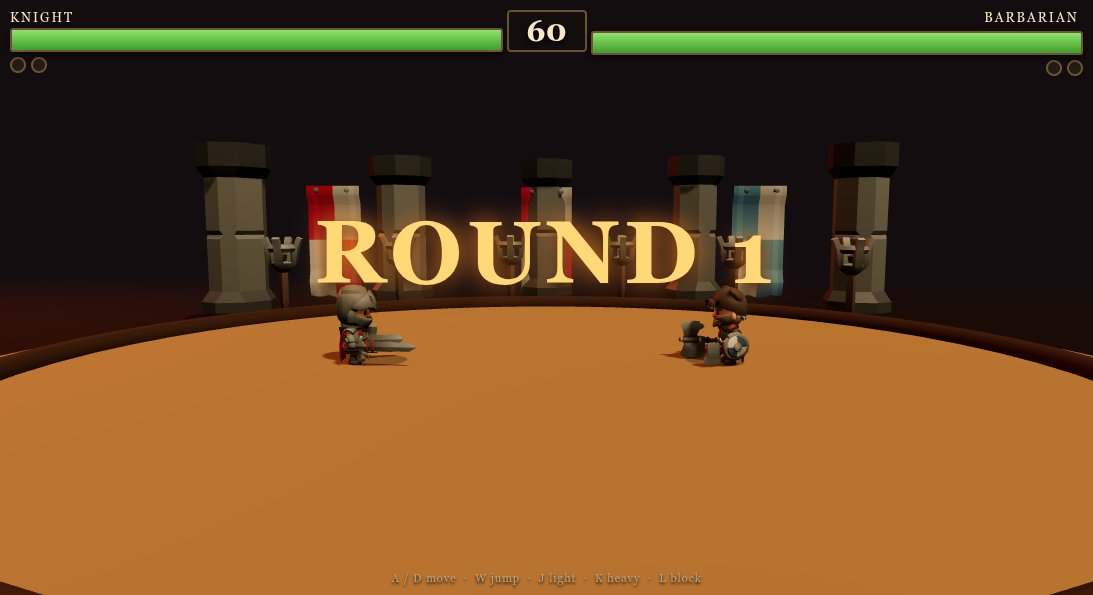
Create a playable 3D arcade fighting game titled “Clash Circuit.” Use a fixed, side-on arena camera: a perspective camera looks toward the center of a circular fighting platform, with the two fighters shown in profile facing each other. The scene should have a dark navy/black background and light fog, with dramatic stylized lighting: a warm directional key light, cool blue rim light, soft shadows, and a saturated indigo arena floor. Build the arena as a wide, low circular platform with a golden torus ring around its edge and sparse dark vertical posts around the perimeter. Add two tall glowing blue-purple rectangular banners/signs toward the rear left and right of the arena. Keep the visual style clean, high-contrast, game-like, and slightly cinematic rather than realistic.

Place the player fighter Rook at x=-2.2 and the opponent Mira at x=2.2. Use animated humanoid 3D character models: Rook should read as a fantasy warrior with a weapon/armor silhouette, while Mira should read as a martial-artist/monk character. Scale both similarly, give them idle, run, jump/roll, punch/attack, heavy/sword attack, hurt, block/weapon-idle, and death animations where available. They should face one another and remain constrained to the horizontal arena bounds, approximately x=-4.1 to x=4.1. The player controls Rook; Mira is controlled by a simple close-range AI that walks toward Rook, attacks when near, and occasionally blocks. Include hit spark particles on impact, punch impact audio, and brief visible feedback messages.

The core goal is to defeat Mira by reducing her health to zero while preserving Rook’s health. Each fighter starts at 100 health. Basic attacks have a short active hit window and only hit when fighters are close (roughly 1.45 world units): J performs a quick light punch for 9 base damage, and K performs a slower heavy attack for 18 base damage. L holds guard/block; while blocking, incoming damage is reduced to 25%. W makes Rook jump, with gravity bringing him back to the platform. A and D move left and right. Prevent normal movement while attacking or hurt, and allow a light/heavy attack input to be buffered during an existing attack. Show a “FIGHT!” message when a match starts or restarts, show “HIT!” when Rook connects, “OUCH!” when he is hit, and show “ROOK WINS” or “MIRA WINS” on defeat. Stop normal combat when the game is over and provide a Restart button.

Add a combo system for Rook: consecutive successful hits build a combo, the combo expires after about 1.15 seconds without another hit, and display a gold “N HIT COMBO” label near the top center while active. Rook’s damage gets a small multiplier increasing with the combo, capped at five combo increments. When Rook reaches a five-hit combo, trigger a stronger “COMBO FINISHER!” hit with extra damage, impact feedback, a brief camera shake and slow-motion effect, then reset the combo.

Add an energy/mana resource labeled “ENERGY” in the upper-left HUD. It starts at 100, regenerates at about 14 per second up to 100, and is spent by skills. Place three floating cyan octahedral energy pickups across the arena at x=-3.2, 0, and 3.2. They should slowly rotate, bob, glow, and have orbiting sparkle shards. Rook automatically collects one when close, gaining 35 energy; hide it for five seconds, then respawn it. Play a pickup sound and show “ENERGY +35,” with a small burst of shards when collected.

Provide two player skills in an upper-right skill panel: Q BURST costs 40 energy and E DASH costs 25 energy. Both share a cooldown of a few seconds and are disabled/visually dimmed when unavailable, with the button text changing to show the remaining cooldown. Q BURST should perform a powerful close-range special attack for 30 base damage. E DASH should move Rook rapidly about 1.05 units toward Mira and perform the same powerful strike, showing “DASH STRIKE!”; Q should show “POWER BURST!”. Specials should be unavailable during another attack, while hurt, when defeated, or without enough energy.

Create an HTML overlay HUD over the canvas. At the top, show Rook on the left and Mira on the right with two adjacent outlined health bars: Rook’s fill is a green gradient and Mira’s is a pink/red gradient. Centered below them, show “ROUND 1 · BEST OF 3” exactly as a presentation label; it is a static match label and does not require implementing multiple rounds. Put the energy meter under the upper-left area. Put the transient large message around the upper center and the combo text beneath it. Include a Restart button at upper right, a Training button at upper left, and a hidden “Reset Dummy” button that appears in training mode. Training mode should make Mira a stationary practice dummy: she does not approach or attack, and when her health reaches zero she immediately resets to 100 health, clears the combo, and shows “DUMMY RESET.” The Training button should toggle between normal fight mode and training mode, updating its label to “Training ON”; Reset Dummy should restore Mira to full health and place her back around x=2.2.

Support both keyboard and touch controls. Display a small help strip near the bottom reading “A / D move · W jump · J punch · K heavy · L block · Q/E skills”. Along the bottom, add translucent circular touch buttons for left, right, JUMP, GUARD, PUNCH, and a larger pink-accented HEAVY button. Touch buttons should set the same controls as the keyboard and work on mobile; on larger screens they can be partially translucent. Use responsive positioning, dark translucent panels, pale lavender borders, uppercase compact typography, and gold/pink/cyan accent colors matching the HUD. Render with antialiasing, shadows, fog, ACES-style tone mapping, and responsive resizing to maintain the composition on narrow mobile screens as well as desktop.