Appearance
Skip to content
Arcade › Clash Circuit
Clash Circuit
How to play
Click the game above and it runs right here in your browser. No download, no installer, no account needed. KyrieIrvingfan built it with Cinevva, so it works on a phone or a tablet too.
Discussion
Nobody has said anything about Clash Circuit yet. Play it, then tell KyrieIrvingfan what you would add next.
Make your own game
Clash Circuit was built by KyrieIrvingfan with the Cinevva game creator: describe the game you want in chat, watch it get built, and play it in your browser minutes later.
Remix Clash Circuit opens the real game in the creator and forks its actual files, chat and design doc, so you start from the code rather than from a description.
Read the build brief for Clash Circuit
Cinevva's analyzer read this game's design doc and its source, then wrote the brief below. "Make your own" hands it to the game creator as your opening message, so you start from a real spec rather than a one-line idea.
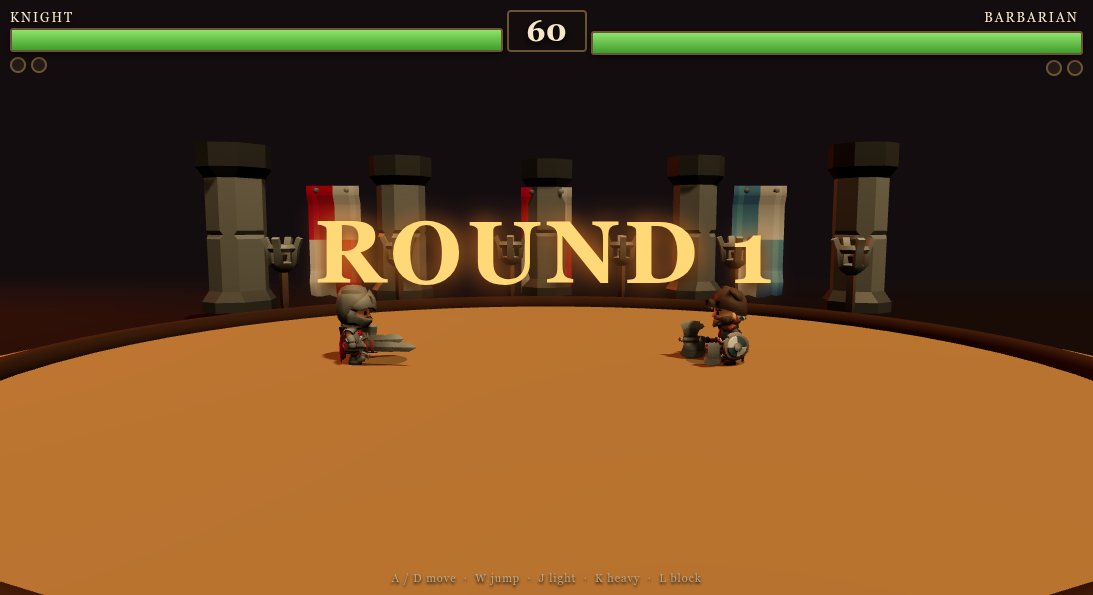
Create a browser-based 3D low-poly 1v1 fighting game titled “Clash Circuit,” using Three.js and a responsive HUD. Begin on a full-screen character-select card with the label “CHARACTER SELECT,” the currently selected fighter’s uppercase name, description, stat hint, and three buttons: “◀ Prev,” “Fight,” and “Next ▶.” Cycle among exactly three player fighter presets: Striker (balanced, blue body with mint accent; speed 5.4, punch 8, kick 13, jump 8.8, block damage factor 0.2), Bruiser (purple body with orange accent; speed 4.9, punch 10, kick 16, jump 8.1, block factor 0.25), and Glider (teal body with yellow accent; speed 6.2, punch 7, kick 11, jump 9.8, block factor 0.18). The CPU rival uses a magenta/red body with yellow gloves/boots and a tan blocky head, and is an aggressive AI opponent.

After pressing Fight, show a side-view arena in a dark futuristic setting. Use a perspective camera that frames both combatants, smoothly tracks their midpoint, and slightly zooms out as their separation increases. The scene background is deep navy (#151a2e) with subtle fog. The floor is a broad dark blue-gray circular platform/cylinder with a glowing pale-cyan torus ring around its edge, placed over a dark gridded floor. Arrange many thin, dark navy rectangular pillars of varied heights around the arena perimeter. Light the scene with cool hemisphere lighting and a strong white directional light, with shadows enabled.

Build each fighter from simple primitive meshes with a readable low-poly silhouette: a rectangular torso, cube head, separate grouped upper/lower arms ending in cube gloves, and grouped two-part legs ending in blocky feet. The selected player begins at x=-2.6 facing right and the rival at x=2.6 facing left. Keep them on a horizontal lane, constrain each to roughly x=-4.7..4.7, prevent overlap closer than 0.9, and prevent them from becoming more than 3.8 apart. Add simple idle bobbing, alternating leg/arm motion while moving, visible jump pose, recoil/flash when hit, raised arms/lean while blocking, an extended arm animation for punches, and a leg-swing animation for kicks. They can jump under gravity, with a grounded floor at y=0.

The goal is to defeat the rival by reducing health from 100 to zero. Each round lasts 60 seconds. Player controls: A or Left Arrow moves left, D or Right Arrow moves right, W/Up Arrow/Space jumps, J punches, K kicks, Shift holds block, L activates SUPER, and R restarts after match over. Punches are quick (0.28 seconds), have 1.45 range and the selected fighter’s punch damage; kicks are slower (0.42 seconds), have 1.85 range and kick damage. Only apply a hit during the attack’s active timing window, only once per attack, when fighters are close vertically; apply knockback, with kicks stronger than punches. Blocking is only effective while grounded, reduces damage to the fighter-specific block factor, and slows movement while held. Include occasional small upward knockback on an unblocked grounded hit.

Implement a SUPER power with a five-second cooldown. When ready, pressing L or the mobile SUPER button launches a glowing projectile/fireball from the fighter toward the opponent. The player fireball should be cyan/blue-white and the rival fireball orange; make it a glowing emissive sphere with a translucent outer shell, rotation and subtle pulsing. It travels horizontally for about 2.2 seconds at high speed, deals kick damage plus 8, and applies strong knockback on contact. Visually flash the fighter’s torso/head with purple while the super is active. Show “SUPER READY” or a countdown in the HUD and on the mobile button.

The rival AI should approach when farther than about 1.9 units, retreat when too close, sometimes bait in the ideal range, occasionally block when the player attacks nearby, attack within range with a mixture weighted toward punch and kick, and occasionally jump when far away. Both fighters should face each other continuously. Use lightweight synthesized Tone.js sounds for punch, kick, block, jump, and KO.

Use a match structure of first to two round wins. At round end, stop combat for about 2.2 seconds, show a message such as “PLAYER wins the round” or “RIVAL wins the round,” then reset both health and positions and start the next round. A round can end by KO or by decision when the 60-second timer reaches zero; higher health wins, with a random winner if health is exactly tied. When either fighter reaches two round wins, show a centered match-over overlay with “PLAYER WINS” or “RIVAL WINS,” state whether it was by KO or Decision, and provide a restart button; desktop text should say press R to restart and mobile text should invite tapping restart.

HUD styling should be bold, clean, and high contrast over the 3D arena. Across the top, show PLAYER on the left and RIVAL on the right, each with a framed horizontal health bar: player gradient mint-to-cyan and rival gradient orange-to-coral/red. Under each bar show two round markers using filled and empty circles. In the center show “ROUND 1” (or the current round) and a large countdown number starting at 60. Include a small SUPER status near the player panel. At the bottom/center show contextual text such as “Striker — Fight!”, round result messages, or restart instructions. Match the visible presentation: dark navy background, white uppercase typography, thin translucent borders, neon cyan arena ring, chunky colored fighters, and restrained glow.

For touch devices, detect coarse pointer/touch input and provide a touch-safe bottom control layout: held left/right movement buttons, held BLOCK, tap JUMP, PUNCH, and KICK buttons, plus a prominent center SUPER button. The select screen buttons and restart button must also work by touch. Make the layout responsive: on narrow screens widen the camera field of view and scale/reposition HUD and controls so the fighters remain visible. Do not add weapons, extra fighters, projectiles beyond the SUPER fireball, items, stages, or game modes not described here.