Appearance
Skip to content
Arcade › Castle Clash
Castle Clash
How to play
Click the game above and it runs right here in your browser. No download, no installer, no account needed. Caleb Ralphs built it with Cinevva, so it works on a phone or a tablet too.
Discussion
Nobody has said anything about Castle Clash yet. Play it, then tell Caleb Ralphs what you would add next.
Make your own game
Castle Clash was built by Caleb Ralphs with the Cinevva game creator: describe the game you want in chat, watch it get built, and play it in your browser minutes later.
Remix Castle Clash opens the real game in the creator and forks its actual files, chat and design doc, so you start from the code rather than from a description.
Read the build brief for Castle Clash
Cinevva's analyzer read this game's design doc and its source, then wrote the brief below. "Make your own" hands it to the game creator as your opening message, so you start from a real spec rather than a one-line idea.
Create a browser-based 3D platform fighting game titled “Castle Clash: Classbound.” Use a dark, polished fantasy UI and a fixed side-on/three-quarter arena camera. The game opens on a full-screen character-selection menu over a deep purple-black background. Show the large centered gold title “CASTLE CLASH,” with a subtitle explaining that it is a classbound platform fighter in an original D&D-inspired keep where the player picks a champion and knocks castle guards from the arena. Below, show a scrollable responsive roster grid: five columns on wide screens and two on mobile. Include these ten selectable cards, with the first card selected by default and selected cards getting a gold border, glow, and slight upward lift: Aegis — KNIGHT — “Sword arc · Shield bash · Iron leap”; Shade — ROGUE — “Dagger flurry · Smoke roll · Backstab”; Bramble — DRUID — “Vine lash · Root snare · Bear pounce”; Ember — SORCERER — “Arc bolt · Blink · Meteor burst”; Lyra — BARD — “Note slash · Hype chord · Encore”; Thorn — RANGER — “Arrow shot · Roll · Volley”; Oath — PALADIN — “Mace smash · Holy guard · Radiant dive”; Korr — BARBARIAN — “Axe cleave · Rage · Ground quake”; Vexa — WIZARD — “Staff spin · Blink · Rune burst”; Sable — MONK — “Palm combo · Focus · Sky kick.” Each card has a warm-gold name, mint uppercase class label, and small pale move description. Put a large orange-red, gold-outlined button labeled “ENTER THE KEEP” below the roster.

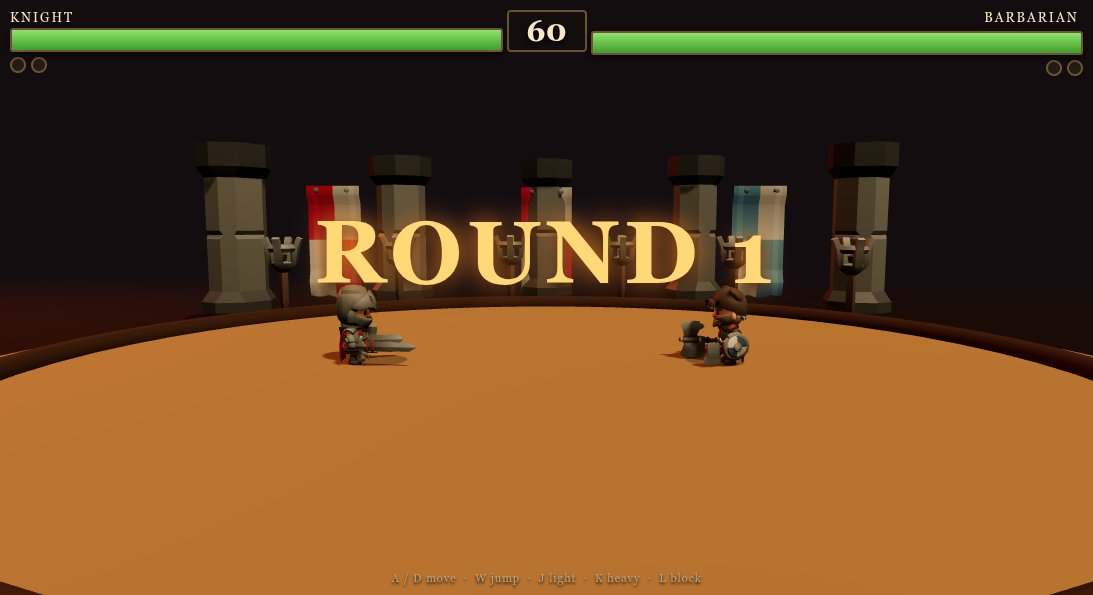
When the button is pressed, hide the menu and enter the playable battle. Render the arena in Three.js or an equivalent 3D engine with a dark purple background and fog, warm directional sunlight, soft purple ambient light, shadows, and a cinematic ACES-like tone. Build a castle keep from simple low-poly box geometry: a long stone floor spanning the arena, a dark back wall, tall square towers on the far left and right, and three raised horizontal platforms at different heights: a left platform around x=-5 and y=2.4, a right platform around x=5 and y=3.5, and a central platform around x=0 and y=5.3. The arena bounds are approximately x=-10 to 10. Decorate the back wall with repeated dark window openings and alternating blue/red hanging banners. Add glowing rotating rune rings on the left, right, and center platforms. Keep the visual style as moody stylized fantasy: charcoal purple masonry, muted mauve platforms, gold UI trim, and warm sunlight.

Spawn the chosen player fighter on the left at x=-6 and an enemy on the right at x=6. The enemy is automatically chosen as the roster character three positions after the selected character, wrapping through the ten-character roster. Use low-poly animated fantasy character assets or close equivalents: knight models for Knight/Paladin/Barbarian, rogue models for Rogue/Bard/Monk, ranger models for Druid/Ranger, and wizard models for Sorcerer/Wizard. If model loading is unavailable, display a simple colored capsule-like fighter placeholder. Give fighters their roster-associated accent colors. Face the player toward the right and enemy toward the left, flipping their models as they change direction.

Implement simple platform-fighter physics. Horizontal movement uses A/D or left/right arrows at about speed 7, with acceleration/damping; W, Space, or up arrow jumps only while grounded, with jump velocity about 11 and gravity about -24. Clamp fighters to the arena’s x bounds. A fighter stands on the ground at y=0 except over the three platform x ranges, where the floor heights are approximately 2.4, 3.5, and 5.3. Fighters can fall/jump between these surfaces. The player attacks in the direction they are facing: J is a light attack causing 6 damage and knockback 5, K is the class-special input causing 9 damage and knockback 10, and L is a heavy attack causing 12 damage and knockback 8. Attacks affect the opponent only when within about 2.2 horizontal units, within about 2.1 vertical units, and on the attacker’s facing side. Add a short shared attack cooldown of about 0.28 seconds, visible hit feedback/flash, and launch knockback with an upward component. The roster move descriptions are flavor/UI text; keep the actual attack behavior as the common light/special/heavy hit system rather than inventing separate spell or weapon mechanics. The enemy continuously approaches the player, jumps occasionally, and randomly uses light/heavy attacks when close.

At the top of the battle screen, show a fixed HUD with three dark rounded pills: the selected fighter’s “name · class” at left; centered YOU and ENEMY health displays with rounded bars; and a “0 - 0” score at right. Both health bars begin at 100: player bar uses a mint-to-pale-yellow gradient and enemy bar uses a coral-to-gold gradient. On reaching zero health, award one point to the opponent, update the score, and immediately reset both fighters to their starting sides with full health; there is no separate game-over screen. Show a bottom-centered hint: “A/D or ◀▶ move · W / Space jump · J light · K class special · L heavy”. On narrow/mobile screens, show translucent circular touch controls at the bottom: left/right arrows, an up arrow, and J/K/L attack buttons. Make the layout responsive, hide overflow, and ensure touch controls do not scroll the page. Use a side-following camera that smoothly tracks the player’s x position while looking toward the middle of the arena, keeping the entire vertical castle scene readable.