Appearance
Skip to content
Arcade › Blaze Clash
Blaze Clash
How to play
Click the game above and it runs right here in your browser. No download, no installer, no account needed. kw2296cc built it with Cinevva, so it works on a phone or a tablet too.
Discussion
Nobody has said anything about Blaze Clash yet. Play it, then tell kw2296cc what you would add next.
Make your own game
Blaze Clash was built by kw2296cc with the Cinevva game creator: describe the game you want in chat, watch it get built, and play it in your browser minutes later.
Remix Blaze Clash opens the real game in the creator and forks its actual files, chat and design doc, so you start from the code rather than from a description.
Read the build brief for Blaze Clash
Cinevva's analyzer read this game's design doc and its source, then wrote the brief below. "Make your own" hands it to the game creator as your opening message, so you start from a real spec rather than a one-line idea.
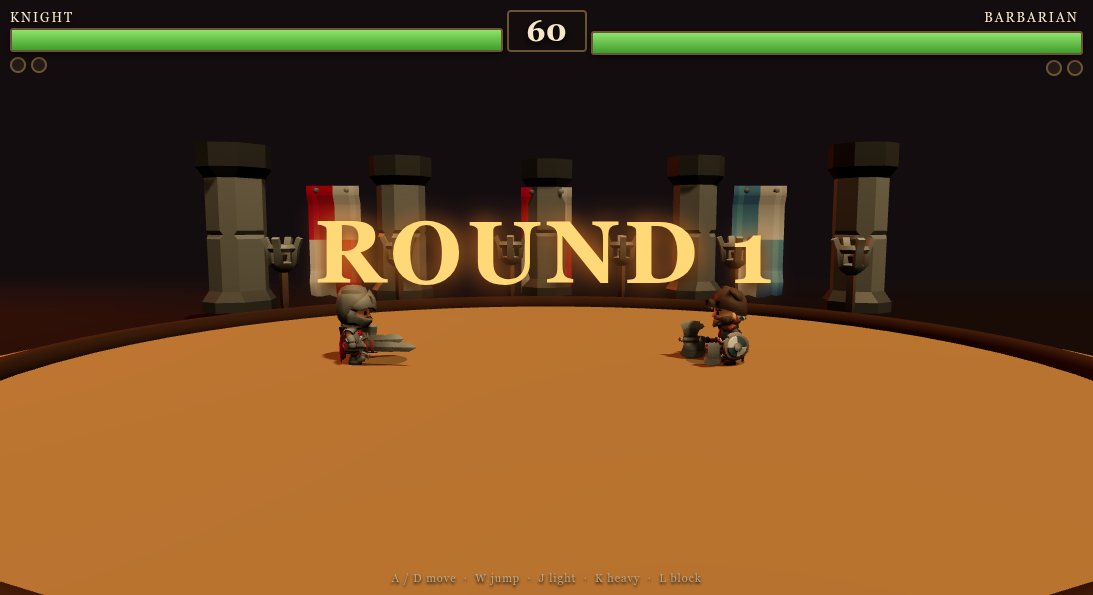
Rebuild a single-player 3D side-view arena fighting game titled “Blaze Clash.” Use Three.js (or an equivalent real-time 3D engine) with an orthographic camera looking across a flat horizontal arena. Keep the camera mostly fixed, centered on the fighters, with a subtle shake on impacts. The scene should have a very dark plum/black background and fog, a broad dark reddish-brown floor/platform, a faint orange glowing strip on the ground, tall dark pillars in the background, and six elevated braziers with orange flame sprites. Add roughly 90 small rising ember particles in orange, gold, and pale yellow throughout the scene. Use warm directional, rim, and ambient lighting with bloom-like emissive materials and a moody fire-lit atmosphere.

The game opens on a character-selection overlay titled Blaze Clash. Show two selection columns: “Player fighter” and “Rival fighter,” each containing the same four selectable fighter cards. Each card includes a stylized canvas preview, name, style description, and visible Speed, Power, and Jump stat pills. Default selections are Ember Twin for the player and Solar Monk for the rival. Provide a Start battle button. The four selectable fire-spirit fighters are:
- Ember Twin: balanced flames; orange body, golden glow, pale accent, flowing ribbon-like accents; speed 7.2, power 1.00, jump 12.5, aura 1.0.
- Solar Monk: fast pressure; golden-orange body, yellow glow, pale accent, a diagonal staff silhouette; speed 7.8, power 0.92, jump 13.2, aura 0.85.
- Cinder Wisp: aerial control; orange-red body, gold glow, pale accent, a glowing orbit ring around the torso; speed 6.9, power 1.05, jump 14.1, aura 1.15.
- Inferno Fox: heavy hits; red-orange body, amber glow, pale accent, two horn-like projections; speed 6.6, power 1.14, jump 12.1, aura 1.25.

Build each fighter as an animated flame humanoid rather than a static sprite. Each has a glowing rounded torso, pale head/face area with two small bright eye marks, a tall translucent flame sprite rising above the head, capsule-like segmented arms and legs with pale hand/foot tips, and the selected accessory. Use a warm emissive palette: orange, coral, red-orange, gold, cream, and white. Fighters stand on small dark oval ground shadows and face one another. The player starts on the left at x=-5.5 and the CPU rival on the right at x=5.5. They cannot fully overlap: when closer than about 1.45 world units, push them apart. Clamp them within the arena width.

Start battle with a brief intro countdown message sequence “3”, “2”, “1”, then “Fight.” During combat, display a fixed HUD top bar with the player’s name and numeric HP on the left, rival numeric HP on the right, two horizontal health bars, and a centered badge reading “Arena Duel” and the current message. Both fighters begin with 100 HP. The player wins when the rival reaches zero HP; the rival wins when the player reaches zero. On knockout, show a hit/knockout pose, update the center message to “<fighter name> wins,” then display a “Match over” result overlay naming the winner and explaining that the loser hit zero flame. Include Rematch and Character select buttons. Rematch immediately resets both fighters and their HP; character select returns to the selection screen. Also support pressing L for instant rematch and Escape to return to selection.

Keyboard controls during the fight: hold A to move left and D to move right; press W to jump; press F to punch; press G to kick; hold H to block. On narrow/mobile layouts, show touch controls along the bottom: left and right movement buttons, Jump, and a right-side cluster with BLOCK, KICK, and PUNCH. The buttons should visibly highlight while pressed. Include a small instructional tip overlay: “Keyboard: A / D move, W jump, F punch, G kick, H block” and mobile guidance.

Combat mechanics must be implemented, not just animated. Horizontal movement accelerates toward the selected fighter’s speed. Gravity is 30; jumping uses the fighter’s profile jump value. A punch is faster and shorter range: duration 0.34 seconds, active from 0.12–0.20 seconds, reach 1.85, damage 10 multiplied by the fighter’s power. A kick is slower and longer range: duration 0.49 seconds, active from 0.20–0.31 seconds, reach 2.45, damage 15 multiplied by power. Attacks should use distinct animated poses: punch extends the right arm with a forward torso lean; kick extends the right leg with a stronger lean. Fighters can only attack when not already attacking, stunned, or knocked out. Detect hits by horizontal range, facing direction, and vertical alignment. On hit, flash the defender, apply knockback and upward velocity, briefly stun them, cancel their attack, and produce a small camera shake. Blocking only works while grounded, facing the attacker, and not attacking; reduce incoming damage to 35% with a minimum of 2, use a shorter stun and reduced knockback. Track a simple combo count internally and make the CPU capable of pressure.

Animate fighters continuously: idle flame/body sway, run-cycle arm and leg motion, jump pose, punch, kick, block pose with both arms raised, hit-stun recoil, and a tilted, lowered knockout pose. Scale or sway the flame aura during attack, hit, and idle states. Make the accessory animate subtly: rotate the Solar Monk staff slightly, rotate the Cinder Wisp orbit ring, sway Ember Twin’s ribbons, and keep Inferno Fox’s horns visible. The CPU should approach the player when far away, back off slightly when too close, reactively block when the player is attacking nearby, and randomly choose punches or kicks when in range, with occasional jumps. It should use cooldowns so attacks are not continuous. Keep the overall presentation faithful to a glowing hand-built fire-spirit arena fighter: dark glassy UI panels, cream text, muted tan secondary text, gold/orange selected borders and buttons, translucent overlays, rounded cards, and fire-colored health bars. Make the interface responsive: selection columns stack on narrow screens, the HUD adapts, and mobile controls appear below about 820px width.